Slate or Tile — Which Is Better for a New Roof?
This is the most common decision when replacing a pitched roof, and the honest
answer is that neither is better in the abstract. Both give an attractive,
durable finish. What decides it is the building.
- Roof pitch. Every covering has a minimum pitch below which
the manufacturer will not warrant it, because below that angle wind-driven
rain gets pushed back up under the lap. Slate tolerates the lowest pitches;
plain tiles need the steepest roofs.
- What the structure was built for. Concrete tile is heavier
per square metre than natural slate. On older property framed for slate that
is a question to answer rather than assume — and going lighter is never
a problem.
- The existing covering and the street. On a terrace or a pair
of semis the roof usually reads as one plane, so a different covering on one
half is visible from a long way off.
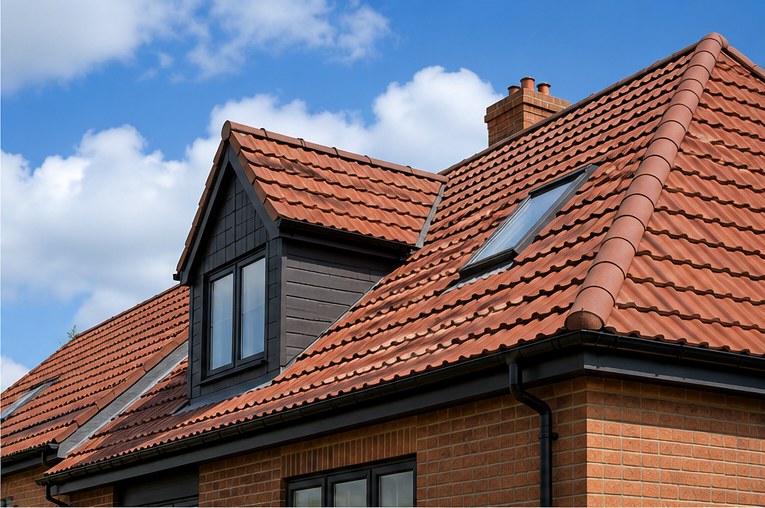
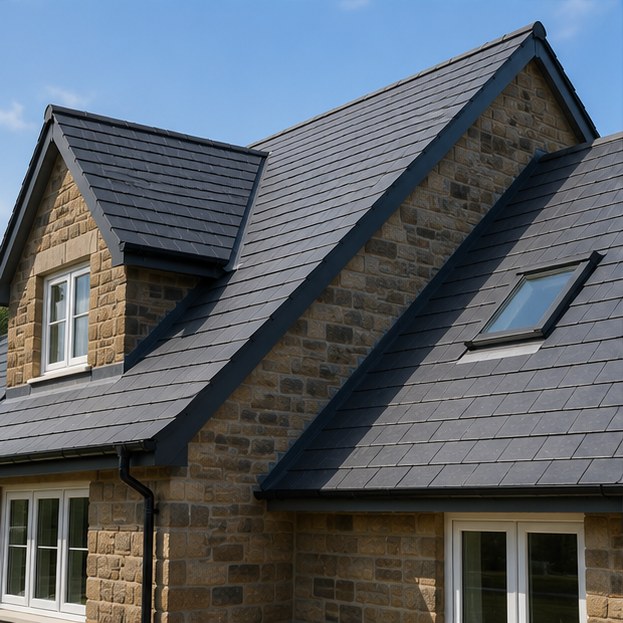
- Appearance and budget. Natural slate is the highest material
cost and the slowest to lay; concrete interlocking tile is the lowest of both.
Clay and fibre cement slate sit between them.
Because both are part of the same service here, we can price the options side by
side rather than steering you towards whichever one we happen to fit.
Roofs rarely fail because the covering wore out. They fail at the
fixings, the battens, the underlay and the lead — so choose the covering for
the building, then pay attention to the specification underneath it.
Does My Roof Need Replacing?
Not every roofing problem needs a new roof, and we would rather say so. Many
isolated issues are dealt with perfectly well by a repair. Replacement becomes
worth considering when problems are becoming widespread, or an ageing roof needs
attention across several different areas.
Reasons homeowners get in touch about a new roof include:
- Repeated roofing problems, in different places each time
- An ageing roof covering that is nearing the end of its life
- Numerous damaged or slipped tiles or slates
- Several previous repairs, at shortening intervals
- Widespread deterioration of the covering
- A property renovation, or altering and improving a property
- Wanting a complete new roofing system rather than another patch
The first step is always to assess the existing roof.
Roof Repairs or a Complete New Roof?
There is a reasonably objective way to tell these apart, and it is worth knowing
before you get quotations.
Ask why the last failure happened. If there is a clear answer — a gale, a
blocked valley, a chimney flashing that was never properly formed, a gutter that
has been overflowing onto one area for years — that is a local problem with
a local solution, and a repair fixes it.
If the honest answer is “it just went”, and it has happened in more
than one unrelated place, that is different. The components present across the
whole roof — the fixings, the battens, the underlay — are all the same
age and reach the end of their working lives together. When one of those goes it
goes everywhere, and no repair addresses it, because the problem is not in the
place that failed but in the places that have not failed yet.
The diagnostic question: is there a reason this
particular part of the roof failed? If yes, repair it. If the honest answer is
“no, it just went”, the rest of the roof is on the same trajectory.
Replacing an Old Tiled Roof
Older tiled roofs eventually develop problems across larger areas. Individual
broken tiles can be replaced at first, but once deterioration is widespread the
arithmetic changes — particularly because the original tile range is
usually long out of production, so replacements are either salvaged or an obvious
near-match.
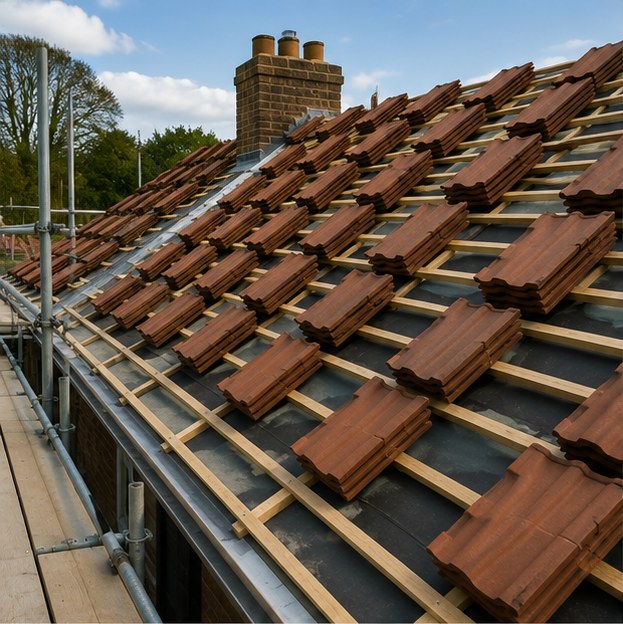
A complete tiled re-roof gives the property an entirely renewed covering and deals
with the underlay, battens, lead and ventilation at the same time. Those are the
parts that actually failed, and they cannot be renewed without taking the tiles
off.
Replacing an Old Slate Roof
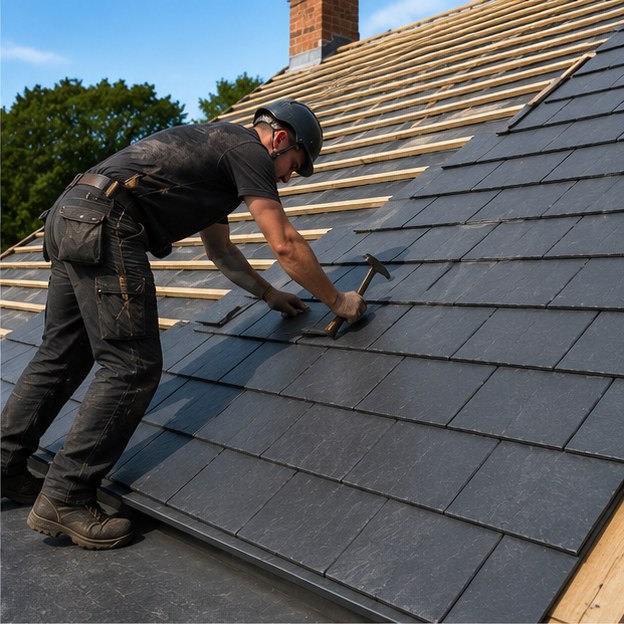
Older slate roofs reach a similar point, though usually for a different reason.
Good slate is extremely durable — what fails first is almost always the
nails holding it on. Every nail went in at the same time and has sat in the same
conditions since, so they corrode together. The symptom is slates slipping in ones
and twos, in unrelated places, with no storm to explain them.
That matters commercially, because it means a failing slate roof often has a
perfectly sound covering on it. Stripping the roof, renewing the battens, underlay,
fixings and lead, and relaying the original slates is a genuine third option
between patching and buying a whole new covering. It is worth having priced
alongside a new roof rather than assumed either way.
New Roofs for Property Renovations
A new roof often forms a major part of renovating an older property, and a
renovation is usually the right moment to do it. Everything that follows —
plaster, decoration, flooring, electrics — is vulnerable to water from above,
and roofing is the trade most affected by weather, so putting the roof early in the
programme removes the largest single risk to the rest of the project.
There is a second reason. A scaffold erected for the roof can also serve chimney
work, rendering, pointing, upper-floor windows, and the fascias, soffits and
guttering. Erecting a scaffold twice on the same house is one of the most common
avoidable costs in domestic renovation.
New Roofs for Extensions
Extensions can need pitched or flat roofing depending on the design. For pitched
extensions, slate or tile can be chosen to complement the main property —
though the extension roof frequently sits at a shallower pitch than the main roof,
which can mean a different covering or a different approach. We check that before
specifying rather than after.
Flat Roof Installations
This page is mainly about pitched slate and tiled roofs, but flat roofing is part
of the wider service. That is useful where a project covers more than one roof
type at once:
- A main pitched roof
- A garage roof
- An extension roof
- A porch roof
- Other flat roofing sections
It means the different areas of a property can be considered as one project rather
than split between trades.
New Garage Roofs
Garage roofing is an area where we have direct customer feedback. One Google
reviewer, Peter Aspinall, wrote:
“Excellent service from Buddy and the team in installing a
new garage roof in a really professional manner. Was kept updated at all stages and
given good advice as to our options. Would highly recommend”
Worth noting on the regulations side: a roof over unheated space — a detached
or unheated garage, an outbuilding, a carport — does not trigger the thermal
upgrade duty that applies to a roof over heated rooms. That is one of the reasons a
garage roof is a different job from a house roof.