★★★★★
“job well done good communication throughout the job very clean and tiddy when the job is finish flat roof replacement many thanks.”
Sumit BalA seam is the only deliberate discontinuity in a waterproof covering, which makes it the place worth understanding.
A flat roof covering arrives in rolls or sheets, so unless the roof is very small there are joins. A seam is where two pieces are made continuous.
It has to do two things at once: be as waterproof as the material either side of it, and accommodate the fact that the covering expands, contracts and moves relative to the deck every day of its life.
Everything about how seams fail comes from that second requirement. A seam is the point where the covering is least able to move freely, and it is therefore the point where daily movement concentrates.
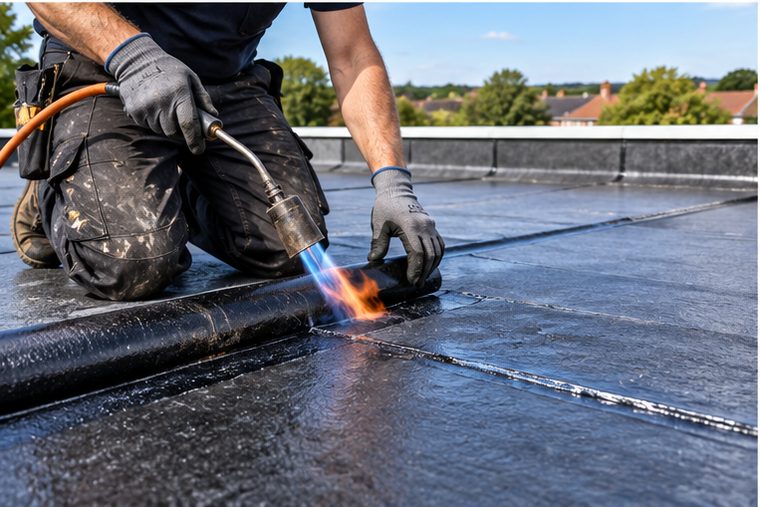
Layers of bitumen felt bonded with heat or hot bitumen, and lapped at the joins.
Insufficient lap. A seam needs a proper overlap; short-lapped and water finds its way under, particularly where the seam runs across the fall rather than with it.
Cold bonding. A torch-on seam that was not brought up to temperature along its whole length has areas that were never properly fused. Those show up as the leak two winters later rather than immediately, which is what makes it hard to attribute.
Fish-mouthing. The edge of the upper sheet lifting into a small open mouth at the lap. Usually a bonding failure, sometimes movement.
Age. Bitumen loses plasticiser over decades and gets harder. The seam is where that hardening first produces a crack, because it is where the movement is.
EPDM is a rubber sheet, and its seams are bonded with a tape and a primer rather than welded. Contamination is the enemy: a seam made over dust or moisture, or without the primer properly flashed off, may hold for a couple of years and then peel.
Single-ply membranes - PVC, TPO and similar - are usually hot-air welded, which fuses the two sheets into one material. A correctly made weld is as strong as the sheet. An under-welded one holds initially and opens under movement; an over-welded one has damaged the sheet itself at the edge.
Both are repairable by somebody with the right kit for that specific system. They are not interchangeable, and using the wrong repair method on a single-ply roof is a common way to make it worse.
On the commercial and light industrial buildings around Queensferry, Shotton and the industrial park, seams stop being a detail and become a major component.
A large flat roof has hundreds of metres of seam. The probability of a defect somewhere along it is a function of length, so seam quality on a big roof matters far more than it does on a garage.
Two industrial-specific causes. Foot traffic - roofs with plant, air handling units or access routes get walked repeatedly, often along the same line, and repeated loading works at a seam. Walkway protection exists for exactly this reason and is frequently missing.
Movement at building joints. Large buildings have structural movement joints, and the covering over them has to accommodate that with a proper detail rather than a straight seam. A seam run across a movement joint is a seam with a scheduled failure.
And on profiled sheet roofs, the equivalent to a seam is the side and end lap between sheets and the sealant and fixings in it - which fail by corrosion and by working loose rather than by delamination, but occupy the same place in the diagnosis.
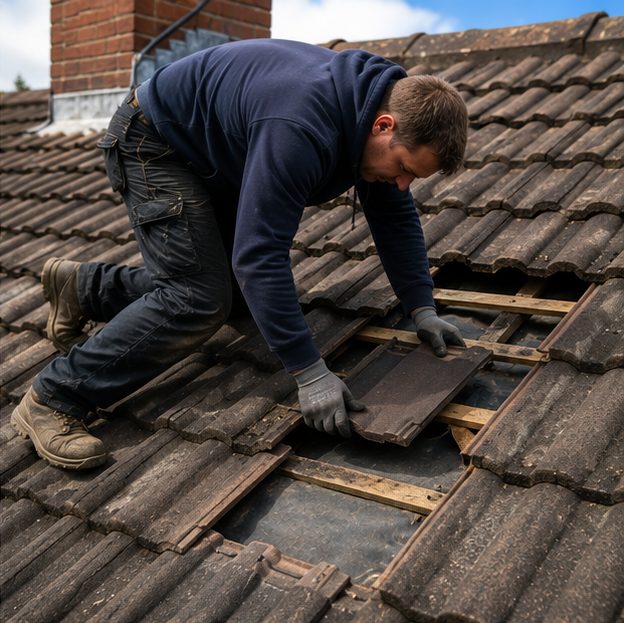
A single failed seam on an otherwise sound covering is a repair, straightforwardly, using the correct method for that system.
Several failed seams is a different finding. If seams are going in more than one place, the question is whether they were all made in the same conditions on the same day - in which case the rest are following - or whether the covering has hardened generally.
And on any roof, a seam that has been repaired and failed again usually needs more than another patch: either the material either side has gone, or something underneath is moving.
On a commercial building the sensible request is a seam survey rather than a repair quotation - somebody walking the roof and probing the seams - so that what gets fixed is everything that is about to leak, not only the one that already has.
The rest of the series, on the questions people ask most.
Every town has its own page, written around what the roofs there are actually like. Start with the main roof repairs page.
“job well done good communication throughout the job very clean and tiddy when the job is finish flat roof replacement many thanks.”
Sumit Bal“Rapid response and fair pricing. Good workmanship. Pleasant staff.”
Ben Green“Very professional efficient team great communication
Would definitely recommend made the process quick and easy will definitely look to keep for any future need
Thankyou”
Describe what is happening and roughly where you are, and we will come back to you — usually the same day. If water is coming in now, please call instead.
Prefer to talk? Call 07464 259566 · WhatsApp 0044 7464 259566 · Email Evensbuddy@yahoo.com
We cover Chester, Cheshire, the Wirral and Flintshire from Elton, just north of Chester.
2 Manley View
Elton
Chester
CH2 4QF
Almost all of our work happens at your property rather than here, so please call before travelling.
Monday – Friday — 24hrs — Emergency Call-Outs
Saturday — 8:00 – 19:00
Sunday — 8:00 – 19:00
Weekday emergency call-outs are answered around the clock. Weekend cover is 8:00 to 19:00.