Weather-Exposed Roof Repairs
Air flowing over a roof behaves like air flowing over a wing. It accelerates as it goes over the edge and over the ridge, and accelerated air is at lower pressure. That produces suction, and the suction is strongest along the verges, at the eaves, at the corners and along the ridge line. On the same roof in the same gale, the middle of a slope is under a fraction of the load the perimeter is carrying.
That is why storm damage on a Hoylake roof is almost always the same list: the ridge, the verge, the corner tiles, and the first course above the gutter. It is not random and it is not bad luck.
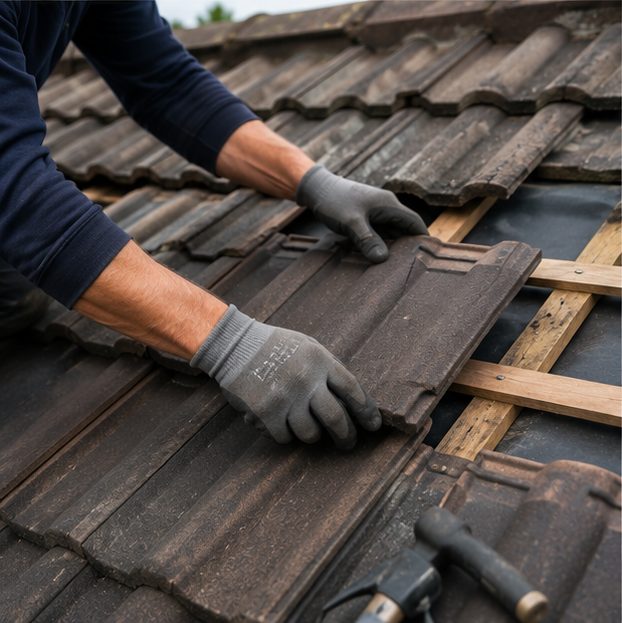
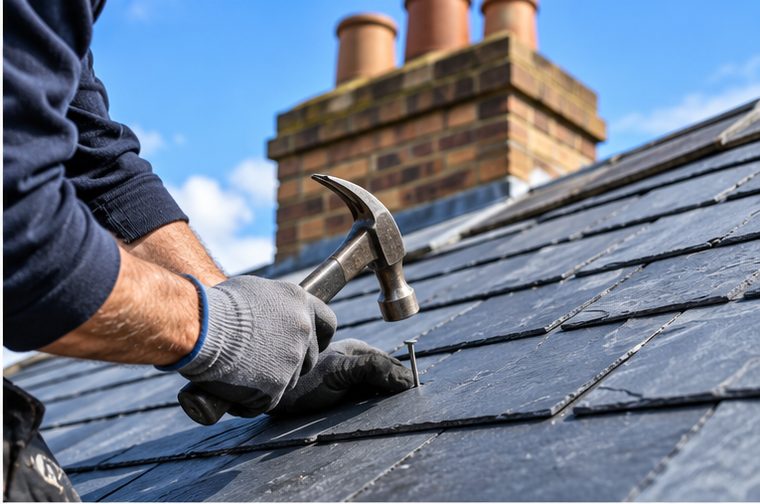
How a roof resists that comes down to fixing. On a plain tiled roof, tiles hang on their nibs and only some courses are nailed — which is fine inland and marginal here. The answer on an exposed site is more fixing: every tile in the perimeter zones mechanically fixed, clips at the verges and eaves, and clips on slates and interlocking tiles where the exposure demands them.
The relevant standard is not a matter of taste. Roof tiling in Britain is designed against BS 5534, which sets out how tiles and slates should be fixed, and it was revised in 2014 specifically to increase fixing requirements — mortar alone is no longer accepted as a fixing for ridges, hips and verges, and dry-fixed or mechanically fixed systems are the norm. Anything on your roof that predates that and relies on mortar alone is not defective, but it is not what would be installed today.
The practical upshot when we repair here: refixing goes back with mechanical fixings and clips as appropriate to the exposure, not simply back the way it was. Putting a ridge back in mortar on a Hoylake seafront property is doing the same job twice.
The other thing exposure does is find gaps. Wind-driven rain is pushed horizontally and even upwards under a covering, so laps that would shed vertical rain perfectly well can let water past. That is why an exposed roof can be entirely sound and still leak in a gale, and why the fix is about detailing rather than about replacing the covering.
Salt and Sand
Hoylake gets sand as well as salt, and both find their way into gutters, valleys and the laps of a covering. Sand in a valley is abrasive as well as obstructive; sand in a gutter behaves like grit and holds water.
It is another reason we look at the rainwater goods here as a matter of course. A valley or gutter carrying half an inch of compacted sand is not draining, and the consequences of that show up somewhere else entirely.
Repair or Replace in Hoylake?
Exposure shortens the life of a covering, but it shortens the life of the details far faster. That means a great many Hoylake roofs that look like candidates for replacement are actually candidates for having their perimeter properly refixed.
The way to tell is where the water is getting in and where the damage keeps appearing. Perimeter and ridge, repeatedly, on a covering that is otherwise in good order, is a fixing job. Failures out in the field of the slope, in ordinary rain, point at the covering itself.
Storm Damage & Emergency Roof Repairs in Hoylake
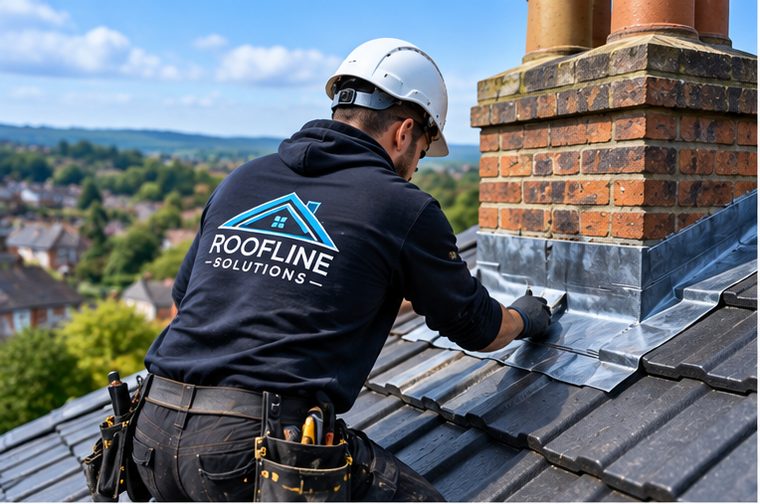
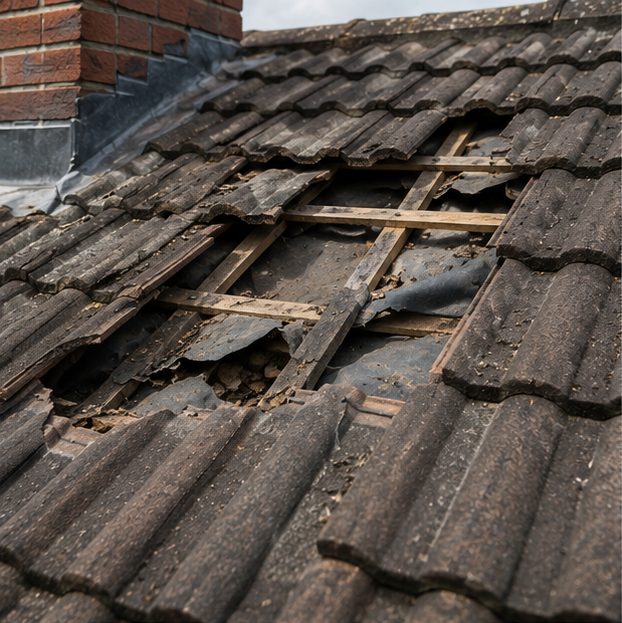
Hoylake takes the weather before most of the peninsula, and the damage lands exactly where the uplift is strongest: the ridge line, the verges, the corners and the first course above the gutter.
When we put that back it goes back with mechanical fixings and clips suited to the exposure rather than simply as it was, because a repair that ignores why it failed is a repair with a date on it.
Emergency call-outs run 24 hours a day, Monday to Friday, with
Saturday and Sunday cover from 8:00 to 19:00.
Please do not go up to look. More people are
hurt inspecting storm damage than by the storm itself. Call
07464 259566 and describe what you can see from the ground.