★★★★★
“job well done good communication throughout the job very clean and tiddy when the job is finish flat roof replacement many thanks.”
Sumit BalEverything worth checking after a storm can be checked from the ground, the loft and the garden. None of it needs a ladder.
Before looking up, look down. What is on the ground is evidence and most people sweep it up before anybody sees it.
Tiles or slates. Keep them. Broken in two usually means impact or foot traffic at some point; completely intact means the fixing let go rather than the wind being exceptional. Either way they identify the profile, which matters if yours is an old one.
Lumps of mortar. In the gutter, on the path, on the drive. That is ridge or verge bedding letting go, and it is telling you before anything falls.
Pieces of lead, plastic verge caps, ridge sections, aerial parts.
Grit and granules. A washing of dark grit at the bottom of a downpipe after a storm is surface coming off a covering. Not urgent, but worth noting.
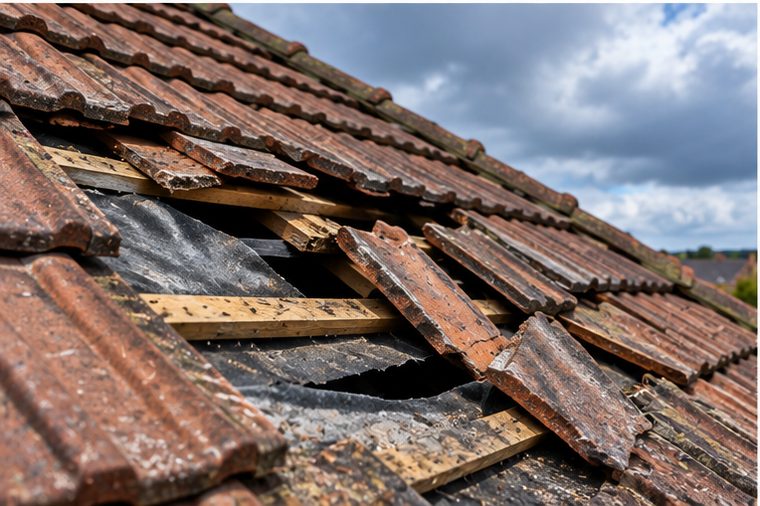
From as far back as you can get with a clear view, with the sun behind you. A photograph at maximum zoom is easier to study than a squint.
Roofs are made of straight lines, and damage shows up as a line that is no longer straight.
The ridge. Look along it, not at it. A dip, a step, a gap, or a tile sitting at an angle.
The verges at each gable, top to bottom. A missing cap, a gap, an edge standing proud.
The courses. A row that steps down where it should be level is a tile that has slipped but not fallen - which is both an early warning and a hazard if it is above anything.
The chimney. The pot upright and seated, the lead lying flat, no dark open line where it meets the brickwork.
The gutters. Sagging, detached at a bracket, or visibly full.
The single most informative thing you can do, and it costs nothing.
Go up in daylight and turn the light off before your eyes adjust. Daylight showing through the covering answers the question in about ten seconds.
Then look for damp: on the underside of the underlay, on the rafters, on the wall plate at the eaves. Note the highest point any staining reaches, because water runs down and never up, so whatever is wrong is at or above that point.
Old and new look different. A dry, sharp-edged brown ring is historic. A dark, soft-edged damp patch is current.
And feel for draught. A new draught in a loft after a gale means a gap somewhere.
Joists only, torch in hand, and not at all if the loft is unboarded, cramped or you are not steady.
Ceilings in every upstairs room, including the ones nobody goes in. Corners, and the junction between ceiling and external wall.
Around any roof window, which is where a surprising proportion of post-storm leaks show up.
Chimney breasts.
And the tops of walls on the upper floor, because water from an overflowing gutter or a lifted eaves detail shows on a wall rather than a ceiling.
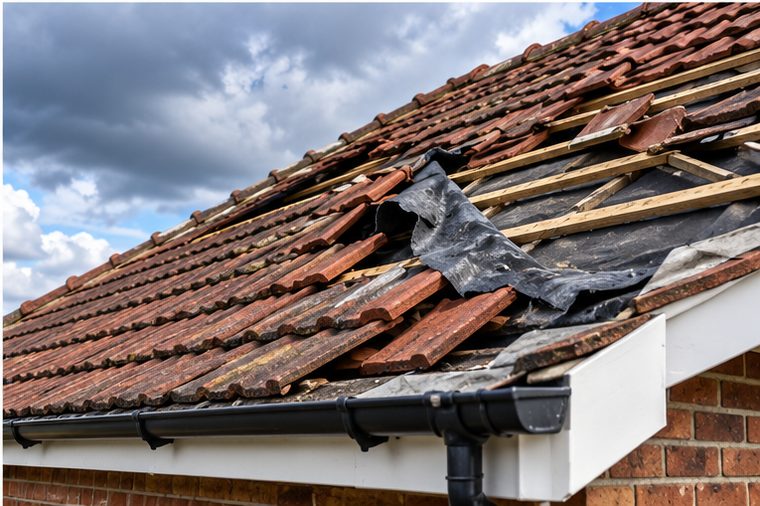
Photograph everything before it is moved or tidied. Wide shots and close-ups, inside and out, and keep the physical pieces.
Sort it into the three tiers: anything loose above where people go, or water near electrics, or a bulging ceiling, is today. An active containable leak or a cluster of gaps is this week. A single gap with nothing showing inside is the next fortnight.
And do not go up to check. Every item on this page is visible from the ground, the loft or the garden, which is the point of writing it as a list. The conditions after a storm are the worst of the year for being on a roof, and more people are hurt inspecting damage than by the storm.
The rest of the series, on the questions people ask most.
Every town has its own page, written around what the roofs there are actually like. Start with the main roof repairs page.
“job well done good communication throughout the job very clean and tiddy when the job is finish flat roof replacement many thanks.”
Sumit Bal“Highly recommend. Very quick and efficient. Great communication. Went above and beyond to work the weekend to complete the work that needed to be done. Very happy with the results.”
Karen Jones“Excellent workmanship by Buddy Evans. I was impressed and amazed at how quickly the job was done. Obviously due to many years' experience. I've used several mediocre or bad roofers in the past and now I've finally found a good one.”
Czeslaw birukowskDescribe what is happening and roughly where you are, and we will come back to you — usually the same day. If water is coming in now, please call instead.
Prefer to talk? Call 07464 259566 · WhatsApp 0044 7464 259566 · Email Evensbuddy@yahoo.com
We cover Chester, Cheshire, the Wirral and Flintshire from Elton, just north of Chester.
2 Manley View
Elton
Chester
CH2 4QF
Almost all of our work happens at your property rather than here, so please call before travelling.
Monday – Friday — 24hrs — Emergency Call-Outs
Saturday — 8:00 – 19:00
Sunday — 8:00 – 19:00
Weekday emergency call-outs are answered around the clock. Weekend cover is 8:00 to 19:00.