The short version
- Wet loft insulation stops insulating and does not recover
- Timber needs to stay damp for a while before rot starts - but it does
- On an exposed roof one gap rarely stays one gap
- The repair is cheap; everything downstream of it is not
The Question Behind the Question
People asking this usually mean "is it worth calling somebody out for one tile", and it is a fair question. One tile does not flood a house.
The answer is that the water damage from a single displaced tile is rarely dramatic and frequently expensive, because it happens slowly, out of sight, to things that cost more than tiles.
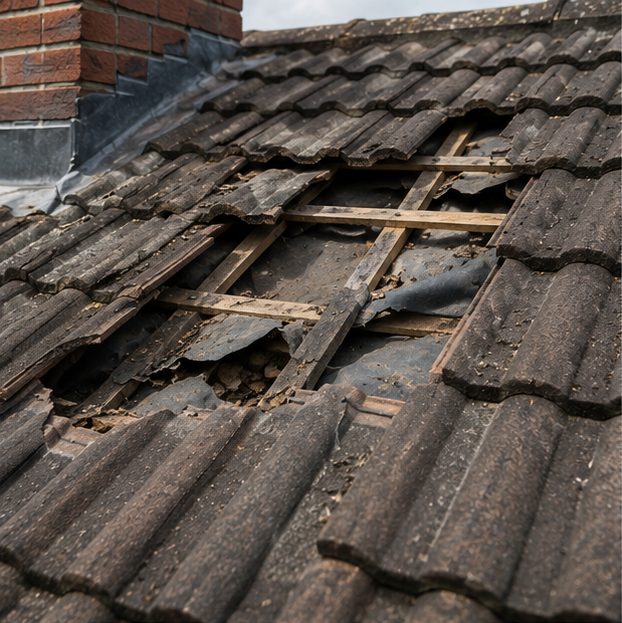
What Actually Gets Damaged
Insulation. Mineral wool works because it holds still air. Wet it and it compresses, loses its loft and stops insulating - and a soaked quilt in a cold loft does not dry out again in any useful timescale. A patch of ruined insulation is not expensive to replace but it is a real cost, and it is quietly raising your heating bill in the meantime.
Ceiling plaster. Plasterboard that has been wet swells, loses its paper bond and stains through any number of coats of emulsion. Once a board has gone soft it does not come back and the ceiling has to be cut out and made good.
Timber. The important one. Battens and rafter tops that stay damp through a season begin to decay, and there are fungi that will run through structural timber given persistent moisture. Wood generally needs to be above roughly twenty per cent moisture content for that to start, which a roof leak comfortably achieves in a loft with poor ventilation.
Electrics. Downlighters and ceiling roses sit exactly where water running along a joist tends to arrive.
Stored belongings. Lofts are full of the things people cannot replace.
The Timescale
A day or two of water through a single gap does essentially nothing. That is why the first leak is usually survived without consequence.
A season of it is a different matter. Damp insulation, a stained ceiling, and battens that are no longer sound where a nail has to go. At that point the tile is no longer a tile job, because there is nothing solid to fix the replacement to.
Two or three seasons is where structural decay becomes a genuine possibility rather than a scare story, particularly at the eaves where the wall plate sits and ventilation is often poorest.
On This Coast, One Gap Rarely Stays One
The Hoylake-specific part. Wind loads a roof by suction, and that suction is strongest at the verges, the eaves, the corners and the ridge - exactly where tiles here tend to move in the first place.
A tiled roof is partly self-supporting: the tiles hold each other down. Remove one and its neighbours have a free edge for the wind to get under, and on a roof facing open water that edge is being worked at every time it blows.
So the practical answer on an exposed roof is that the question is not really "can one slipped tile cause damage". It is "how long will there be only one". On this coast, usually not long.
The Arithmetic
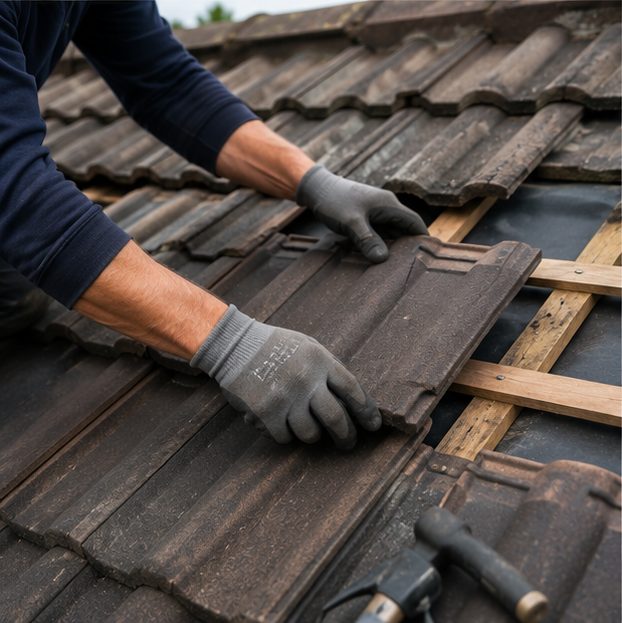
Replacing a slipped tile is one of the cheapest jobs on a roof, and where access is straightforward it is cheaper still.
Replacing a slipped tile, a metre of batten, a bay of insulation and a section of ceiling is a different number entirely, and none of the extra parts is roofing.
That is the whole case for dealing with it in weeks rather than seasons. Not because one tile is a crisis, but because everything downstream of it costs more than the tile does.