The short version
- A make-safe is judged on whether it can be undone, not how it looks
- Nothing should be nailed through what will need repairing later
- Sheeting must be tied and weighted, never just laid on
- Being told it is temporary is what separates it from a bodge
Temporary Work Is Not Second-Rate Work
There is a reflex to treat any temporary repair as a corner being cut. That is wrong, and it stops people accepting work they need.
After a storm the roof is doing damage every hour it stays open. Stopping that is the priority, and it frequently has to happen in conditions where a permanent repair is not possible - wind still blowing, surfaces wet, no daylight, mortar unable to cure, no scaffold yet.
Most insurance policies also expect you to take reasonable steps to prevent further damage, which is precisely what a make-safe is.
So the question is not whether to accept temporary work. It is what makes a temporary repair a good one.
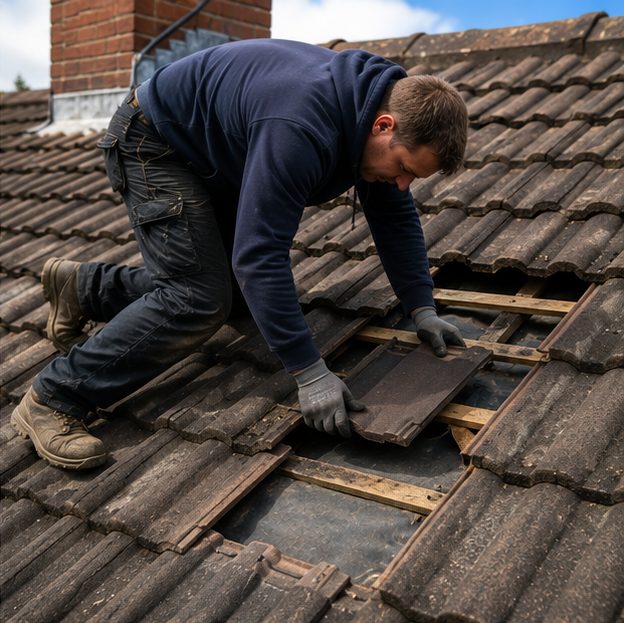
What a Safe Make-Safe Looks Like
It is reversible. Nothing is nailed, screwed or bonded through something that will have to be repaired properly later. A sheet fixed by driving nails through sound tiles has created a second job.
Sheeting is tied and weighted, not laid on. A tarpaulin that is not secured at every edge is a sail. It will come off in the next gust, and it may take more of the roof with it or end up in somebody's garden. Battens, sandbags, ties around something structural - not bricks on the corners.
Loose material is removed rather than balanced. A ridge tile that cannot be properly refixed tonight is safer in the garden than back on the ridge in a gale.
What is below is dealt with. If something is unsafe overhead and cannot be removed tonight, the area underneath is cordoned and you are told which door not to use.
And you are told it is temporary, with the permanent work arranged rather than left to whenever the leak comes back.
What an Unsafe One Looks Like
A tarpaulin held down with bricks and nothing else. It lasts until the next gust and then becomes a hazard.
Anything nailed through sound covering. Every one of those nail holes is a new leak path and every one has to be made good later.
A large area of sealant, mastic or spray-on product over a junction, described as the repair. It sheds water for a season, then shrinks and cracks and holds water against the defect, and it has to be removed before anything proper can be done.
Somebody working on a roof in wind, in the dark, without proper access, because you asked them to and they did not want to say no. That is a decision a competent roofer takes out of the customer's hands.
And the doorstep version: a van appears in a damaged street, somebody offers to fix it now, and there is pressure to decide. Take a name and a business address, get any claim in writing, and ring a firm you have looked up.
How Long a Good One Lasts
A properly secured sheet over an opening will hold for weeks rather than days, and through ordinary weather. It is not a season-long solution and it should not be sold as one - ultraviolet light degrades sheeting, ties chafe, and the next serious blow tests it.
The realistic expectation is that a make-safe buys the time needed to get daylight, settled weather and proper access, which in practice is usually days to a couple of weeks.
If a temporary repair has been in place for months, either the permanent work fell off somebody's list or there is an insurance conversation stuck somewhere. Both are worth chasing, because the roof underneath is not improving.
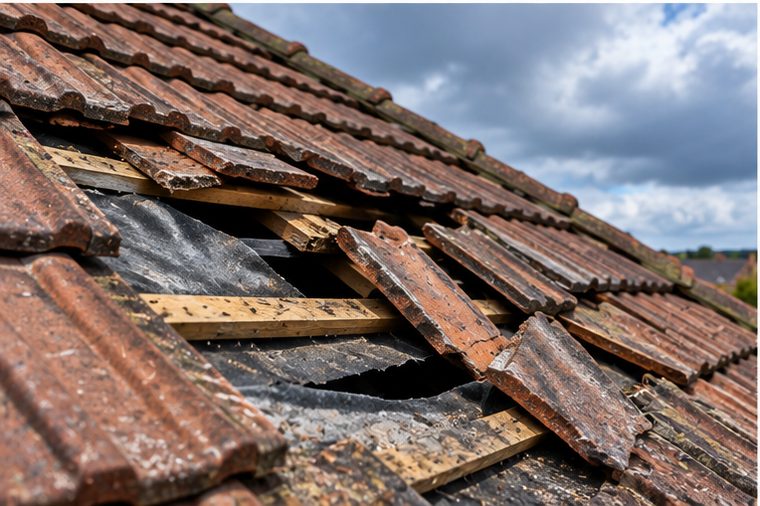
The Ellesmere Port Angle
Two local practicalities.
The wind comes off the estuary with very little in the way, which means sheeting here has to be secured properly rather than adequately. A sheet that would sit happily on a sheltered inland roof will not sit on an exposed one here.
And a good proportion of the "storm damage" calls we take from this town turn out to be drainage rather than covering - an overflowing gutter, a backed-up valley, water getting behind a fascia. Those need no patch at all. They need clearing, and that is the cheapest good news in roofing.
It is worth mentioning on the phone whether the weather that caused it was windy or simply heavy and prolonged, because those two point at completely different things and one of them may not need a repair at all.