★★★★★
“I had a leak in my vally had a number of roofers to come and take a look couldn’t find the problem Roofline’s solutions fixed the problem first time. Very happy with these guys thank you for the brilliant service”
Michael PriceThis is the single commonest reason a roof claim is refused, and the honest answer is usually messier than either side puts it. What an inspection looks for, what the findings mean, and why worn does not have to mean declined.
Buildings insurance exists to cover sudden and unexpected events. It does not exist to cover a roof getting older, and every policy sold in this country says so somewhere. The phrasing moves around — wear and tear, gradual deterioration, a gradually operating cause, lack of maintenance, the action of weather over time — but the exclusion itself is universal. There is no policy on the market without one.
Sitting alongside it, many policies carry a condition expecting the property to be kept in a reasonable state of repair. That one is easy to miss, because it lives among the conditions rather than the exclusions and nobody reads the conditions. It is the reason an insurer is entitled to ask what was done about a ridge that a previous roofer had already flagged, or about a valley somebody had quoted for and nobody had booked.
Together the two allow a question that feels brutally unfair standing in a wet hallway: would this part have failed anyway? The insurer is not accusing anyone of neglect. It is drawing the line its contract draws, between damage the weather caused and deterioration the weather merely exposed. Knowing that the question is coming is most of the battle, because it changes what you keep, what you photograph and what you throw in the skip.
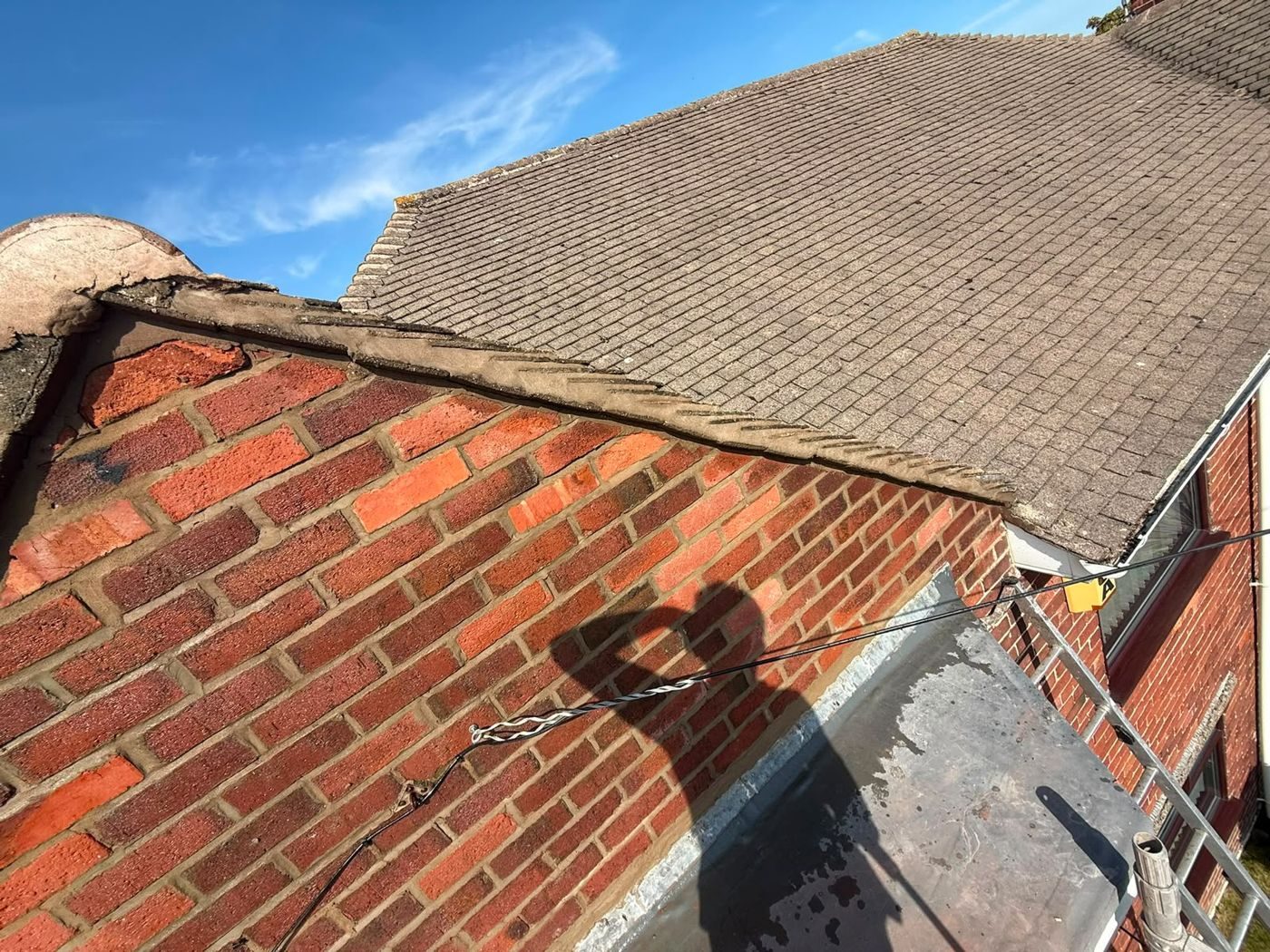
Photograph of our own work.
If the claim is big enough to be looked at in person, the person who comes is usually a loss adjuster, who is appointed by and works for the insurer rather than for you. They are not there to admire the view. They are looking for physical signs that a component had already lost its fixing, and on a pitched roof the same short list comes up over and over.
Mortar that has lost its bond. On a great many older roofs the ridge and hip tiles are bedded in mortar and nothing else. Mortar is rigid, the roof moves with heat and frost, and after enough winters the bond breaks even though every tile is still sitting exactly where it was put. Lift one and it comes away clean, with dry sandy bedding underneath and no grip at all. It is the commonest finding on a storm claim by a wide margin, and it photographs unmistakably.
Nail fatigue in old slates. Natural slate outlasts the nails holding it. When the nails corrode and snap, slates slide out one at a time with nothing whatever wrong with the slate itself. A roof that has been shedding the odd slate quietly for a long while tells one story; a dozen on the lawn on the same morning tells another. Either way the gap wants covering before the next wet spell, and the roof repairs section takes that on in how quickly should missing tiles be replaced.
Perished underlay. The felt or membrane under the tiles is the roof’s second line of defence. Old bitumen felt goes brittle, tears along the batten lines and sags into useless strips. Once it has gone, one displaced tile puts water straight into the loft, which is why a modest amount of damage on a tired roof causes so much more harm inside than the identical tile would on a sound one.
A verge that was hollow behind. The mortar bed running up the gable looks solid from the pavement and can be completely detached from the tile behind. Tap it and it sounds empty. Wind that finds its way into that gap does not need to be remarkable to lift the whole strip, and the strip usually takes the end tiles with it.
Here is the part most pages on this subject step around. Most storm damage to a British roof is a worn component that the wind finished off. That is not a cynical view, it is simply what the four failure modes above describe. A ridge tile on sound bedding very rarely leaves a roof. One resting on mortar that lost its grip several winters back leaves the moment a gust gets under it, and it was going to, sooner or later, on some windy night or other.
Which means the two stories a homeowner gets told — it was the storm, it was wear and tear — are usually both partly true, and the disagreement is really about proportion. That is precisely what the third of an insurer’s three tests asks. Not whether wear existed, but whether the weather was the main cause of what happened. The other two tests are set out in what insurers actually mean by storm damage.
It also means the strength of a claim often rests on what can still be seen after the event, and on whether anybody recorded it before the roof was made safe and the debris cleared. The underside of a ridge tile, photographed on the day, carries more weight than a page of argument three weeks later. That is the whole case for getting a proper record made early, and for not tidying up first.
An old roof is not an uninsurable roof, and a worn component does not by itself defeat a claim. If it did, buildings insurance would cover almost nothing, because almost every roof in the country has wear somewhere on it. The exclusion bites on damage that deterioration caused, not on damage that happened to a house which also has deterioration.
What actually happens varies enormously. Some claims are accepted in full where the weather was plainly the dominant cause even on a tired roof. Some are declined outright. In between, insurers sometimes settle part of the work, putting right what came off while declining the pre-existing condition around it, and sometimes raise betterment where a repair would leave the roof in materially better order than before. Which of those you meet depends on your wording and on the facts of your roof, and anybody who tells you in advance which it will be is guessing.
If a claim is declined and you disagree, insurers have to operate a complaints procedure, and the Financial Ombudsman Service can consider the complaint free of charge once that procedure is exhausted. A homeowner may also choose to engage a loss assessor, who works for the policyholder for a fee and is the opposite number to the adjuster. Both are the homeowner’s call entirely. We take no view on either, we are not assessors, and we do not deal with insurers on anyone’s behalf. What we do is describe the roof accurately, including the parts of it that were already worn.
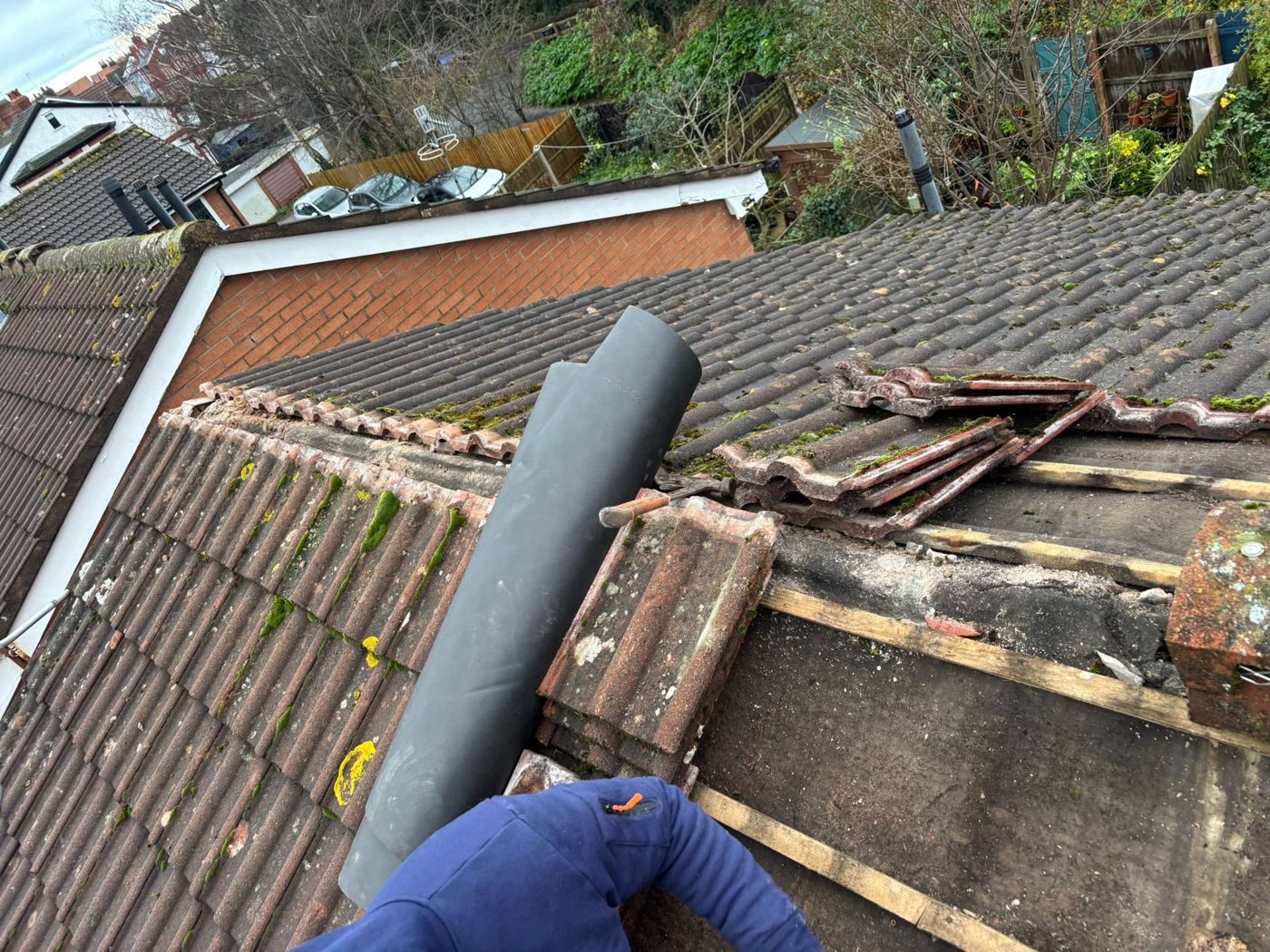
Photograph of our own work.
Two of the most useful things are done before anybody arrives, and each needs only a line here. Keep what came off the roof rather than clearing it away, because on this particular question the underside of a component settles more than any amount of argument — a fresh break looks nothing like a surface that has been weathering quietly for a long time. And have the roof photographed before the temporary covering goes on as well as after, since sheeting hides precisely what is in dispute. Why both matter, and what else a written record has to contain before it is worth anything, is the subject of what should be in a roofer’s report.
Keep the temporary work and the permanent repair as two separate jobs on two separate pieces of paper, since most policies expect reasonable steps to limit further damage but do not expect a full repair to be authorised before anybody has assessed it.
Then gather the dull paperwork, because it answers the reasonable repair question before it is asked. Previous invoices, an earlier roofer’s report, records of gutters being cleared, anything showing the roof was maintained. Be aware that this cuts both ways: a quotation for work that was recommended and never carried out tends to surface at exactly the wrong moment, so if something has been outstanding it is better to say so yourself.
None of that is about proving the roof was perfect, because no roof is. It is about being able to show what condition it was in and what was being done about it, so that the wear on it is a fact in the file rather than a hole in your account of things. The storm damage service page explains how a make-safe, a written report and a permanent repair fit together in practice.
The other guides in this set. What happens in the hours right after a storm is covered in detail on our roof repairs section, and linked throughout these pages rather than repeated.
Emergency call-outs across all of it, including Chester, Ellesmere Port, Neston, Runcorn, Frodsham, Helsby, Tarvin, Birkenhead, Wallasey, Heswall, Hoylake, West Kirby, Bebington, Deeside, Flint, Widnes, Warrington, Northwich, Winsford and Tarporley.
Start with the main storm damage page, or the town pages on roof repairs.
“I had a leak in my vally had a number of roofers to come and take a look couldn’t find the problem Roofline’s solutions fixed the problem first time. Very happy with these guys thank you for the brilliant service”
Michael Price“Highly recommend. Very quick and efficient. Great communication. Went above and beyond to work the weekend to complete the work that needed to be done. Very happy with the results.”
Karen Jones“Excellent work from the lads at roofline solutions. I had a leak in my valley, they came out and sorted it within a day.”
Chris HollewellDescribe the roof and roughly where you are, and we will come back to you — usually the same day. If water is coming in now, please call instead.
Prefer to talk? Call 07464 259566 · WhatsApp 0044 7464 259566 · Email Evensbuddy@yahoo.com
We cover Chester, Cheshire, the Wirral and Deeside from Elton, just north of Chester.
2 Manley View
Elton
Chester
CH2 4QF
Almost all of our work happens at your property rather than here, so please call before travelling.
Monday – Friday — 24hrs — Emergency Call-Outs
Saturday — 8:00 – 19:00
Sunday — 8:00 – 19:00
Weekday emergency call-outs are answered around the clock. Weekend cover is 8:00 to 19:00.