★★★★★
“I had a leak in my vally had a number of roofers to come and take a look couldn’t find the problem Roofline’s solutions fixed the problem first time. Very happy with these guys thank you for the brilliant service”
Michael PriceAn insurer is being asked to accept a cause, not a price. This is what the report has to contain, what has to be photographed and kept before anybody tidies up, and what the document looks like when it has been done properly.
Most people ring a roofer after a bad night and end up holding a piece of paper with a total on it. That is a quotation, and it answers a question nobody on the insurance side has asked yet. Before anyone decides what a repair costs, somebody has to establish what happened to the roof.
A quotation prices work that has not been done. An invoice records work that has. A report does neither. It describes a building, names the parts of the roof that have failed, sets out what condition those parts were in, and says what the person who wrote it believes caused the failure. It is evidence rather than a price, and it is read by somebody who has never seen the house and is not coming to look. Anything understood between you and the roofer on the driveway, and never written down, is simply missing.
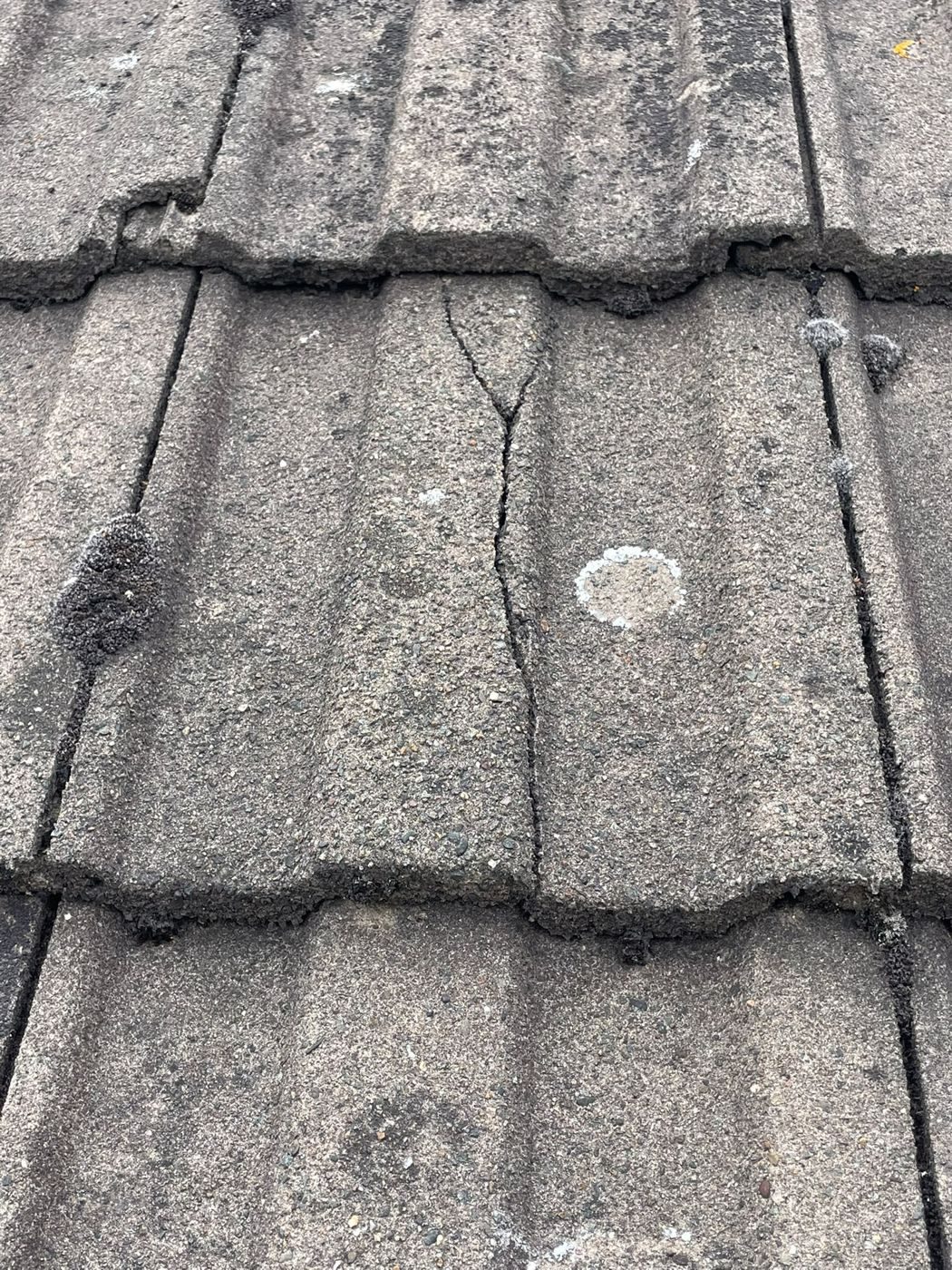
Photograph of our own work.
The components, named. Not “damage to roof” but the ridge, the verge, the valley, the flashing to the chimney, the tiles at the head of the rear slope. A roof is an assembly of separate parts, each failing in its own way, and a document that names none of them cannot be tested by anybody.
The condition of each one. This is the part usually missing, and the part that matters most. Bedding that has lost its bond and lifts by hand is a different finding from bedding that has been broken; a nail head rusted through is a different finding from a slate snapped across. The question being asked is about cause, and condition is how cause gets argued.
Where on the building, and when. The elevation, the slope, the position on it, and the date somebody stood there and looked. Dates run right through a claim file, and a report that floats free of them is hard to tie to the rest of it.
What the weather appears to have done. Not a ruling on whether it counts as a storm, which is not a roofer’s decision to make, but what the damage is consistent with: which direction things have moved, which elevation took it, and whether the pattern reads as uplift at an edge or as something that had been letting water in quietly.
The separation, where it can honestly be made. Sometimes a fresh break can be told from an old one — clean fracture faces, bright metal at a tear, mortar grey inside and weathered outside. Sometimes it cannot, and then the report says so, because asserting a line the roof does not support loses the reader entirely. Why that distinction decides so many claims is set out in the guide to wear and tear.
The make-safe and the permanent repair, apart. Two jobs, decided separately, so the temporary covering gets its own description and the permanent repair gets another: which components come off, what goes back, what access it takes, and whether anything underneath has to be dealt with while the roof is open. Scaffolding is quoted separately from the work, so it appears separately here too, and who pays for which is a subject of its own.
A report without photographs is an assertion. With them it becomes a record, and the pictures do three jobs at once: placing the failure on the building, showing its condition closely enough to be argued about, and fixing the date it was in that state.
Which is why a folder of close-ups is not enough, and why the work goes in three layers. The whole elevation, so the reader can see the slope and where on it the trouble is. The middle distance, putting the damage next to something identifiable — the stack, a window, the gable end — because a close-up on its own could have been taken on any roof in the county. Then the detail, near enough to see the fracture, the bedding or the fixing.
Then the inside, which gets forgotten because it is not the dramatic part: where water has come through and onto what, the ceiling, the stain, the loft timbers, the bucket it is landing in, and the same spot again as it spreads or dries. Those, with the ones from the ground and from an upstairs window, are what a household can take safely; the ones from the roof itself are the roofer’s job, and the whole reason he goes up with a camera is so that nobody who lives there has to. There is a list of what can be seen from ground level on our roof repairs section: what to look for.
When is the part that goes wrong most often. The roof has to be photographed before the make-safe goes over it: the minute a sheet is across the opening, the condition underneath has gone as far as anybody who was not standing there is concerned. Then photograph the covering once it is fixed, so there is a record that the building was protected and from when. Keep the files as they came off the camera rather than cropping and re-saving them, because the date travels with the original.
Whatever came off the roof is physical evidence of how it was fixed, and it stops being evidence the moment it goes in a skip. Broken tiles, lengths of ridge, lumps of old bedding, torn underlay, the nails or clips that were meant to be holding it — photograph them where they landed, from wherever you can safely stand, then put them somewhere dry at the side of the house until the claim is settled.
They are worth keeping because they answer questions no picture of the roof can. The underside of a ridge tile shows whether the mortar broke or simply let go, which is very nearly the whole wear-and-tear argument in one object, and a nail still gripping a fragment of batten is a different story from a shank rusted to nothing. None of it can be recovered from a photograph of a tidy garden.
Then write things down, on the day, in whatever form you will actually keep — a note on the phone does the job. When you first noticed, and how. What the weather was doing. What you found and where. Who you rang, and when. Who attended, what they did and what they said still needed doing. When you notified the insurer and what reference you were given. Every time water came in afterwards, and anything you had to pay for in the meantime, with the receipt.
That note is worth more than it looks, because a claim is a timeline as much as it is a roof. An account written on the day, whose dates agree with the photographs and with what the roofer later describes, settles a great many questions before anybody asks them. One assembled from memory afterwards, with gaps where the dates should be, invites every one of them.
There is a document that circulates after every serious blow: a letterhead, two lines reading “storm damage to roof, tiles missing, full replacement required”, and a total at the bottom. It is not a report. It contains one assertion and a price, and asks the reader to take both on trust.
The tests are not technical. Does it name components, or only name the roof? Does it describe condition, or only damage? Is it dated, and does it say when the roofer was on the building? Are the photographs referred to in the text, so the reader knows which picture supports which sentence? And does it say what could not be seen — because there is always something, and a document that states no limits has usually not looked very hard.
Then the one that decides the rest: does whoever wrote it appear to have been on the roof? Bedding cannot be tested from a driveway, and nail fatigue cannot be seen from one. Whether the underlay beneath a slipped tile is sound or has perished to a cobweb is something you establish by lifting the tile next to it and looking, as in the photograph below. Those are precisely the findings that decide whether a failure reads as sudden or as gradual, and they are only available to somebody standing on the slope.
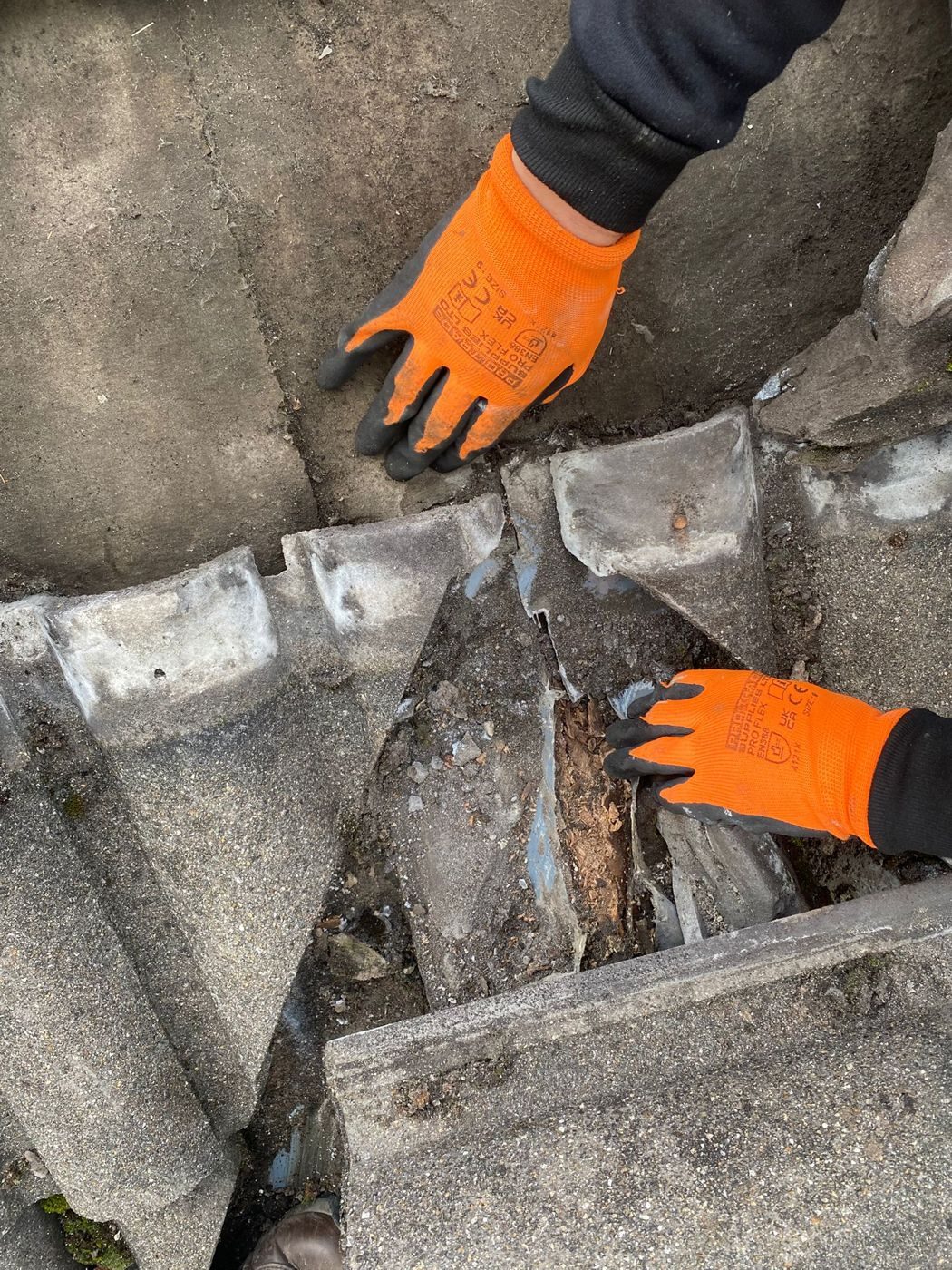
Photograph of our own work.
We come out, make the roof safe, and write the report. It comes to you, with the photographs, and you send it in. That is the whole of our involvement in the paperwork, and better said here than left to arrive as a surprise later. The rest of what we do on a storm job is on the storm damage page.
We are not loss assessors and we are not loss adjusters. We do not deal with insurers, we do not handle claims, and we will not tell you what your policy covers. A loss adjuster is appointed by the insurer and works for the insurer; a loss assessor is engaged by the policyholder, for a fee, and works for them. We are a roofing firm, and the report is a roofing document about a roof.
There is a reason to prefer it in that order. A report carries weight roughly in proportion to how disinterested its author looks, and a tradesman describing a slope he has stood on is a more straightforward witness than somebody with a stake in the outcome. What we can be held to is what is in the document: the components, the condition, the pictures and the date.
The other guides in this set. What happens in the hours right after a storm is covered in detail on our roof repairs section, and linked throughout these pages rather than repeated.
Emergency call-outs across all of it, including Chester, Ellesmere Port, Neston, Runcorn, Frodsham, Helsby, Tarvin, Birkenhead, Wallasey, Heswall, Hoylake, West Kirby, Bebington, Deeside, Flint, Widnes, Warrington, Northwich, Winsford and Tarporley.
Start with the main storm damage page, or the town pages on roof repairs.
“I had a leak in my vally had a number of roofers to come and take a look couldn’t find the problem Roofline’s solutions fixed the problem first time. Very happy with these guys thank you for the brilliant service”
Michael Price“Highly recommend. Very quick and efficient. Great communication. Went above and beyond to work the weekend to complete the work that needed to be done. Very happy with the results.”
Karen Jones“Excellent work from the lads at roofline solutions. I had a leak in my valley, they came out and sorted it within a day.”
Chris HollewellDescribe the roof and roughly where you are, and we will come back to you — usually the same day. If water is coming in now, please call instead.
Prefer to talk? Call 07464 259566 · WhatsApp 0044 7464 259566 · Email Evensbuddy@yahoo.com
We cover Chester, Cheshire, the Wirral and Deeside from Elton, just north of Chester.
2 Manley View
Elton
Chester
CH2 4QF
Almost all of our work happens at your property rather than here, so please call before travelling.
Monday – Friday — 24hrs — Emergency Call-Outs
Saturday — 8:00 – 19:00
Sunday — 8:00 – 19:00
Weekday emergency call-outs are answered around the clock. Weekend cover is 8:00 to 19:00.