★★★★★
“I had a leak in my vally had a number of roofers to come and take a look couldn’t find the problem Roofline’s solutions fixed the problem first time. Very happy with these guys thank you for the brilliant service”
Michael PriceWhether a repair disappears or shows depends on what is on your roof, how old it is and whether anyone still makes it. The honest options, and why matching is rarely an insurance question.
Three things settle it: what the tile is made of, what shape it is, and whether anybody still makes that shape. Material and profile together are the tile’s identity, and a tile that looks similar from the pavement can be the wrong thickness, the wrong length or have an interlock that will not sit against its neighbour.
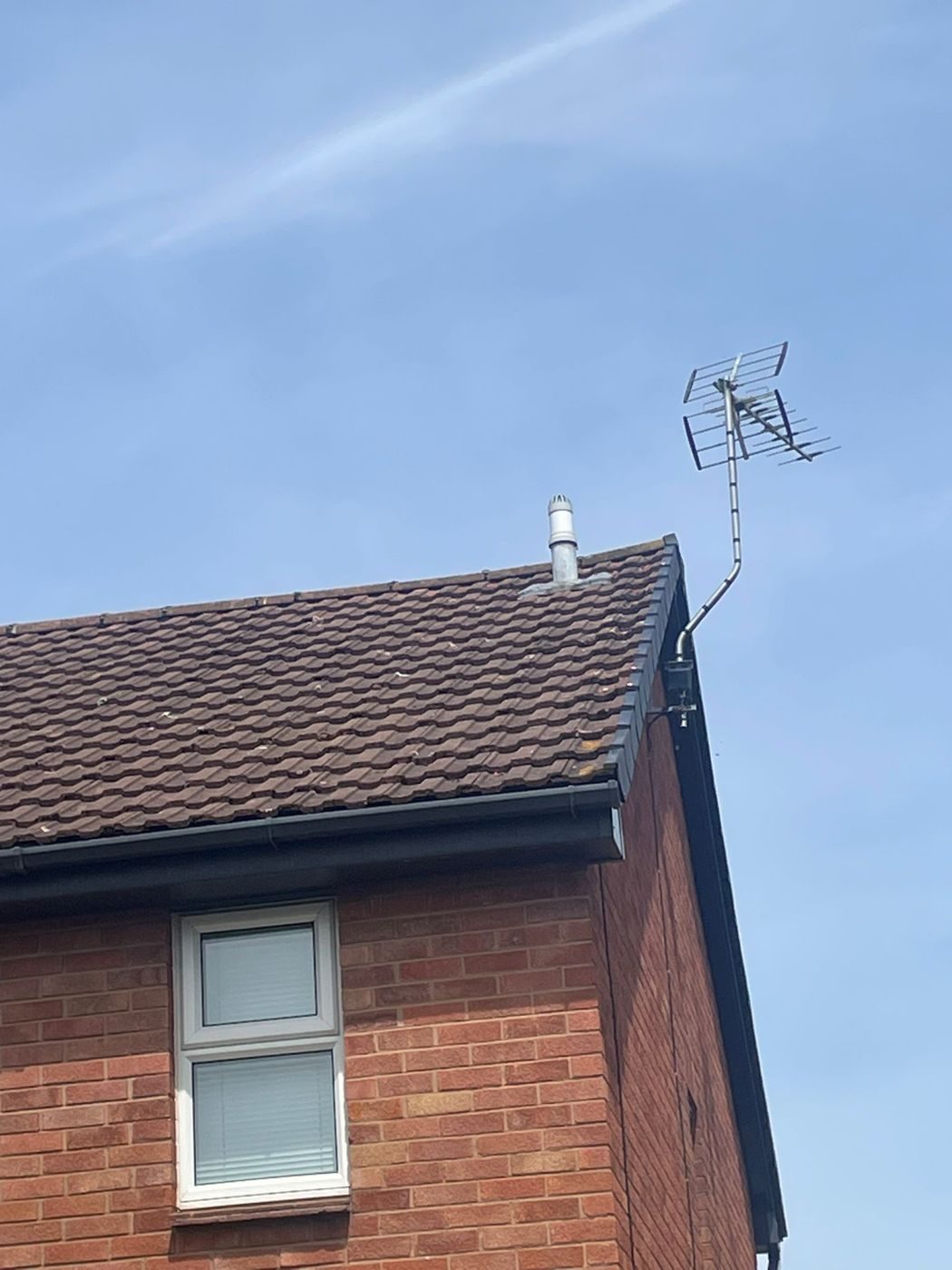
The easy end of the range is concrete. Interlocking concrete tiles went onto an enormous amount of housing in the second half of the last century and they were made in a handful of very common patterns by a small number of manufacturers, most of which are either still in production or have a current equivalent that drops straight in. The roof in the photograph below sits at that end of the range: an ordinary interlocking profile of the kind that went onto street after street, which is exactly what makes replacing one tile in it undramatic.
The hard end is everything older. Hand-made clay, machine-made clay in a discontinued pattern, natural slate from a quarry that has closed, and concrete profiles that were dropped years ago because fashions changed. Some of those can be sourced with a bit of looking. Some genuinely cannot be bought new at any price, and a roofer who tells you otherwise on the doorstep has not checked.
Quantity matters as well. One or two tiles on a rear slope is a different proposition from a whole gable elevation, because a handful can be found or borrowed from somewhere on the building, while a large area needs a real supply. It is worth asking which of those you are in before anyone starts.
Photograph of our own work.
Even a perfect match is a new tile on a weathered roof, and for a while it will say so. Concrete tiles are pigmented through a surface layer that fades and picks up lichen and dirt; the tile leaving the factory today is the colour yours was when it went on, which is not the colour it is now. Clay changes less but still darkens and gathers growth. Slate dulls rather than fades, and the shade varies by quarry in the first place.
Most concrete repairs close that gap noticeably as the new tiles weather through a wet winter or two, but it is fair to expect a visible difference in the meantime, and anyone promising otherwise is overselling. Where the repair sits decides how much that matters: a patch halfway up a front elevation facing the street is seen every day, and the same patch on a rear slope is not seen by anybody.
Roofs also carry more than one colour perfectly normally. Ridge and hip tiles are often a different shade from the tiles they sit on, and the trims and the guttering different again — the black verge trim and gutter against brown tiles in the photograph above are how that roof was built rather than a compromise. Worth remembering before assuming that any difference in shade is a fault.
Reclaimed. Salvage yards hold clay, slate and older concrete by profile, and for a discontinued tile this is usually the first place to look. The catch is condition and supply. A reclaimed clay tile can be sound or can be close to the end of its useful life, reclaimed slate needs sorting for thickness and for holes punched in the wrong place, and what a yard holds this month is not what it held last. Everything worth using gets checked before it goes up.
The closest current equivalent. Where nothing reclaimed can be found, there is often a modern tile of the right size and pitch that is simply not identical to look at. On a rear elevation, an outbuilding or a low extension roof most people take that and think no more about it. On the front of a house it depends entirely on how different the two are, which is a conversation to have with the actual tiles in your hand rather than from a catalogue.
Robbing a slope nobody sees. The neatest answer for a visible repair, and the one that surprises homeowners. Sound original tiles are lifted from somewhere out of view — a rear slope, a garage, the side of a dormer — and used to make the visible repair, and the new or nearly-matching tiles go where they were taken from. The front of the house stays consistent and the mismatch ends up facing the garden. It costs more in labour than a straight swap, and on a bad match it is usually worth it.
There is a fourth trick worth knowing, which is scattering rather than blocking. A solid square of slightly different tiles reads as a patch from the far side of the road; the same tiles spread among the old ones over a wider area read as a roof that has been lived in. It is not always possible, but where it is, it is free.
Deciding between the three starts with identifying the tile — material, profile, size and, where it can be told, who made it — and then finding out what is actually available rather than what ought to be. You hear which of the options you are in, in writing, and how obvious the difference is likely to be, before anything is ordered or lifted. What a damaged tile needs, as distinct from what it can be matched with, is a separate question, and what is the best fix for storm-damaged tiles answers that one.
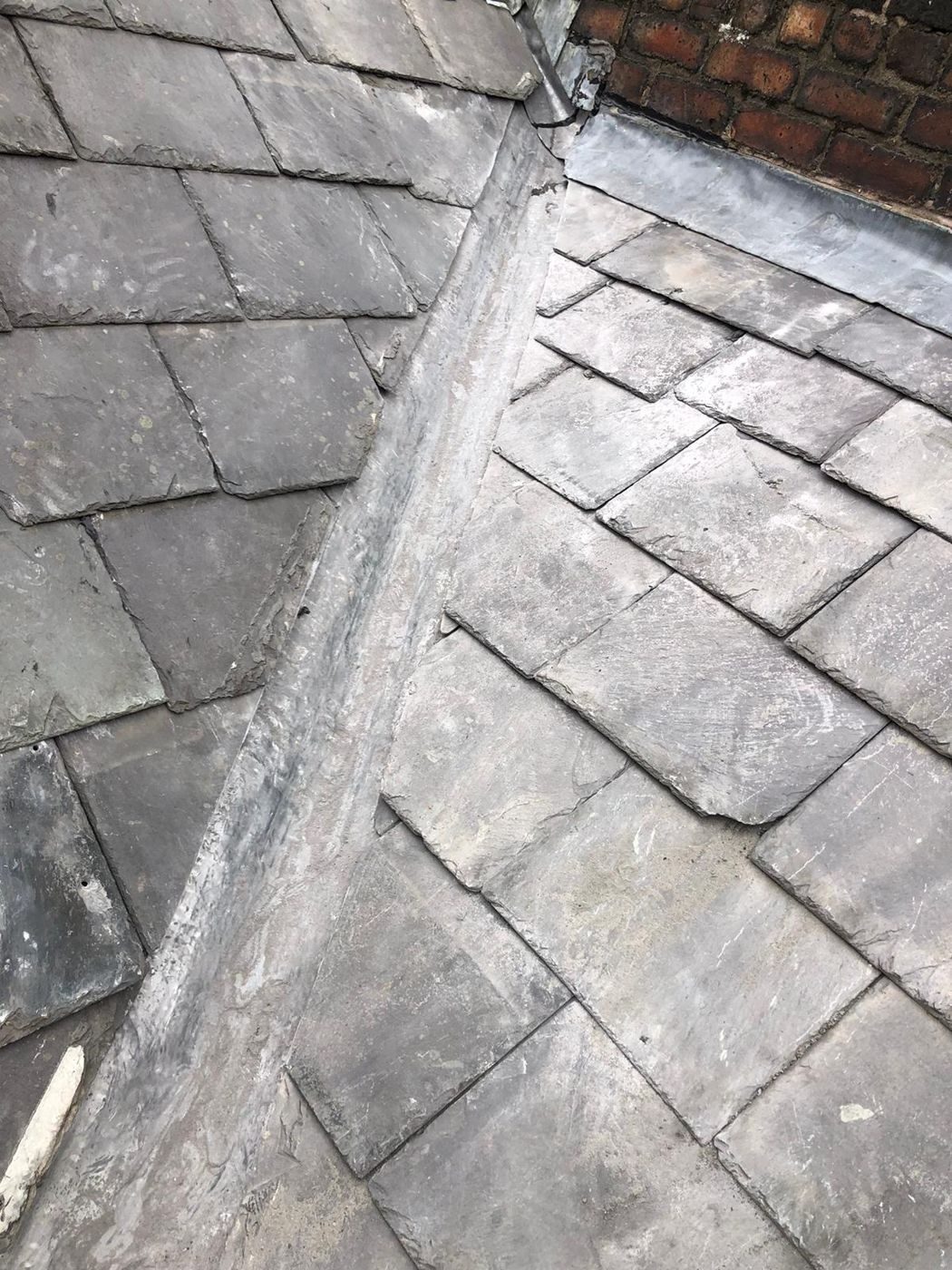
Natural slate is its own subject. Sizes are traditionally imperial and there are a lot of them, thickness and texture vary by quarry, and Welsh, Spanish and Westmorland slates sitting side by side do not look alike. Worse, on an older slate roof the commonest failure is not the slate at all: the nails corrode and give up while the slate is still perfectly serviceable, which is why slates slide out in wind without a mark on them. That changes what a repair has to do, because replacing one slipped slate on a roof whose nails have gone is a holding job rather than a fix — which is the distinction can storm-damaged roofs be patched safely takes on, on our roof repairs section.
Clay splits into two. Plain clay tiles are still made widely and a sympathetic match is usually available, and hand-made tiles have enough variation between individual tiles that new ones blend in better than you would expect. Machine-made clay in a discontinued pattern is the awkward one, particularly the strongly shaped profiles — pantiles, double romans and the like — where the shape has to be right or the water does not run where it was designed to run. Those are matched exactly or not at all.
Interlocking tiles are similarly unforgiving, because the side lap is doing real work rather than decoration. Plain tiles and slates are laid in a double lap and are far more tolerant of a near-miss, which is one reason a plain tile roof can be patched over and over without ever looking patched.
Photograph of our own work.
This is the clause people have heard of and almost nobody has read. In principle, a matching items or pairs and sets provision deals with what happens when one part of a matching set is damaged and the rest is not: does the policy pay anything towards the undamaged parts so that the whole thing still matches afterwards?
In practice the wordings vary enormously. Some policies have no such provision at all. Some have one but exclude external surfaces, which takes the roof straight out of it. Some limit it to a single room or a single elevation, some cap it, and some apply it only where a match genuinely cannot be obtained. Because of that, nobody outside your insurer can tell you what yours does, and that includes us. Read the policy booklet and the schedule, and if the answer is not obvious, ask your insurer or your broker before you assume anything.
What can be said safely is this: the normal starting point for an insurer is to put right the damage rather than to improve the appearance of the undamaged part of a building, so nobody should proceed on the assumption that a roof will be re-covered to make it match. Plan the repair on the basis that it has to work and look reasonable on its own merits. If the matching question then turns out to be covered, that is a bonus rather than the plan.
Where a match honestly cannot be found, the useful thing is a record rather than an argument — what is on the roof, what was searched for, what is available and what the alternatives look like. That belongs in writing with photographs, dated, and the rest of what goes into one is on the storm damage page. Who does what with it afterwards is set out in loss adjuster, loss assessor, or your roofer.
One last practical thing, whoever ends up paying. If your tile is obsolete and a batch has been tracked down for the repair, keep a few spares somewhere dry. Finding the same profile twice is harder than finding it once.
The other guides in this set. What happens in the hours right after a storm is covered in detail on our roof repairs section, and linked throughout these pages rather than repeated.
Emergency call-outs across all of it, including Chester, Ellesmere Port, Neston, Runcorn, Frodsham, Helsby, Tarvin, Birkenhead, Wallasey, Heswall, Hoylake, West Kirby, Bebington, Deeside, Flint, Widnes, Warrington, Northwich, Winsford and Tarporley.
Start with the main storm damage page, or the town pages on roof repairs.
“I had a leak in my vally had a number of roofers to come and take a look couldn’t find the problem Roofline’s solutions fixed the problem first time. Very happy with these guys thank you for the brilliant service”
Michael Price“Highly recommend. Very quick and efficient. Great communication. Went above and beyond to work the weekend to complete the work that needed to be done. Very happy with the results.”
Karen Jones“Excellent work from the lads at roofline solutions. I had a leak in my valley, they came out and sorted it within a day.”
Chris HollewellDescribe the roof and roughly where you are, and we will come back to you — usually the same day. If water is coming in now, please call instead.
Prefer to talk? Call 07464 259566 · WhatsApp 0044 7464 259566 · Email Evensbuddy@yahoo.com
We cover Chester, Cheshire, the Wirral and Deeside from Elton, just north of Chester.
2 Manley View
Elton
Chester
CH2 4QF
Almost all of our work happens at your property rather than here, so please call before travelling.
Monday – Friday — 24hrs — Emergency Call-Outs
Saturday — 8:00 – 19:00
Sunday — 8:00 – 19:00
Weekday emergency call-outs are answered around the clock. Weekend cover is 8:00 to 19:00.