★★★★★
“I had a leak in my vally had a number of roofers to come and take a look couldn’t find the problem Roofline’s solutions fixed the problem first time. Very happy with these guys thank you for the brilliant service”
Michael PriceMaking a roof safe and repairing it are two jobs with two conversations attached to them. Getting those separated on paper, on the day, is what stops the second one turning into an argument weeks later.
Wind leaves a household with two problems that run at different speeds. One is that the building is taking on water now, which has to be dealt with today, in whatever weather is left over. The other is that a roof has an opening in it, which has to be put right properly, dry, with access, and in most cases after somebody has worked out who is paying. Treating those as one job is the commonest way a bad night turns into a bad month.
The make-safe is the first of them. Sheeting an opening, taking down or refixing whatever has come loose before it lands on somebody, clearing a gutter that is tipping water into the wall, getting standing water out of the fabric. It is temporary on purpose. It is not built to sit there through a season of gales and it is not meant to.
The permanent repair is the second, and it is a different visit altogether: settled weather, the right access, the components on site, and enough time to open the roof up and look at what is underneath before closing it again. Almost everything about it — the scope, the cost, who has agreed to it — is different from the first job.
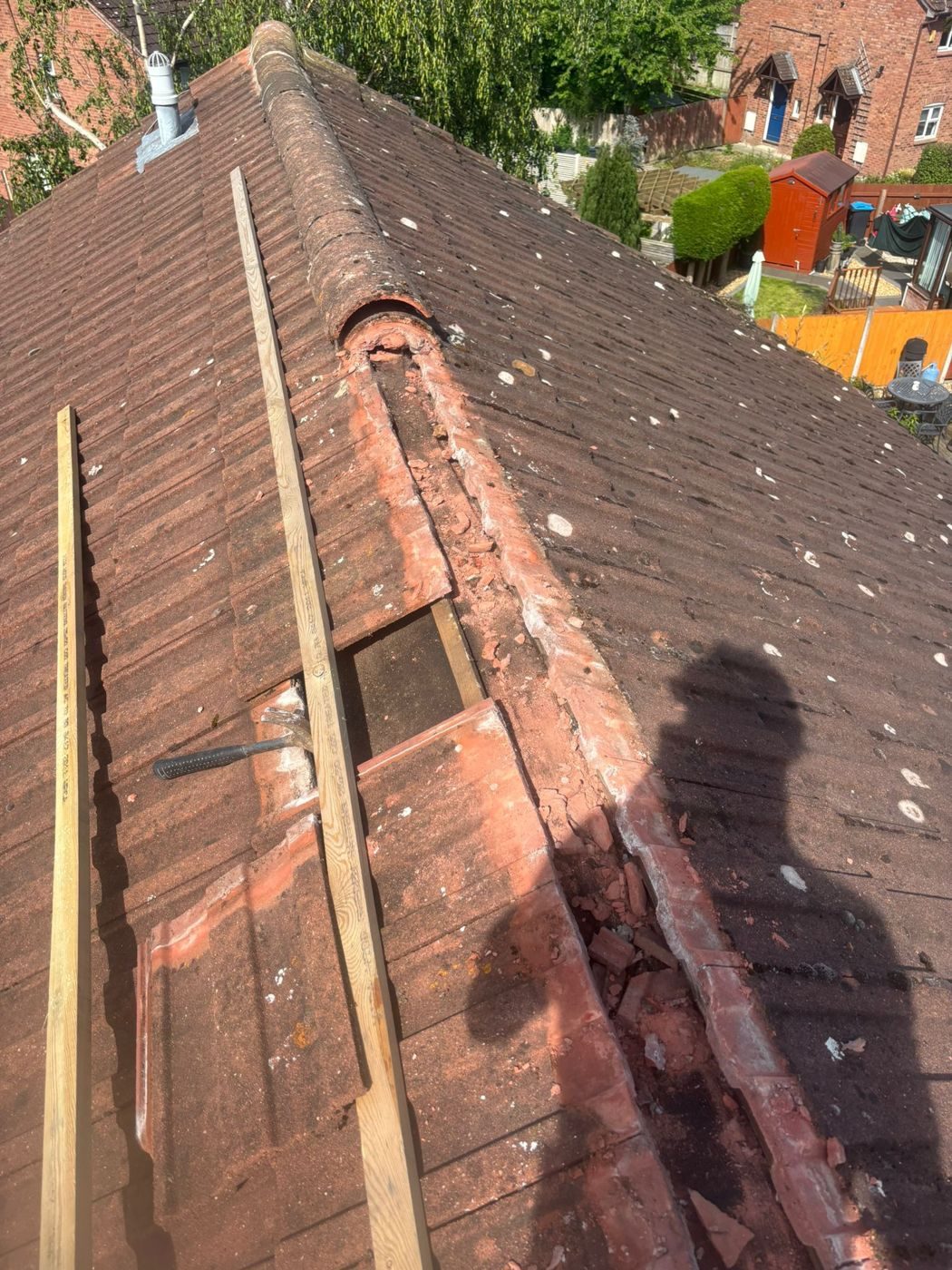
Photograph of our own work.
Most home insurance policies require the policyholder to take reasonable steps to prevent further damage once something has happened. The wording differs and the obligation is real: leaving a roof open to the rain for a fortnight because you were waiting to be told what to do is not usually looked on kindly. Emergency work to stop water entering is normally acceptable before anybody has inspected, and that duty is the reason why.
A permanent repair is a different matter, because it does two things an insurer would rather do first. It disposes of the evidence — once the broken components are in a skip nobody can look at them again — and it commits to a scope and a cost that have not been agreed with anyone. That is the point at which people find themselves holding a bill they assumed somebody else had accepted.
So the practical order is: stop the water, then stop. Notify the insurer as soon as you reasonably can, and if the covering went on in the middle of the night because it could not wait, say that — it is precisely the situation the reasonable steps wording exists for. What happens after that turns on your policy and your insurer, and no web page can tell you which way yours will go.
The uncomfortable half of the answer is that the roofer’s customer is you. You rang, you agreed to the work, and the bill comes to you. An insurer reimburses a policyholder under a policy; it does not become the tradesman’s customer because a claim exists somewhere. That holds for the emergency attendance and it holds for the repair.
Whether the emergency work is then reimbursed, and how it sits against your excess, is between you and your insurer and depends entirely on the wording you bought. Some policies deal with emergency work inside the claim. Some treat it as its own item. Some want to be told before anything is spent unless it genuinely could not wait. Nobody can tell you which of those describes yours except the people who wrote it, and that phone call is worth making before you assume.
What helps in every version of it is paperwork that comes apart. A single invoice reading “roof works” forces the whole thing to be treated as one decision. Two documents — one for the attendance and the temporary covering, one for the permanent repair — let each be considered on its own merits. Ask for it that way at the beginning; separating it afterwards is much harder and looks worse.
Standing in the hall with a bucket under the landing ceiling, nobody is at their sharpest. These are worth having in your head before you need them.
Is this the temporary job or the permanent one? Ask it in those words and make the answer be one or the other. What are you doing today, and what will still need doing? Will the emergency attendance be invoiced separately from any repair? Do I get something in writing with photographs, and is that separate too? Am I agreeing to anything beyond today by letting you start?
Then two that people never think of until afterwards. Will you photograph it before you cover it up? And what happens to the broken components? Both answers belong in the written record, and what to photograph, what to keep and what to write down is set out in full in our guide to the roofer’s report.
None of that asks you to know anything about roofing. It asks the person on your drive to answer plainly, and somebody who will not answer plainly has told you something useful.
After a serious blow the county fills up with people who were not here the week before. Most of them are roofers. A few are running a different business altogether, and the tell is how quickly the conversation arrives at a complete new roof.
The straight version of the job looks like this: the opening gets covered, you are told what has failed and what it needs, and the second conversation happens later, in writing, where everyone can see it. The other version looks like this: the opening gets covered, and the same visit produces a figure for a full replacement, some urgency about signing, and an offer to take the insurance side off your hands. Those are not the same trade.
A make-safe must never be sold as the repair, and a repair must never be smuggled in behind a make-safe. If somebody sheets your roof and the invoice that follows is for a new one, two jobs have been run together, and the moment to catch that is before anyone starts rather than after. Being pressed to decide on the spot is a reason to wait, not a reason to hurry.
Keep the names straight as well, because they get used very loosely on doorsteps. A loss adjuster is appointed by the insurer and acts for the insurer. A loss assessor is engaged by the policyholder, for a fee, and acts for the policyholder. A roofer is neither, and one who offers to take your insurer on for you is selling something outside his trade — who is who in a claim sets the three roles side by side. We make the roof safe and hand you a written record with photographs, and the person who submits it is you.
The photograph below is one of ours, and it is a finished lean-to covering rather than a temporary one. The distinction between those two is the whole of this page.
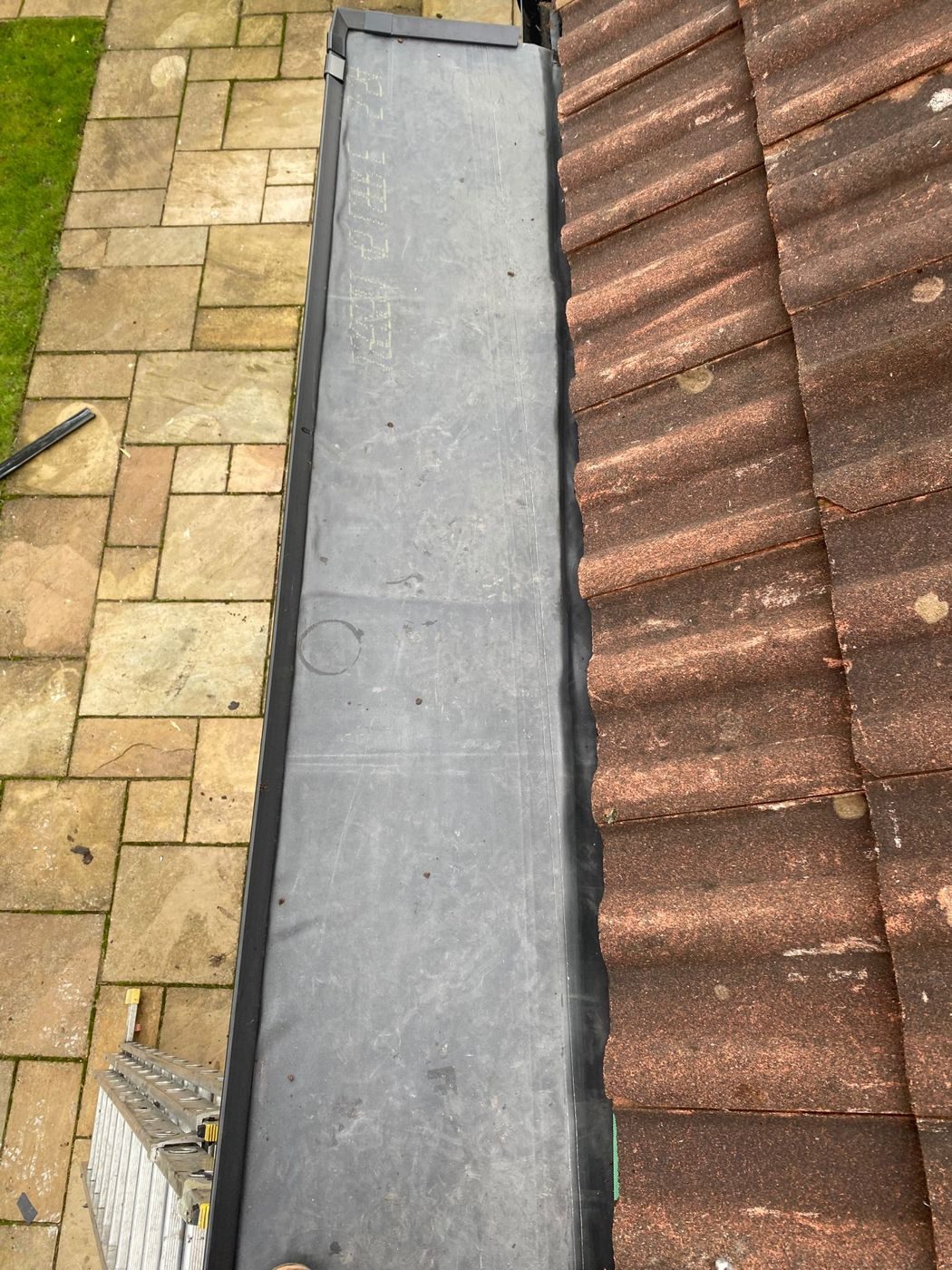
Photograph of our own work.
Not everything that moves in a gale needs somebody out that night, and treating it all as urgent has a cost of its own. Water entering a room people use, anything loose above a path, a pavement or a road, a ceiling holding water, an opening straight through into the loft — those are tonight. One tile off a garage in settled weather is not. Whichever it is, work it out from the ground or from an upstairs window, because going up to look in the dark or in wind turns a roofing problem into a hospital one.
Where that line falls is covered properly on our roof repairs section rather than here: what counts as emergency roof damage and when a missing tile becomes an emergency are both worth reading before you decide whether to ring in the small hours, and there is a step-by-step page on what to do first.
If it is tonight, ring rather than email. Weekday cover here runs around the clock, and at weekends from eight in the morning until seven in the evening. The rest of what happens on a storm job, from the first visit through to the written record, is set out on the storm damage roof repairs page.
The other guides in this set. What happens in the hours right after a storm is covered in detail on our roof repairs section, and linked throughout these pages rather than repeated.
Emergency call-outs across all of it, including Chester, Ellesmere Port, Neston, Runcorn, Frodsham, Helsby, Tarvin, Birkenhead, Wallasey, Heswall, Hoylake, West Kirby, Bebington, Deeside, Flint, Widnes, Warrington, Northwich, Winsford and Tarporley.
Start with the main storm damage page, or the town pages on roof repairs.
“I had a leak in my vally had a number of roofers to come and take a look couldn’t find the problem Roofline’s solutions fixed the problem first time. Very happy with these guys thank you for the brilliant service”
Michael Price“Highly recommend. Very quick and efficient. Great communication. Went above and beyond to work the weekend to complete the work that needed to be done. Very happy with the results.”
Karen Jones“Excellent work from the lads at roofline solutions. I had a leak in my valley, they came out and sorted it within a day.”
Chris HollewellDescribe the roof and roughly where you are, and we will come back to you — usually the same day. If water is coming in now, please call instead.
Prefer to talk? Call 07464 259566 · WhatsApp 0044 7464 259566 · Email Evensbuddy@yahoo.com
We cover Chester, Cheshire, the Wirral and Deeside from Elton, just north of Chester.
2 Manley View
Elton
Chester
CH2 4QF
Almost all of our work happens at your property rather than here, so please call before travelling.
Monday – Friday — 24hrs — Emergency Call-Outs
Saturday — 8:00 – 19:00
Sunday — 8:00 – 19:00
Weekday emergency call-outs are answered around the clock. Weekend cover is 8:00 to 19:00.