★★★★★
“job well done good communication throughout the job very clean and tiddy when the job is finish flat roof replacement many thanks.”
Sumit BalThree materials cover almost every domestic flat roof in Cheshire. Each of them is the right answer somewhere and the wrong answer somewhere else, so this page says what each is good at before it says anything about choosing.
Telling the three apart is easy once you know what you are looking for, and you can usually do it from a window. Built-up felt is laid in strips, so you will see parallel joint lines running across the roof at regular spacing, and the surface is either coated in mineral granules like very fine grit or finished with a reflective paint. It is the only one of the three where the joints are an obvious visual feature.
Fibreglass, or GRP, reads as one continuous hard shell with a slight sheen to it and no joints anywhere, usually in dark grey or a sand colour. The edges are the giveaway: on a GRP roof the trim is a moulded profile that the laminate is built into and over, so the edge looks like part of the same object rather than something screwed on afterwards. Tapped, it sounds hard and hollow.
EPDM rubber is matt, dark, slightly dusty to the touch and visibly soft — it follows every small dip in the deck beneath it rather than bridging them. The field of the roof usually has no joints at all, and the edges are finished with separate metal trims, commonly black, with the rubber dressed down over them. From a distance an ageing rubber roof and an ageing felt roof look alike until you spot whether there are strips.
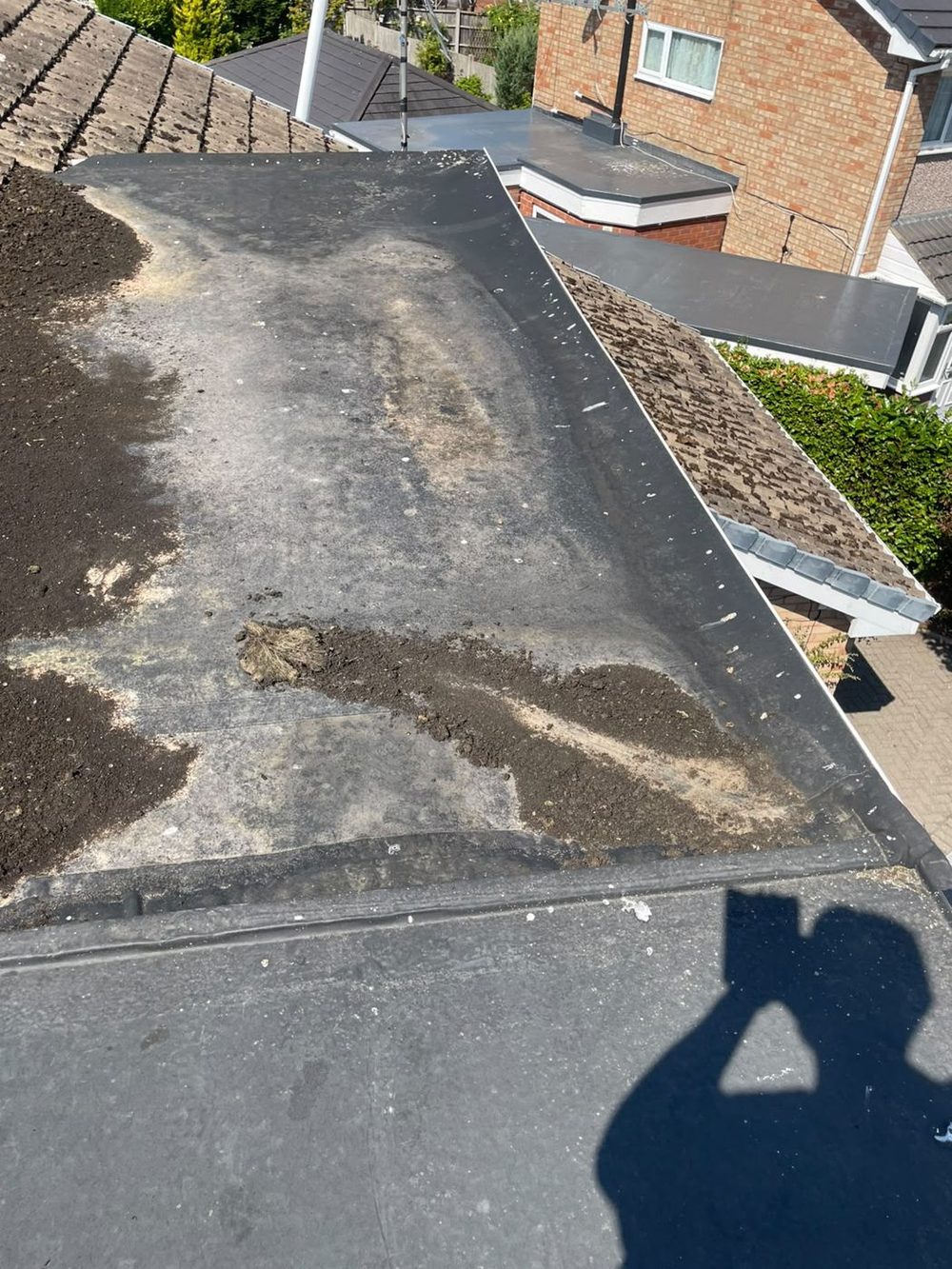
Photograph of our own work.
Modern torch-on felt is not the material that gave felt its reputation. It is a polyester-reinforced bitumen sheet, laid in layers, and it is tougher, more elastic and far more forgiving of movement than the old fibre-based stuff that so many garages were covered in. Laid properly in two or three layers with staggered joints, it makes a thick, heavy, physically robust covering that puts up with abuse.
Its real strength is detail. Bitumen is worked hot, so it can be coaxed round shapes that would need a fabricated piece in any other system: odd little dormer cheeks, parapets, awkward junctions with stonework, roofs cut about by pipes and cables. It is also repairable locally by anybody with the right torch and a roll, and on a roof that is already felt and basically sound, matching the existing system is often cheaper and more sensible than starting again in something else.
The weakness is the one that has always been there: joints. Every strip has to bond to its neighbour, and every one of those bonds has to survive years of expansion and contraction. Bitumen also stiffens as the temperature drops, so it is least flexible exactly when the building is moving most, and the surface finish weathers away under sunlight until the sheet below is exposed. And torching a naked flame along a timber eaves detail is a real consideration on an occupied house rather than a theoretical one.
GRP is glass fibre matting laid into a liquid resin and cured in place, so it forms a single rigid laminate with no joints in it anywhere — not in the field, not at the upstands, not at the edges. The trims are bonded into the laminate as part of the same shell. That seamlessness is genuine and it is the reason the material has a following.
It is also hard. A cured GRP roof will take foot traffic, ladders, furniture and general knocking about far better than a soft membrane will, which makes it a reasonable choice for a roof that people actually use, or for a balcony deck with the appropriate non-slip finish worked into the topcoat. Because it is applied wet and shaped in place, it handles complicated geometry well: integrated gutters, stepped levels, curved edges, bay canopies with several planes meeting at once. And it can be finished in colours that a rubber sheet simply does not come in.
Against all that, it is brittle, and that is not a small point on a domestic roof. A GRP shell is rigid, while the timber deck beneath it expands, contracts, takes up moisture and deflects under load. Where the deck moves and the laminate cannot, the laminate cracks — classically along a board joint, or at the angle where the flat surface turns up into an upstand, which is the sharpest stress point on the roof. That is why GRP asks for a very stable deck: a specific board, well supported, tightly fixed, with the joints treated as the system requires rather than however the deck happened to go down.
It is also weather-dependent in a way the others are not, because it has to cure. Resin needs warmth and a dry surface to go off properly, and a laminate that cured cold, damp or too quickly is compromised from the first day in ways nobody can see. That rules out a lot of the Cheshire calendar. Repairs are a further consideration: you cannot patch GRP with a patch, you grind back and re-laminate, and the repair is visible.
The case for rubber is short. It arrives as a single sheet large enough that most domestic flat roofs are covered in one piece, so the joints that felt fails at are simply not present, and it stays flexible when it is cold. Where the deck below moves, the covering moves with it instead of resisting it. Those two properties between them remove most of the ways an ordinary extension or garage roof gets into trouble.
It has real weaknesses and they deserve saying. It is soft, so a dropped tool, a dragged ladder foot or a sharp piece of rubble can puncture it, and it is not a wearing surface in its own right — a roof meant to be walked on needs a protection layer and a walking deck over the top, specified from the start. It does not get on with petrol, oils or solvents, which is worth remembering on a garage roof next to a flue or where the mower gets filled. And because it is bonded rather than mechanically locked in place, the quality of the adhesive work and the edge detailing is the whole job. A badly laid rubber roof ripples, and where somebody has used field adhesive instead of the proper seam tape on a joint, that joint will eventually let go.
What it is not is a repair. Rolled over a soft deck, or over falls that hold water where they should not, rubber will do exactly what anything else would do, only more slowly and at greater expense.
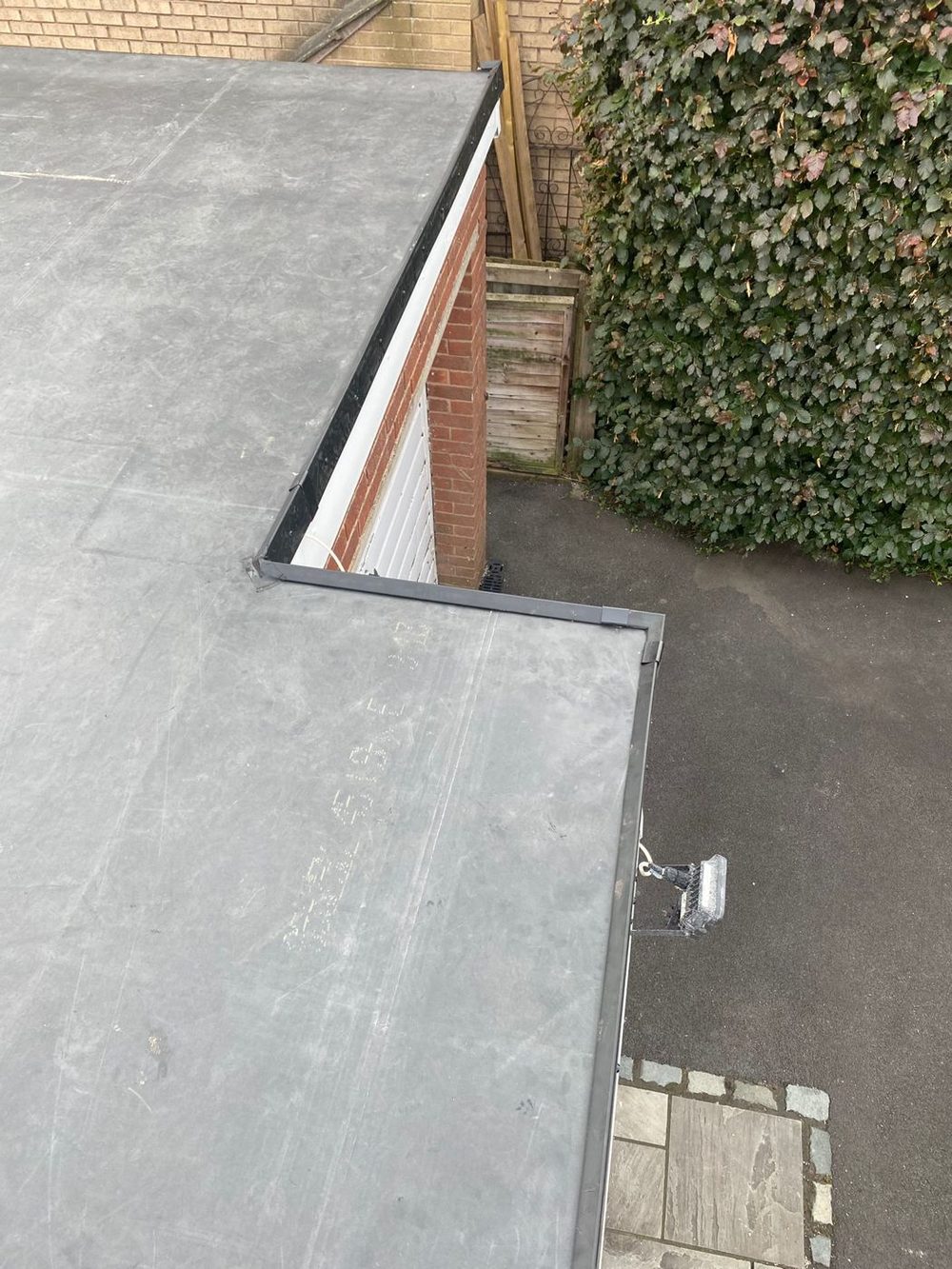
Photograph of our own work.
For a straightforward rear extension, garage, dormer top or porch canopy on a timber deck — which describes the overwhelming majority of flat roofs on Cheshire houses — rubber is usually the better fit, because timber moves and rubber does not mind. For a roof that people will stand on, or one with genuinely complicated geometry and a new deck built to suit, GRP earns its place, provided the work is done in weather that lets it cure. For a small, fiddly roof covered in obstructions, or an existing felt system that is sound and only wants extending or matching, torch-on felt remains a perfectly respectable answer.
Season matters more than people expect. GRP needs warmth and dry boards. Rubber goes down into a deck adhesive that has to be able to dry, and its perimeters into a contact adhesive that has to flash off first; neither behaves in the wet or in real cold. Felt can be laid in conditions that would stop both, which is occasionally the reason it is chosen, though a flame near timber in a confined space is its own set of considerations.
The most useful thing you can do, whichever way you lean, is ask the contractor which manufacturer’s system they intend to use, then read what that manufacturer publishes about that specific product rather than relying on anything said in a conversation. A quotation that names the system, the deck and the insulation is telling you something. One that says “rubber roof, supply and fit” is telling you nothing at all. What a rubber build-up involves is set out on the EPDM rubber roofing page, and the repair side of an existing covering sits with flat roof repairs.
The rest of the series, on the questions people ask most.
Across Chester, Cheshire, the Wirral and Deeside. Start with the main EPDM rubber roofing page.
“job well done good communication throughout the job very clean and tiddy when the job is finish flat roof replacement many thanks.”
Sumit Bal“I had a leak in my vally had a number of roofers to come and take a look couldn’t find the problem Roofline’s solutions fixed the problem first time. Very happy with these guys thank you for the brilliant service”
Michael Price“Highly recommend. Very quick and efficient. Great communication. Went above and beyond to work the weekend to complete the work that needed to be done. Very happy with the results.”
Karen JonesDescribe the roof and roughly where you are, and we will come back to you — usually the same day. If water is coming in now, please call instead.
Prefer to talk? Call 07464 259566 · WhatsApp 0044 7464 259566 · Email Evensbuddy@yahoo.com
We cover Chester, Cheshire, the Wirral and Flintshire from Elton, just north of Chester.
2 Manley View
Elton
Chester
CH2 4QF
Almost all of our work happens at your property rather than here, so please call before travelling.
Monday – Friday — 24hrs — Emergency Call-Outs
Saturday — 8:00 – 19:00
Sunday — 8:00 – 19:00
Weekday emergency call-outs are answered around the clock. Weekend cover is 8:00 to 19:00.