★★★★★
“job well done good communication throughout the job very clean and tiddy when the job is finish flat roof replacement many thanks.”
Sumit BalA puddle that is still there days after the rain stopped is either nothing at all or the most useful piece of evidence your roof will ever give you. Which one depends on where it is, what it is sitting on, and whether it is moving.
A flat roof is not flat. It is built with a shallow fall so that water crosses it and leaves, and while it is doing that the surface is wet, sometimes for hours. That is the roof working. Ponding is something else: water that is still standing once the roof has had a fair chance to drain and dry, which in practice means a day or two after the rain has stopped, in weather that would dry a path.
Most people first notice it by accident from an upstairs window, usually because the pond has caught a reflection and drawn the eye. If you have missed the wet, the roof will tell you anyway once it dries. A pond leaves a tide mark: a ring of fine silt, a darker patch of ingrained dirt, green algae, and sometimes a rim of lighter deposit where the water evaporated. Those marks tell you where water sits even in the middle of a dry August, which makes them more useful than the puddle itself.
Scale matters. A thin film in one corner of a garage roof after a week of rain is not the same animal as a sheet of water covering a third of the roof that never fully goes at any point in the winter. Both get described as ponding, and only one of them is worth spending money on.
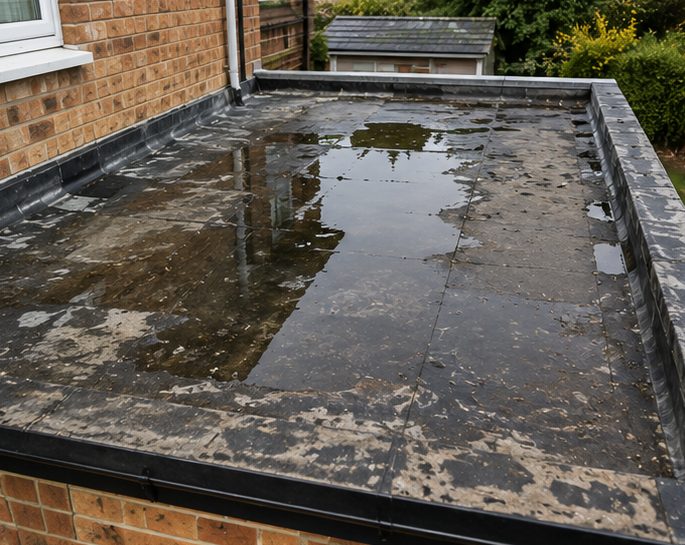
Image above is for illustration purposes only.
There are only a few causes, and they are worth separating because the answer differs for each. The first is that the roof never had enough fall to begin with, which happens on older work and on anything built by somebody who took the word flat literally. British practice designs in more fall than the finished roof needs, precisely because some of it is going to be lost, and a roof built with the bare minimum on paper arrives at nothing on site.
The second is deflection. Timber joists bend under their own weight, under snow, under anything stored on the roof, and under water itself, and over time some of that bend stays. The dip that results is usually mid-span, parallel to nothing in particular, and it collects water in the middle of a roof that drains perfectly well everywhere else. Deflection also explains why a pond can appear on a roof that was fine for a long time, and why it tends to get slowly deeper rather than staying the same.
The third is drainage that does not work where it is. An outlet placed somewhere other than the low point, a gutter that has dropped or filled so water backs up along the edge, an outlet choked with leaves, or a trim standing slightly proud of the covering so that it dams the last centimetre of water at the edge. Any of these produce a pond that has nothing to do with the falls at all, and the first of them to check is always the outlet, because it is the only one that might clear itself with a hand and ten minutes.
On a rubber roof, standing water is much less alarming than it looks. EPDM does not absorb water, it does not soften, it does not rot and it is not weakened by being wet for long periods, so a shallow pond sitting on a sound membrane over a sound deck is doing essentially nothing to it. Manufacturers have their own positions on this and they are worth reading for the specific product, but as a general proposition a puddle is not eating the roof.
What it does do is cosmetic and slightly inconvenient. Ponded areas collect airborne dirt, which settles as the water evaporates, so they go dark and stay dark. Algae grow in them, which makes that part of the roof slippery. Leaves and grit accumulate in them rather than being washed to the outlet. In a hard frost the pond becomes a slab of ice, and in a bad winter it can freeze and thaw repeatedly, which is hard on anything that has already got a fault in it.
So on a sound modern membrane roof, a modest pond in a fixed place that is not getting worse is usually filed under things worth knowing rather than things worth doing. Photograph it, note where it is, and look again after a winter.
The pond that matters is the one that changes. If it is covering more of the roof than it did, or lying deeper, or has appeared somewhere it never used to, the shape of the roof is moving, and that means the structure is doing something rather than the covering. It is also self-reinforcing: standing water is heavy, so a dip that holds water gets loaded by the water it holds, and it deepens.
On a bitumen roof the material itself has a stake in the argument. Prolonged saturation is hard on felt: it softens the surface, works into the open end of any joint, lifts the mineral finish, and feeds the moss that then holds yet more water against the covering. Add freezing and thawing and a pond sitting over a lap is actively prising it apart. A large permanent pond on an old felt roof is a genuine reason to bring the whole question forward.
Location does the rest of the talking. A pond sitting against an upstand raises the water level against the one detail that depends on being above it. A pond over a joint of any kind keeps a standing head of water on the weakest line on the roof. And a pond that forms directly over a habitable room, rather than over a garage, is carrying weight where weight is least welcome. None of those is an emergency on its own; all of them shorten the odds.
One more case deserves naming, because it comes up often. If a roof was recovered recently and it ponds now, the falls were not corrected during the work. A new covering laid on the old profile reproduces the old profile exactly, and anyone who quoted for that roof without raising the subject was quoting to put the same problem back.
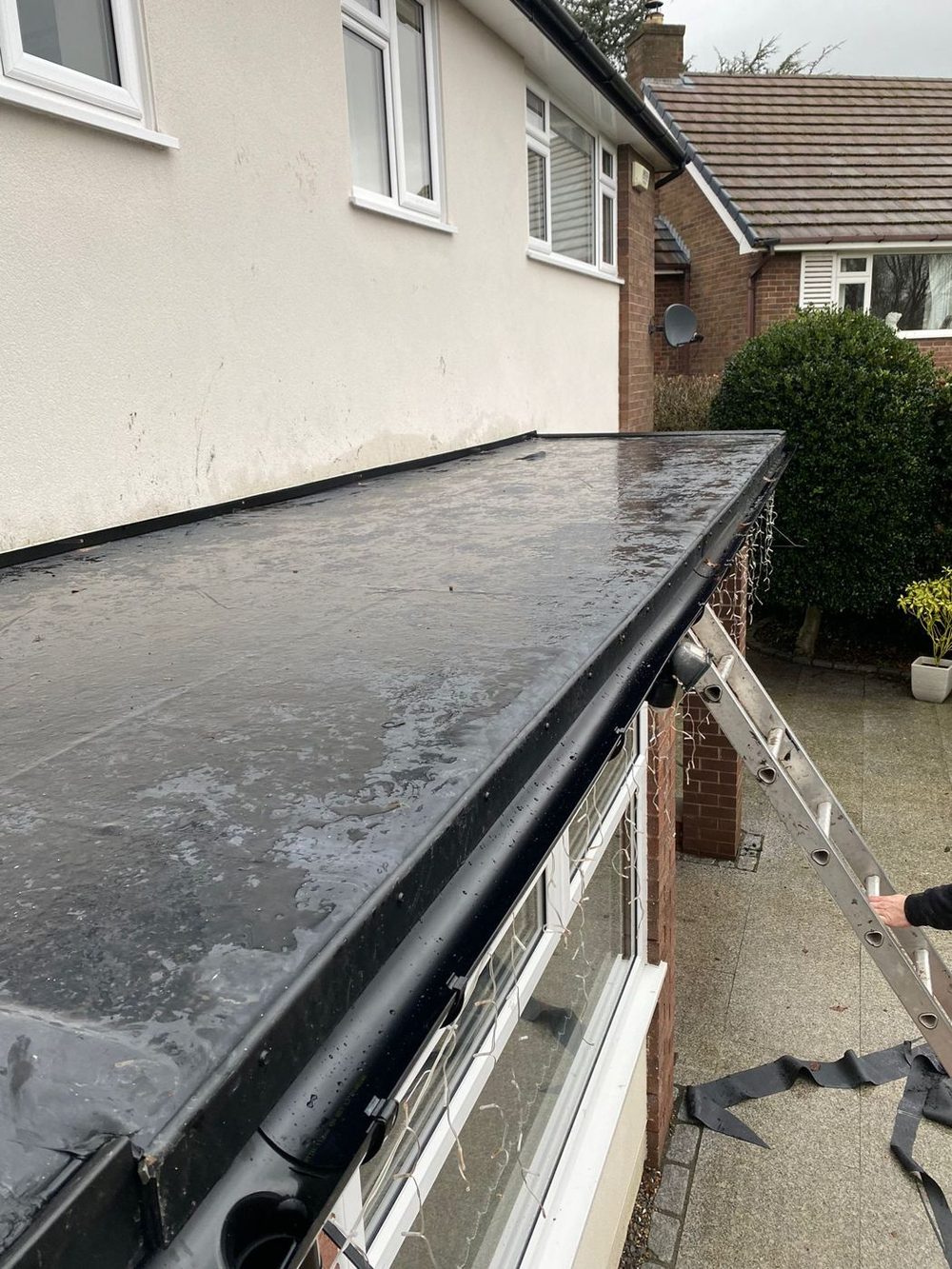
Photograph of our own work.
The cheap end first. Clear the outlet and the gutter, because a surprising proportion of ponds are simply blocked drainage and stop being ponds within the hour. That is a job for whoever is already safely working at that level, not for you on a Sunday — please do not go up to deal with it, because the low corner where the water gathers is exactly where a deck softens first and it will look no different from anywhere else until it gives.
Beyond that, fixing a fall means changing the shape of the roof, and the shape of the roof is under the covering. In practice that means one of three things: re-cutting or adding firring pieces over the joists so the deck itself slopes correctly, laying tapered insulation over the deck to build the fall into the insulation layer, or, where the problem is local, adding or relocating an outlet so water has somewhere to go from where it actually collects. All of those happen with the covering off. None of them can be done from above.
Which is the honest summary of the whole subject. A covering is not a levelling compound, and no membrane, coating or extra layer will make water run uphill. If a roof ponds and the ponding is the kind that matters, the falls get dealt with when the roof is open, or they do not get dealt with at all. The rubber roofing page covers what that build-up looks like; if you want an opinion on a particular puddle, a photograph from an upstairs window two days after rain is the single most useful thing you can send us.
The rest of the series, on the questions people ask most.
Across Chester, Cheshire, the Wirral and Deeside. Start with the main EPDM rubber roofing page.
“job well done good communication throughout the job very clean and tiddy when the job is finish flat roof replacement many thanks.”
Sumit Bal“I had a leak in my vally had a number of roofers to come and take a look couldn’t find the problem Roofline’s solutions fixed the problem first time. Very happy with these guys thank you for the brilliant service”
Michael Price“Highly recommend. Very quick and efficient. Great communication. Went above and beyond to work the weekend to complete the work that needed to be done. Very happy with the results.”
Karen JonesDescribe the roof and roughly where you are, and we will come back to you — usually the same day. If water is coming in now, please call instead.
Prefer to talk? Call 07464 259566 · WhatsApp 0044 7464 259566 · Email Evensbuddy@yahoo.com
We cover Chester, Cheshire, the Wirral and Flintshire from Elton, just north of Chester.
2 Manley View
Elton
Chester
CH2 4QF
Almost all of our work happens at your property rather than here, so please call before travelling.
Monday – Friday — 24hrs — Emergency Call-Outs
Saturday — 8:00 – 19:00
Sunday — 8:00 – 19:00
Weekday emergency call-outs are answered around the clock. Weekend cover is 8:00 to 19:00.