★★★★★
“job well done good communication throughout the job very clean and tiddy when the job is finish flat roof replacement many thanks.”
Sumit BalAn overlay is quicker, cleaner and less disruptive, and on a minority of roofs it is genuinely the right call. This is how that minority is identified, and what you give up on every roof outside it.
An overlay means leaving the existing covering where it is and bonding the new membrane on top of it, with the old surface prepared, cleaned and made good first. The old covering is not being ignored; it is being promoted to a layer of the new roof. That is the whole idea in a sentence, and it is also the source of every question worth asking about it.
The attraction is obvious and it is not dishonest. Nothing is ripped off, so there is no skip of wet felt and rotten board, no open roof waiting on the weather, and no day where the room below has nothing but a tarpaulin over it. The work is shorter, the mess is less, and the building is never exposed. On a roof that deserves one, an overlay is a proportionate answer rather than a short cut.
The difficulty is that the conditions which make it proportionate are specific, they have to hold everywhere on the roof rather than in the parts that are easy to look at, and an overlay is the one operation that permanently removes the chance of checking. Once the new sheet is down, whatever was underneath is sealed in and will not be seen again until the next time the roof is opened.
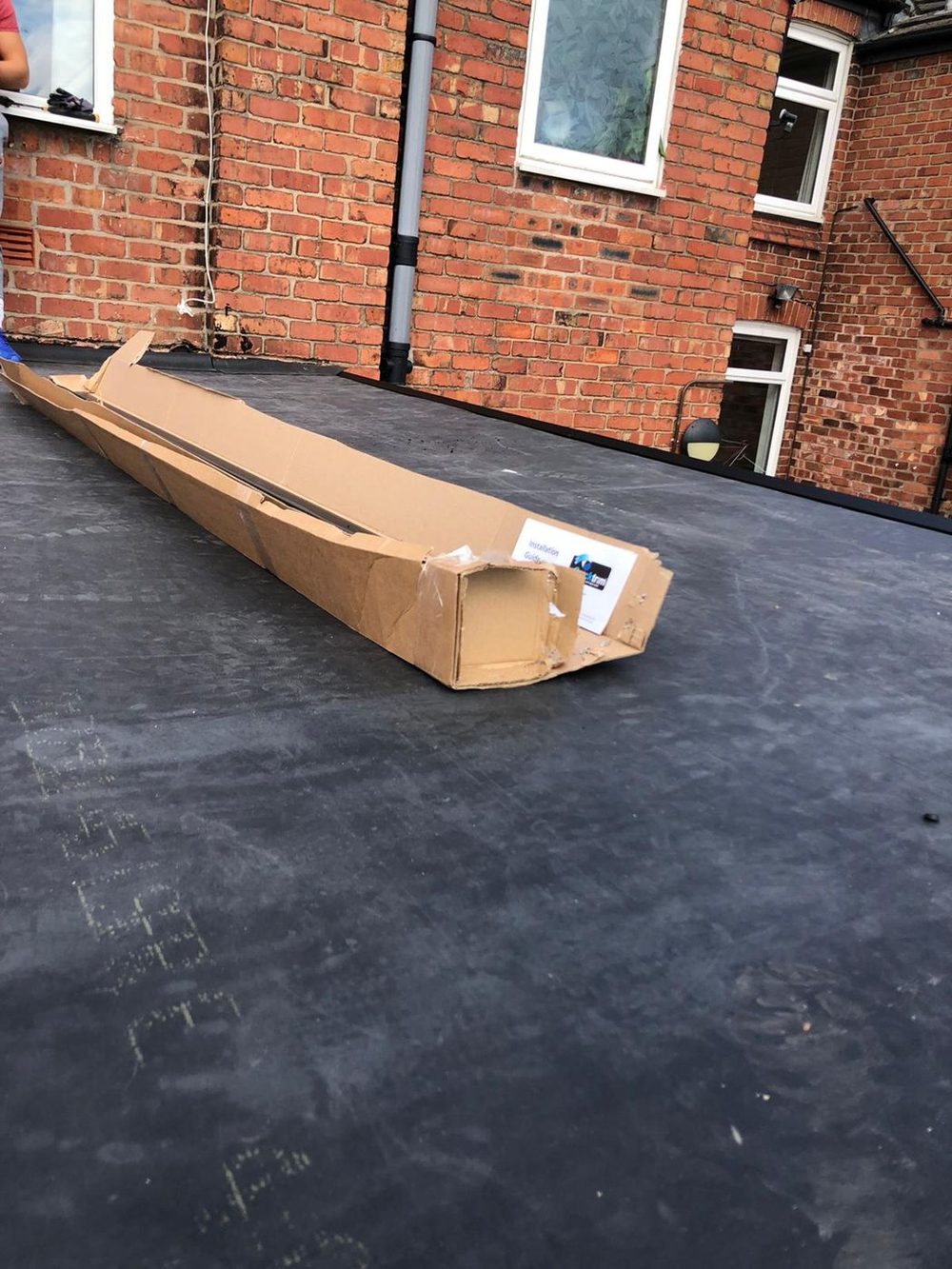
Photograph of our own work.
The first is adhesion. The existing covering has to be firmly attached across the whole area, because the new membrane is being bonded to it and can be no more secure than the thing it is stuck to. Anything blistered, lifting at a joint, loose underfoot or sounding hollow is not a base. A single loose area is not a local problem either — wind that gets under the old layer takes the new one with it.
The second is moisture. Whatever water is in the build-up on the day of the work stays in it. A membrane is a vapour barrier, so an overlay over damp insulation or a damp deck removes the only route that moisture had for drying out, and traps it against timber for the rest of the roof’s working life. On a cold deck with insulation between the joists, that consideration matters more than anything else on this page.
The third is drainage, and the fourth is the structure. A roof that ponds will pond identically afterwards, because an overlay reproduces the existing profile exactly and adds a millimetre or two to it. And a deck that has softened anywhere is not made firmer by another covering; it simply carries the new one down with it when it finally gives.
A proper assessment involves opening the roof in a small way rather than looking at it. A neat cut through the existing covering in a couple of places — at the lowest point, near the wall junction, and anywhere the ceiling below has a history — shows the state of the layers, whether the insulation is dry, what the deck is made of and whether it is still sound. The openings are made good afterwards. It takes a fraction of the time a strip does and it settles the argument.
The rest is done from underneath and from the edges. The underside of a garage deck is open to view. A void hatch takes a torch. The fascia and soffit line, sighted along from the garden, says whether the structure has moved. The ceiling below says whether water has been arriving, and for how long. None of that requires anybody to stand on a roof whose condition is precisely the thing in question.
The answer you are listening for is a specific one. “It looks all right from up here” is not an assessment. “We cut through in three places, the deck is dry ply in all of them, the falls run to the outlet and the covering is bonded everywhere we tested” is. If nobody will open it, the honest position is that nobody knows, and the quotation should say so in those words.
Materials have opinions about each other. Bitumen and some of the adhesives and membranes used on modern flat roofs do not sit happily together, and where a rubber sheet is going over an old bituminous surface the system may call for a separating layer, a particular primer, or a mechanically fixed board over the top of the old covering before anything is bonded. That is a question about the specific system rather than a general rule, and it is answered by the manufacturer’s own instructions for that product.
This is a reasonable thing to ask a contractor directly: which system is being used, and what does its literature say about bonding it over existing bitumen? A firm working to a named system will answer without hesitating. An answer along the lines of it being fine because it always is should slow the conversation down.
Surface preparation belongs in the same paragraph. Moss, lichen, algae, loose mineral, old repair patches, standing dirt and anything left over from a previous coating all have to come off, and the surface has to be dry when adhesive goes on it. An overlay bonded to a layer of dead moss is bonded to nothing.
Every layer left in place and every layer added raises the finished surface, and the details around the perimeter are all measured from that surface. An upstand that was already a little short becomes shorter. The gap under a door threshold or a window cill narrows. The gutter sits a fraction lower in relation to the edge. On most roofs a single overlay absorbs that easily; on a roof already carrying two or three old layers it does not, and that is one of the ways a roof runs out of overlays.
The edge details do not get overlaid in any case. Trims come off and new ones go on, upstands are re-formed and re-terminated, corners and outlets are made afresh in the new material. Since the perimeter is where flat roofs actually leak, an overlay that leaves the old trims and the old sealant in place has saved money on the field of the roof and spent nothing at all on the part that matters.
It is worth understanding what that means for comparing quotations. Two firms can both be offering an overlay and be offering quite different work, one of them re-forming every detail in new material and the other bonding a sheet up to the existing trim. The rubber roofing page describes what a full detail set involves.
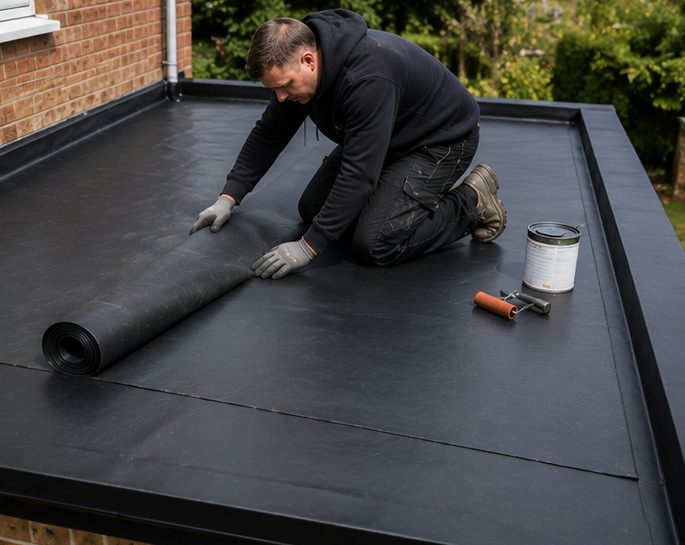
Image above is for illustration purposes only.
Set aside the materials for a moment. The genuine difference between the two approaches is not speed or mess, it is knowledge. A strip tells you the condition of every joist, every bearing and every board, and it lets any fault found be dealt with while the roof is open and the work is cheap. An overlay tells you nothing about any of them and commits you to finding out later.
On a sound roof that information is not worth much, which is exactly why an overlay can be the right answer: there was nothing to find. On a roof with a history of leaks, an uncertain deck, a ceiling that has been stained more than once or a covering that has been patched repeatedly, the information is the most valuable thing available and an overlay throws it away in an afternoon.
Our position is unglamorous. Where the conditions genuinely hold we will say so and the work will be smaller. Where they do not, we will say that too, even though it makes the quotation bigger and occasionally loses the job to somebody who did not open anything. If you want an opinion on which of the two your roof is, get in touch — and please do not go up there to prod it in the meantime.
The rest of the series, on the questions people ask most.
Across Chester, Cheshire, the Wirral and Deeside. Start with the main EPDM rubber roofing page.
“job well done good communication throughout the job very clean and tiddy when the job is finish flat roof replacement many thanks.”
Sumit Bal“I had a leak in my vally had a number of roofers to come and take a look couldn’t find the problem Roofline’s solutions fixed the problem first time. Very happy with these guys thank you for the brilliant service”
Michael Price“Highly recommend. Very quick and efficient. Great communication. Went above and beyond to work the weekend to complete the work that needed to be done. Very happy with the results.”
Karen JonesDescribe the roof and roughly where you are, and we will come back to you — usually the same day. If water is coming in now, please call instead.
Prefer to talk? Call 07464 259566 · WhatsApp 0044 7464 259566 · Email Evensbuddy@yahoo.com
We cover Chester, Cheshire, the Wirral and Flintshire from Elton, just north of Chester.
2 Manley View
Elton
Chester
CH2 4QF
Almost all of our work happens at your property rather than here, so please call before travelling.
Monday – Friday — 24hrs — Emergency Call-Outs
Saturday — 8:00 – 19:00
Sunday — 8:00 – 19:00
Weekday emergency call-outs are answered around the clock. Weekend cover is 8:00 to 19:00.