★★★★★
“I had a leak in my vally had a number of roofers to come and take a look couldn’t find the problem Roofline’s solutions fixed the problem first time. Very happy with these guys thank you for the brilliant service”
Michael Price
Roofline in UPVC across Deeside — houses along the estuary towns and commercial and light industrial units, where the length of the run and the way you reach it change the job more than the material does.
Deeside is two kinds of building on the same stretch of the estuary. There are the streets of houses through Connah’s Quay, Shotton, Queensferry, Garden City and Sealand, and there is the industrial park behind them, which is sheds — portal frame units, trade counters, workshops and yards. Both have a roofline. They are the same four parts doing the same four jobs, at lengths that have nothing in common.
Roofline Solutions works on commercial and light industrial buildings as well as houses. What we can tell you honestly is what that work involves rather than how many of them we have counted, because the useful part for anyone getting quotations is understanding what the surveyor should be looking at before a figure is written down.
On a house the questions are colour, profile and whether the timber is sound. On a unit the material question is usually the easy one and three others come first: how long is the run, what is the water actually draining into, and how is anyone getting up there while the building carries on being used. Those three decide almost everything else.
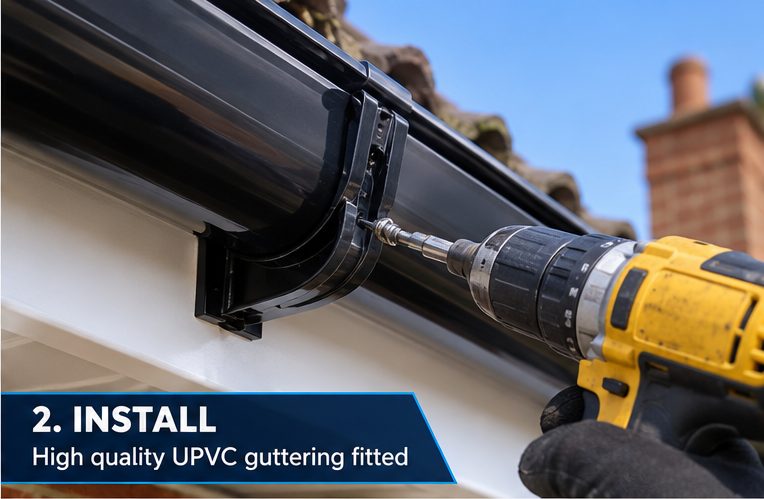
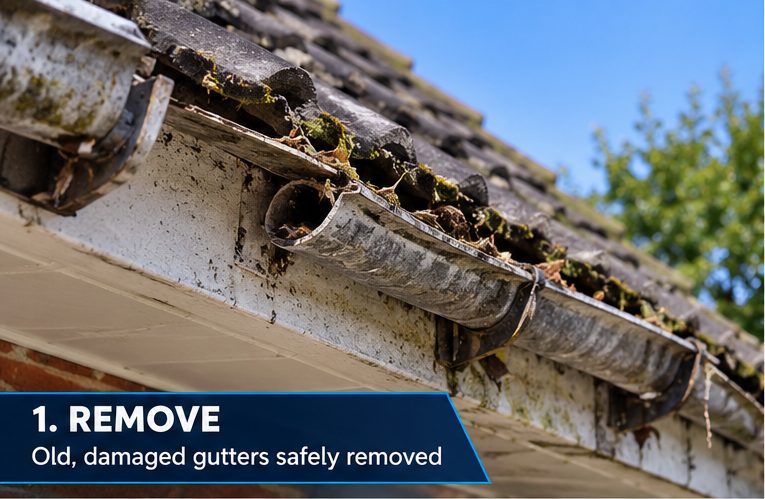
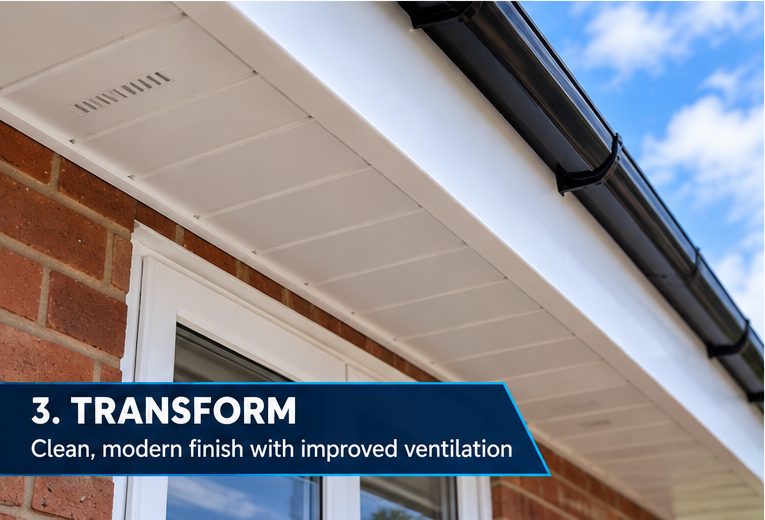
Images above are for illustration purposes only. Photographs of our own work are on the main roofline page and in the gallery.
A domestic eaves run is perhaps eight metres. A unit can be forty or more in one unbroken line, and that changes the engineering rather than just the quantity. Fall has to be set to outlets along the length instead of running the whole way to one end, or the far end sits deep enough to spill over the back. UPVC also moves with temperature: a long line fitted hard up against itself on a cold morning will buckle and lift its brackets on the first hot afternoon, so the unions are set with the expansion gap the profile is marked for rather than pushed home.
The word box gutter causes more confusion on these buildings than anything else. An eaves gutter hangs on the outside edge and UPVC does that job well. A box or valley gutter is the trough that runs between two spans of a multi-bay roof, or behind a parapet, and it is usually a metal or lined trough built into the structure. If that is where the water is getting in, a new eaves gutter will not touch it — that is a different repair in a different material, and the honest thing is to identify which of the two you have before anyone quotes for either.
Then there is getting to it. Height, the surface underneath, and what that surface is being used for all count. A run over a loading bay, a customer car park or a live yard with forklifts moving is not the same job as the same run over grass, even though the metres are identical. It may need a tower, a scaffold or powered access; it may need part of the yard cordoned; it may be better done outside operating hours. Overhead cables and roof plant narrow the options further. We would rather say which of those a job needs while you are still comparing quotations than discover it on the morning.
Inside a steel-framed unit a roofline leak stays hidden longer than it would in a house, because there is a liner and insulation between the problem and anything you can see. By the time it marks the wall at eaves height, tracks down a stanchion or shows as a stain on the underside of the deck, water has been getting in for a while. A damp patch that appears on the first heavy rain after a dry spell is the classic one, because the debris that had dried hard in the run has just been rewetted.
From the yard you can see more than you would think. Plants growing along the gutter line mean there is enough silt up there to hold a seed. A curtain of water coming off at one joint every time it rains, a puddle that always forms in the same place on the concrete, or a stained streak down the cladding below a single point all give you the location without anyone going up. On the housing side the same rules apply at smaller scale — staining on the wall, a run that has lost its line, a downpipe standing off its clips.
On the estate housing around Deeside, capping over the old timber is the decision that comes up most, and it usually comes up because a neighbour has had it done. The question to ask is not what it looks like from the pavement but what the gutter brackets are screwed into afterwards. Fixings that pass through a thin cap into a board that has already softened are holding onto nothing, and the cap hides that from you rather than from the weather.
On a commercial building the same argument shows up in another material. Over-lining a tired box gutter instead of stripping it back works when the trough underneath is sound and fails when it is not, exactly like capping. In both cases the decision turns on the condition of what is left underneath, which is why we take a look at the substrate before saying anything about the covering.
Gutter size on a unit is arithmetic rather than preference. Roof area, the pitch and the rainfall intensity the run has to cope with set the capacity, and the capacity sets the profile, the number of outlets and the number of downpipes. A domestic half round on an industrial roof area will be overtopping in any serious downpour no matter how well it is fitted. Deep flow and industrial sections exist for this and they are the right starting point.
Where the water goes afterwards is usually fixed before we arrive. Existing below-ground connections are where they are, and that often pins down where the outlets can sit. It is worth checking that the drain taking the discharge can actually cope with a run of that length, and worth thinking about shoes that spill across a yard — in a hard winter that is a sheet of ice across the place people walk.
Fascias, soffits, bargeboards, guttering, downpipes, dry verge and eaves ventilation — and the roof above them when it needs attention at the same time.
“I had a leak in my vally had a number of roofers to come and take a look couldn’t find the problem Roofline’s solutions fixed the problem first time. Very happy with these guys thank you for the brilliant service”
Michael Price“Excellent work replacing ridge tiles, repointing chimney and repairing flashing. Also fixed other broken tiles. Clean and tidy job. Would definitely recommend.”
Neil“Excellent workmanship by Buddy Evans. I was impressed and amazed at how quickly the job was done. Obviously due to many years' experience. I've used several mediocre or bad roofers in the past and now I've finally found a good one.”
Czeslaw birukowskWritten for homeowners working out what their roofline actually needs, before anyone comes out.
Every town below has its own page, written around what the houses there are actually like at eaves level.
Describe what is happening and roughly where you are, and we will come back to you — usually the same day. If water is coming in now, please call instead.
Prefer to talk? Call 07464 259566 · WhatsApp 0044 7464 259566 · Email Evensbuddy@yahoo.com
We cover Deeside from our base at Elton, just north of Chester.
2 Manley View
Elton
Chester
CH2 4QF
Almost all of our work happens at your property rather than here, so please call before travelling.
Monday – Friday — 24hrs — Emergency Call-Outs
Saturday — 8:00 – 19:00
Sunday — 8:00 – 19:00
Weekday emergency call-outs are answered around the clock. Weekend cover is 8:00 to 19:00.