★★★★★
“I had a leak in my vally had a number of roofers to come and take a look couldn’t find the problem Roofline’s solutions fixed the problem first time. Very happy with these guys thank you for the brilliant service”
Michael Price
New roofline in UPVC around Neston and Parkgate, including the older stone-built property where the board has to finish dead straight on a wall head that is anything but.
Neston and the villages beside it have a great deal of building stone in them. Local red sandstone turns up as whole cottages, as the lower courses of brick houses, and as garden walls that will outlast everything attached to them. It is a handsome material to live with and it is not, in any sense that matters to a fascia board, a flat one.
The roofline has to finish straight whatever it is fixed to. On a post-war estate house the rafter feet were cut to a line and the board simply follows them. On an older stone-built property there may be no projecting rafter feet at all, and the top of the wall can wander by an inch or more across a single elevation without anybody ever having noticed from the garden.
Roofline Solutions fits UPVC fascias, soffits, bargeboards, guttering and downpipes around Neston, Parkgate and the Dee edge of the Wirral. On older property the material is the easy decision. How the board is packed, levelled and fixed is very nearly the whole job.
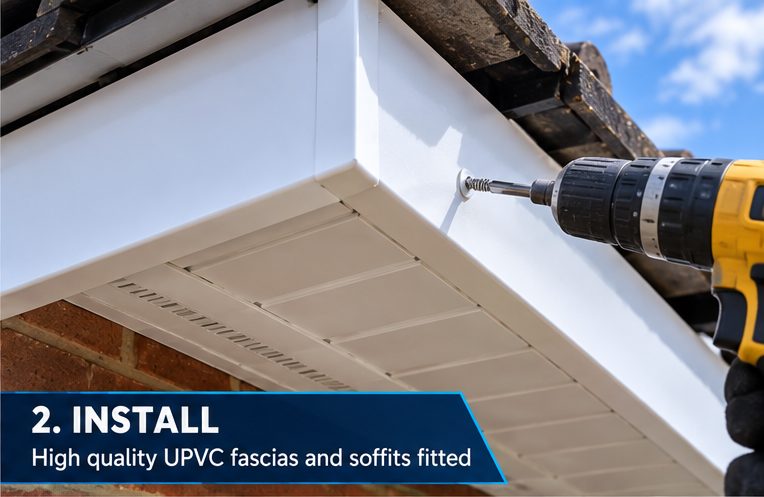
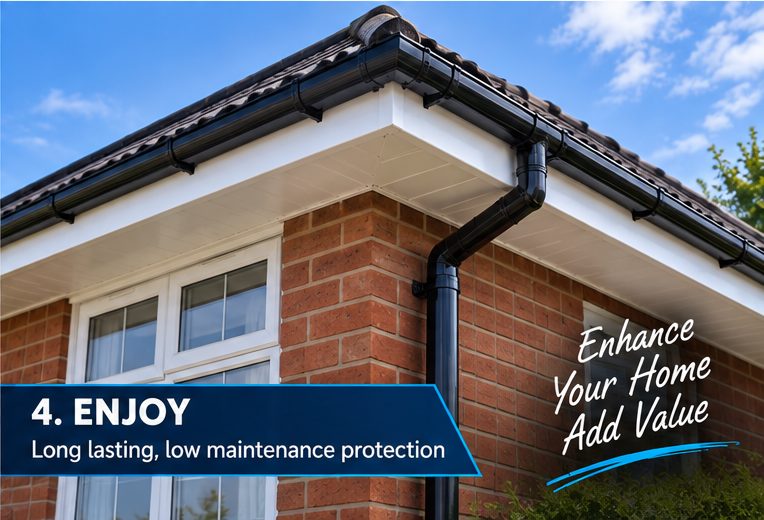
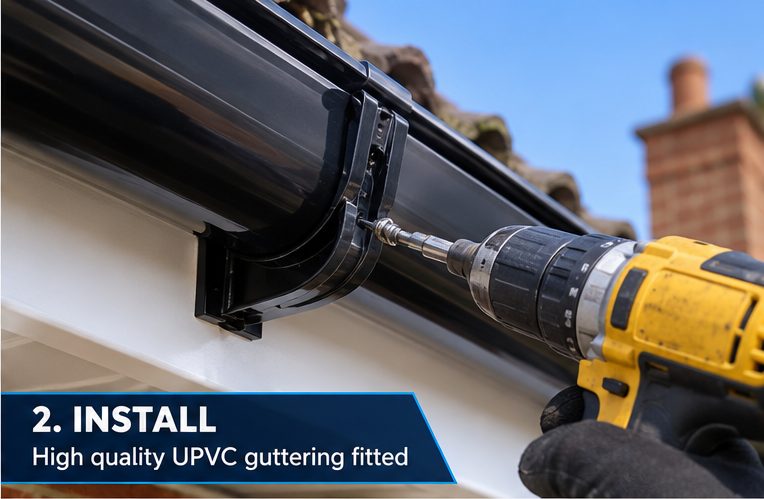
Images above are for illustration purposes only. Photographs of our own work are on the main roofline page and in the gallery.
The first task on a stone-built house is finding out what is actually up there. Sometimes the rafters sit on a wall plate set back behind the face of the wall, sometimes they bear directly onto the stone, and sometimes the old fascia was nailed to a batten that somebody else already packed off the stone a generation ago. None of it is visible until the existing board comes away.
Once it is off, the line is set with a string from one end to the other and the gaps between that string and the wall head are made up with treated timber packers at every fixing point. Packing is not a shortcut; it is the only way a rigid board can hold a straight line across a surface that does not have one. The shortcut is pulling the board into the hollows, which is how a run ends up with three different falls in it.
The fixings change as well. Into rafter ends you are screwing into end grain and choosing a length to suit what is behind. Into a stone wall head you are drilling and plugging, and the anchor has to land in sound stone rather than in a mortar joint that has gone to dust. That is slower per metre, and it is a large part of why an old cottage takes longer than a semi with the same width of frontage.
On a stone house the gutter tends to complain before the board does. Where a fascia has been fixed onto packers that have since rotted, the board stays roughly where it was while the fixings quietly lose their bite, and the run develops a soft sag you can push and feel move. That is a different fault from a fascia that has rotted through, and it is put right differently.
Then look at the stone directly beneath any gutter joint. Sandstone is porous and it keeps a good record of water: a patch that never dries, a green bloom, or a line where the face has eroded back below one union all tell you where the overflow has been going for years. The gutter is the cause, but by then the wall has a problem of its own and cleaning it will not bring the face back. Worth noting too that stone dries slowly, so a patch can stay dark for a week after the gutter above it has been put right.
Capping assumes there is a sound, flat board there to cap. On older property around here that assumption is the thing most often wrong. The existing fascia is frequently a heavy softwood section, dead flat in no direction at all, sitting on packers of unknown age, and a thin UPVC skin over it produces a new face that faithfully follows every fault underneath.
So on stone-built and older brick houses we lean towards taking everything back, and we would rather explain why than simply quote it that way. Stripping off is the one moment when the wall head, the rafter feet and the state of the eaves can all be seen together. On a modern house in the same town the answer may well go the other way, and where the timber is sound we will tell you that just as readily.
Fall is what gets lost on an uneven wall. Guttering needs a steady drop towards its outlet, and if the board it hangs from is following a wavy wall head there is nowhere steady to hang it from. Get the board straight and the gutter becomes the simple part of the day; leave the board wavy and no amount of adjusting brackets afterwards will rescue the run.
Ogee and cast-iron effect sections both sit comfortably on older property if you want something with more shape to it than half round, and black reads better against red sandstone than white does. That is taste rather than performance, and it is worth holding a sample up against the actual wall in daylight before anything is ordered. Stone shifts colour a great deal between a wet morning and a dry afternoon, and a board chosen indoors rarely looks the same once it is up.
Fascias, soffits, bargeboards, guttering, downpipes, dry verge and eaves ventilation — and the roof above them when it needs attention at the same time.
“I had a leak in my vally had a number of roofers to come and take a look couldn’t find the problem Roofline’s solutions fixed the problem first time. Very happy with these guys thank you for the brilliant service”
Michael Price“Excellent work replacing ridge tiles, repointing chimney and repairing flashing. Also fixed other broken tiles. Clean and tidy job. Would definitely recommend.”
Neil“Excellent workmanship by Buddy Evans. I was impressed and amazed at how quickly the job was done. Obviously due to many years' experience. I've used several mediocre or bad roofers in the past and now I've finally found a good one.”
Czeslaw birukowskWritten for homeowners working out what their roofline actually needs, before anyone comes out.
Every town below has its own page, written around what the houses there are actually like at eaves level.
Describe what is happening and roughly where you are, and we will come back to you — usually the same day. If water is coming in now, please call instead.
Prefer to talk? Call 07464 259566 · WhatsApp 0044 7464 259566 · Email Evensbuddy@yahoo.com
We cover Neston from our base at Elton, just north of Chester.
2 Manley View
Elton
Chester
CH2 4QF
Almost all of our work happens at your property rather than here, so please call before travelling.
Monday – Friday — 24hrs — Emergency Call-Outs
Saturday — 8:00 – 19:00
Sunday — 8:00 – 19:00
Weekday emergency call-outs are answered around the clock. Weekend cover is 8:00 to 19:00.