★★★★★
“I had a leak in my vally had a number of roofers to come and take a look couldn’t find the problem Roofline’s solutions fixed the problem first time. Very happy with these guys thank you for the brilliant service”
Michael Price
New UPVC roofline for Heswall, where plots fall away towards the Dee and the real question is usually not the gutter itself but where the water leaves the house and whose ground it lands on.
Heswall is built on a hill. The ground drops from the ridge towards the Dee the whole way through the town, and the houses are stepped down it — terraced gardens, retaining walls, drives that climb, and neighbours who sit a full storey above or below you. It makes for good views and awkward rainwater, because water leaving a roof up here does not simply soak away where it lands.
That is why roofline work in Heswall so often turns into a conversation about downpipes. A run of gutter can be in reasonable order and still be sending several hundred litres an hour to a point that cannot take it: the head of a retaining wall, a rockery, a path that slopes towards a boundary, or a neighbour's drive sitting lower than your own garden. The gutter is doing its job; the trouble starts at the bottom of the pipe.
Roofline Solutions replaces fascias, soffits, bargeboards, guttering and downpipes throughout the Wirral, and on a sloping plot we would rather work out where the water is going before anybody prices the boards. We are fully insured, the quotation is free, and if the answer is that the pipework wants moving as well as renewing, we will say so at the quotation stage.
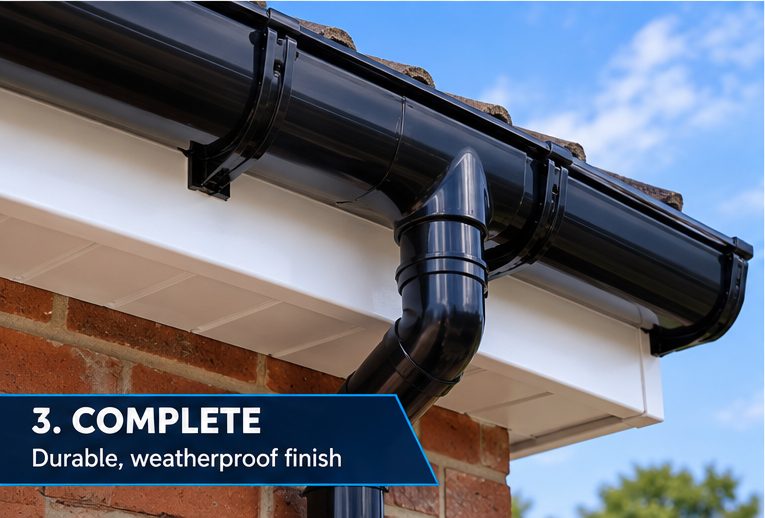

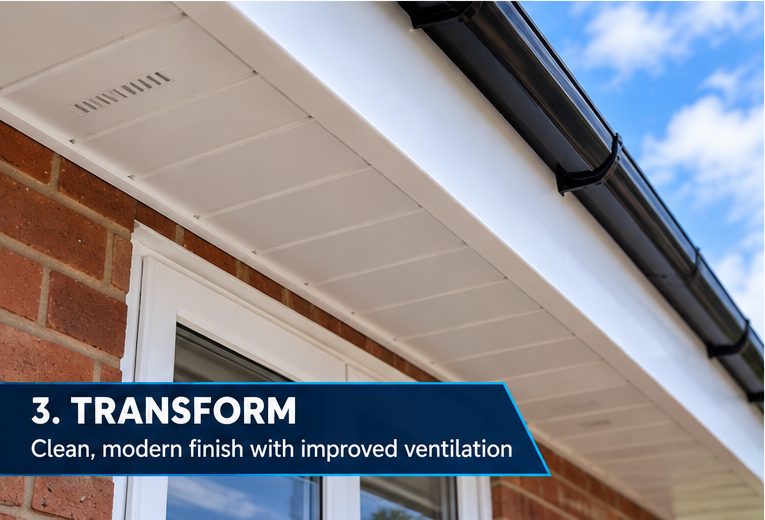
Images above are for illustration purposes only. Photographs of our own work are on the main roofline page and in the gallery.
On a flat street every downpipe drops within a metre of a gully and nobody thinks about it again. On a stepped plot the ground beneath the eaves might be the top of a retaining wall, a set of steps, a raised border or the roof of a garage built into the bank. Put a shoe there and the discharge runs across the surface until it finds the lowest point, which is frequently the boundary. Over a few winters that is what washes out mortar at the foot of a wall and leaves a permanently green strip down one side of a garden.
Where the water crosses a boundary it stops being purely a roofing question. Discharging rainwater onto land that is not yours is a matter between neighbours and, if it has been going on a long time, sometimes more than that; we are not the people to advise you on that side of it. What we can say is that if a pipe is going to be repositioned, or a new outlet put in that sends water somewhere it has not gone before, it is far easier to mention it to whoever is downhill of you first than to have the conversation afterwards.
Moving water on a sloping site is usually less work than people expect, because the cheapest change is to the gutter rather than the pipe. The fall of a run is set towards its outlet, so relocating the outlet to the other end of an elevation moves the whole discharge point without a single extra metre of pipe on the wall. Where the pipe itself has to travel, it can often be taken round a corner with offsets and run down a flank wall to an existing gully, or dropped to a back-inlet gully that takes it into the drain instead of leaving it on the surface.
Look at the ground and the walls rather than the gutter. A dark vertical band of moss on a retaining wall, a bare patch in a border that never recovers, moss on a path that is green all year, or spatter marks up a boundary wall to knee height all say that water is arriving there regularly and with force. Silt or grit fanned out across a slabbed area after heavy rain is the same signal, and it tells you roughly where the discharge point is even if the pipe is round the corner.
On the house itself, watch what happens in a downpour rather than in drizzle. Water running down the outside face of the fascia, or tracking along the underside of the gutter and dripping in a line rather than at one point, usually means the fall has gone or the back edge is letting water past. A gully at the bottom of a slope that stands full for an hour after the rain has stopped is taking more than it can shift, and adding another roof to it will make that worse rather than better.
The argument for capping over existing timber is that it saves the labour of stripping out, and on a Heswall house that argument is weaker than usual because the access is the expensive part, not the tearing off. If a tower or scaffold has to be built on sloping ground or tied over a drop to reach one elevation, the cost of that stands whether the old fascia comes off or stays, so covering sound-looking timber to save an hour rarely pays.
It is also the elevations that are hardest to reach that tend to be worst. The side facing down the slope gets the most weather and the least attention, and it is the one nobody has had a proper look at in twenty years. We take the gutter off, look at the rafter ends and the back of the board, and tell you whether that side is a recover or a replacement before a price is put to any of it.
Gutter sizing matters more on a big roof than a small one, and Heswall has plenty of long runs on houses that were extended sideways at some point. Every square metre of roof above a run has to leave through one outlet unless you put in a second, and the point where a run stops coping is not gradual — it copes, then it overshoots, usually at the low corner. Deep flow sections and a second outlet are the two ways out of that, and which one suits depends on the roof and on where a pipe can sensibly go.
The bottom of the pipe deserves as much thought as the top. A shoe discharging onto a hard surface that slopes the wrong way simply relocates the problem to the boundary; a pipe taken into a back-inlet gully with a grating keeps leaf litter out of the drain and puts the water underground where it belongs. On a stepped plot it is sometimes possible to run the pipe down to a lower level and connect there, which is worth looking at while the scaffold is standing rather than as a separate visit later.
Fascias, soffits, bargeboards, guttering, downpipes, dry verge and eaves ventilation — and the roof above them when it needs attention at the same time.
“I had a leak in my vally had a number of roofers to come and take a look couldn’t find the problem Roofline’s solutions fixed the problem first time. Very happy with these guys thank you for the brilliant service”
Michael Price“Excellent work replacing ridge tiles, repointing chimney and repairing flashing. Also fixed other broken tiles. Clean and tidy job. Would definitely recommend.”
Neil“Excellent workmanship by Buddy Evans. I was impressed and amazed at how quickly the job was done. Obviously due to many years' experience. I've used several mediocre or bad roofers in the past and now I've finally found a good one.”
Czeslaw birukowskWritten for homeowners working out what their roofline actually needs, before anyone comes out.
Every town below has its own page, written around what the houses there are actually like at eaves level.
Describe what is happening and roughly where you are, and we will come back to you — usually the same day. If water is coming in now, please call instead.
Prefer to talk? Call 07464 259566 · WhatsApp 0044 7464 259566 · Email Evensbuddy@yahoo.com
We cover Heswall from our base at Elton, just north of Chester.
2 Manley View
Elton
Chester
CH2 4QF
Almost all of our work happens at your property rather than here, so please call before travelling.
Monday – Friday — 24hrs — Emergency Call-Outs
Saturday — 8:00 – 19:00
Sunday — 8:00 – 19:00
Weekday emergency call-outs are answered around the clock. Weekend cover is 8:00 to 19:00.