★★★★★
“I had a leak in my vally had a number of roofers to come and take a look couldn’t find the problem Roofline’s solutions fixed the problem first time. Very happy with these guys thank you for the brilliant service”
Michael Price
New UPVC roofline in Wallasey, including houses still carrying their original cast iron guttering — what taking it down properly involves, and why it is not a job to start on your own with a ladder.
A great deal of Wallasey went up before the war, and on a surprising number of those houses the original guttering is still there. Cast iron ogee on rise-and-fall brackets, or half round on brackets spiked into the mortar joints, painted over so many times that the mouldings have gone soft under the layers. It is heavy, it is well made, and when it is sound it does the job it was designed for perfectly well.
What usually finishes it is not the iron itself but everything around it: the joints, where the bolt and the bedding compound give up and the section starts weeping down the wall; the back of the gutter, which rusts from the inside where silt has sat wet for decades; and the timber fascia behind, which has been taking the drips. By the time somebody rings us, the iron is generally not the only thing that needs dealing with.
Roofline Solutions replaces roofline in UPVC across the Wirral and takes the old ironwork away when we go. On a house like this the work is as much about getting the existing gutter down safely and finding out what is behind it as it is about fitting the new. We are fully insured, and we look at what is there before quoting anything.
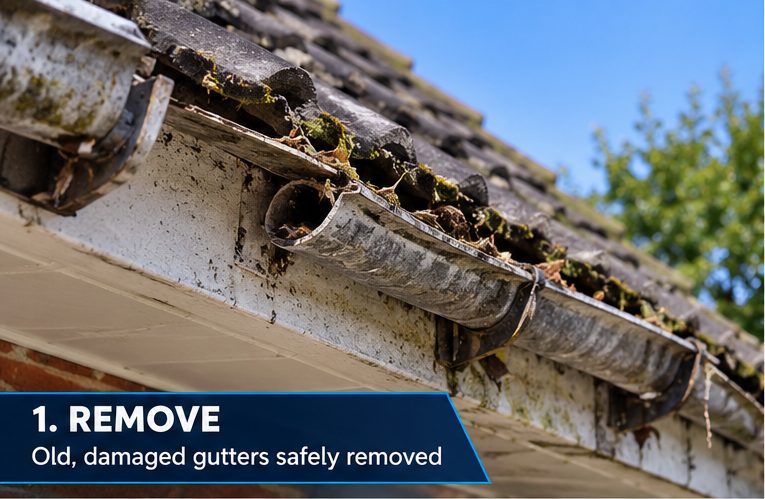
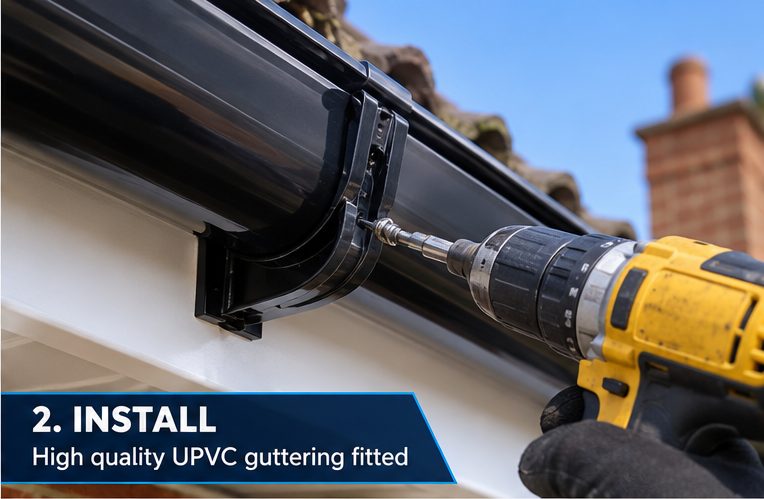
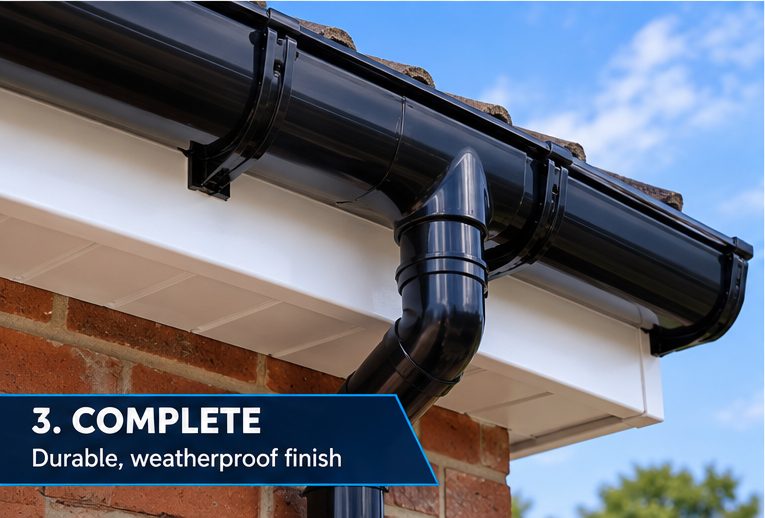
Images above are for illustration purposes only. Photographs of our own work are on the main roofline page and in the gallery.
Start with the weight, because it is the thing people underestimate. A six-foot length of cast iron ogee is a two-handed lift standing on the ground and a genuinely awkward one at eaves height, and a section that has not been cleared in years is carrying a slab of wet silt, moss and grit inside it as well. That load has to come down under control, on a rope or hand to hand, not dropped onto a path or a conservatory roof. It is the reason this is never a one-person job on our vans.
Then the joints. Each length is bolted to the next with a single bolt through the overlap, bedded on putty or mastic that set hard before most of us were born. After decades outdoors that bolt is seized solid, and trying to undo it usually shears the head off or cracks the flange. We cut it instead. Only once the joints are released does a run come apart in the lengths it was built in — and until that point the whole run is one connected weight, which is why levering at one end is such a bad idea.
The brackets tell you what you are dealing with behind the gutter. Rise-and-fall brackets screwed through a timber fascia mean there is a board to inspect and probably to replace. Brackets spiked into the brickwork joints mean there may be no fascia at all, and the new roofline needs timber put up before any plastic goes on. Expect the old paint to be flaking, and be aware that paintwork of that age can contain lead, so it is not something to sand back or burn off in a back garden. We take the iron with us when we leave rather than stacking it by the gate.
Iron fails from the inside outwards, so the run can look solid from the pavement while the back of it is paper-thin. The signals are a rust-coloured weep at a joint that never dries, a brown stain fanning down the brickwork below one particular overlap, flaking scale visible on the inside face when you look along the gutter, and daylight at a hairline crack — often the result of a hard frost on a section that was holding water because the fall had gone. A bracket that has rusted through will let one end of a length drop out of line.
Not everything justifies replacement, and it is fair to say so. Cast iron in reasonable condition can be cleared, re-bolted with new bedding at the weeping joints, wire-brushed and repainted, and it will carry on. What tips it the other way is thinning metal, cracked sections, brackets that no longer hold, or a timber fascia behind that has gone soft — because that board has to come off anyway, and taking the iron down twice makes no sense.
Capping over existing timber is a common offer and on this housing it is often simply not available. Plenty of Wallasey houses never had a fascia in the modern sense: the gutter brackets were driven straight into the brick course below the tiles, and there is nothing behind the iron to cap. Others have a fascia that has spent decades under a leaking iron joint, and the thin plastic board over the top of that hides a problem rather than ending it.
What we do instead on those houses is put up new timber to carry the roofline, fix a full replacement fascia to it, and hang the gutter off that. It is more work than capping and we will not pretend otherwise, but it gives the brackets something to hold and it means the eaves are sealed and ventilated properly rather than boxed in. Where the original board has survived in good order, we will tell you that too.
The replacement does not have to look like plastic pretending to be plastic. Cast-iron effect ogee in UPVC copies the moulded front face of the original section, and on a pre-war Wallasey frontage it keeps the shadow line the house was designed with, which plain half round does not. It weighs a small fraction of what came off, it does not need painting, and it clips together with proper seals instead of bolts and putty.
Getting the new run right is then about brackets and fall. Brackets go at close, regular centres into solid board rather than at the spacing the old iron used, because the iron was largely holding itself up and plastic is not. The fall is set to the outlet by string line, not by eye. Downpipes normally go back into the same positions, since the gullies are where they are, and where the original was iron the new pipe is clipped to the wall on fresh fixings rather than reusing rusted ones.
Fascias, soffits, bargeboards, guttering, downpipes, dry verge and eaves ventilation — and the roof above them when it needs attention at the same time.
“I had a leak in my vally had a number of roofers to come and take a look couldn’t find the problem Roofline’s solutions fixed the problem first time. Very happy with these guys thank you for the brilliant service”
Michael Price“Excellent work replacing ridge tiles, repointing chimney and repairing flashing. Also fixed other broken tiles. Clean and tidy job. Would definitely recommend.”
Neil“Excellent workmanship by Buddy Evans. I was impressed and amazed at how quickly the job was done. Obviously due to many years' experience. I've used several mediocre or bad roofers in the past and now I've finally found a good one.”
Czeslaw birukowskWritten for homeowners working out what their roofline actually needs, before anyone comes out.
Every town below has its own page, written around what the houses there are actually like at eaves level.
Describe what is happening and roughly where you are, and we will come back to you — usually the same day. If water is coming in now, please call instead.
Prefer to talk? Call 07464 259566 · WhatsApp 0044 7464 259566 · Email Evensbuddy@yahoo.com
We cover Wallasey from our base at Elton, just north of Chester.
2 Manley View
Elton
Chester
CH2 4QF
Almost all of our work happens at your property rather than here, so please call before travelling.
Monday – Friday — 24hrs — Emergency Call-Outs
Saturday — 8:00 – 19:00
Sunday — 8:00 – 19:00
Weekday emergency call-outs are answered around the clock. Weekend cover is 8:00 to 19:00.