★★★★★
“I had a leak in my vally had a number of roofers to come and take a look couldn’t find the problem Roofline’s solutions fixed the problem first time. Very happy with these guys thank you for the brilliant service”
Michael Price
New roofline in UPVC across Flint — fascias, soffits, bargeboards and guttering fitted to rendered and pebbledashed walls, where what the fixings land in matters as much as what the boards look like.
A large share of the housing in Flint is rendered or pebbledashed rather than faced in brick, and that single fact changes a roofline job more than most people expect. It is not about appearance. It is about what the fixings go into at the top of the wall, and about how little forgiveness a rendered surface has when someone gets that wrong.
Roofline Solutions fits new UPVC fascias, soffits, bargeboards, guttering and downpipes across Flint and the surrounding villages. Colour, profile and gutter size are chosen on site as they are anywhere, but on a rendered house there is an extra survey question that comes before all of them: how is the existing roofline held on, and is the wall head underneath it still sound.
That question splits Flint houses into two groups, and the difference is visible from the pavement. Some have a proper overhang, with the fascia fixed to the ends of the rafters and a soffit spanning back to the wall. Others have barely any overhang at all, and on those almost everything is carried by the top of the wall itself. The second kind takes longer and needs more care.
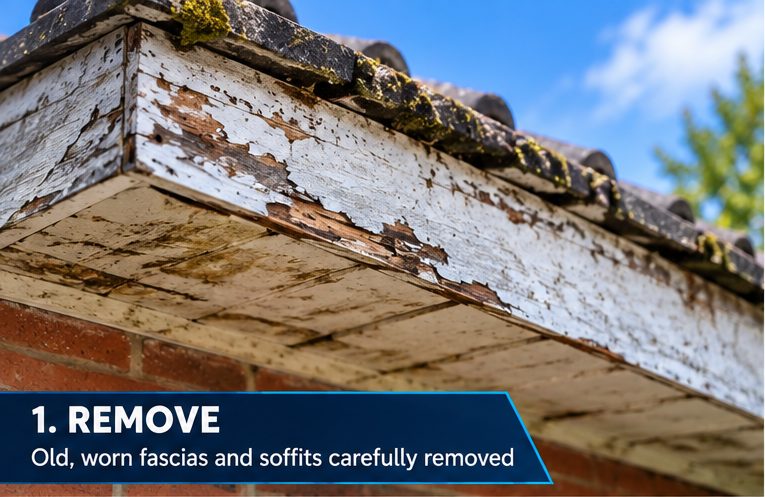
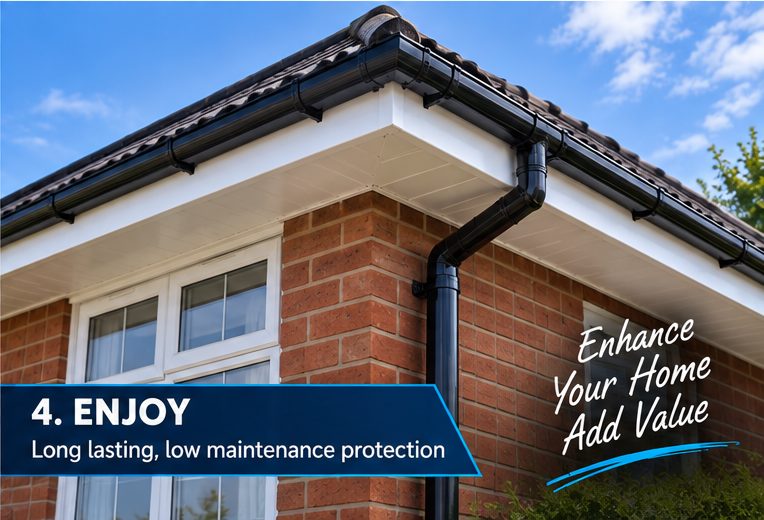
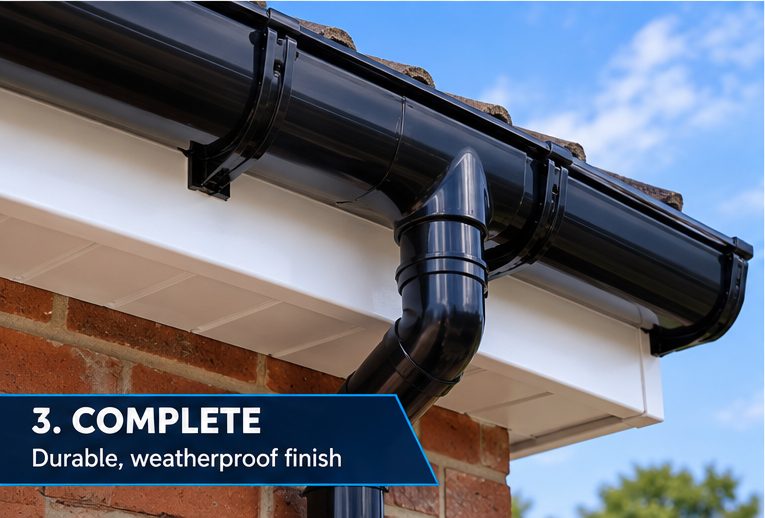
Images above are for illustration purposes only. Photographs of our own work are on the main roofline page and in the gallery.
Where a house has an overhang, the fascia is screwed into the rafter feet, which is timber into timber and straightforward once the old boards are off. The soffit is the part that meets the wall, usually landing on a timber batten plugged into the masonry behind the render. Where a house has a flush or clipped eaves, the rafters stop at the wall and there is little or nothing to fix to except the wall head, so the render is in the load path whether anyone wanted it to be or not.
That is where the care is needed. A plug set in render rather than in the block or brick behind it has very little grip — render can be twenty millimetres or more, and where it has blown it is hollow for a good deal further. The fixing has to reach solid material, which means knowing the depth before drilling rather than after. Pebbledash adds its own problem: hammer action on a dashed face blows the surface off around the hole, and nobody can match the colour or the stone gradation of a dash put on decades ago. The patch always shows.
So the detailing aims to avoid disturbing render at all. The joint where a new soffit meets the wall is closed with a trim and sealed rather than cut into a chase. Fixing positions are set where the wall is sound, which is worth tapping for first, because a wall head that has had a leaking gutter over it for years is very often drummy along that top course. If the render there has already let go, it needs attention before boards go over it, and we would tell you that rather than quietly screwing through it.
Render tells on a failing gutter far more plainly than brick does. A dark vertical band running down from one joint, a green algae bloom in the same line, or a white salty haze where water has been passing through the render and drying out are all the same message. On painted render you get blistering and flaking in a band beneath the gutter, and the paint comes away in sheets because the wall behind it has not been dry for months.
At eaves level, look for a horizontal crack along the top of the wall, or render that sounds hollow when tapped up there. A fascia that has dropped will often have taken the top edge of the render with it. Gaps opening where the soffit meets the wall are worth noticing early for another reason as well — birds and wasps find them quickly, and once something is nesting in the eaves the work has to wait.
Capping over on a rendered house has a consequence people do not expect. A cap adds its own thickness to the front of the existing board, so the gutter ends up sitting further out from the wall than it did. On a house with a generous overhang that is neither here nor there. On a flush eaves it can push the gutter line past the face of the render and change where water coming off the tiles actually lands.
The deeper objection is the same one as anywhere: it leaves the original board in place and doing the work. Where nearly everything is anchored into the wall head, capping does nothing at all about fixings that were driven into render in the first place, and those are usually the reason the run has come loose. We strip back to what is solid and fix into what will hold, which on a rendered wall sometimes means longer fixings than the last installer used.
Getting the fall right matters more on render than on brick, because render shows every overflow and punishes prolonged wetting. Brackets go at proper centres into the fascia, and on a flush eaves where there is no fascia to speak of, rise-and-fall brackets fixed into the wall head do the job instead — set carefully, because every one of them is a hole in the render. Fewer, sounder fixings beat a row of shallow ones.
Downpipes get the same treatment. Pipe clips have to reach masonry rather than stopping in the render, and the pipe is better held slightly off the face so that air can move behind it and the wall can dry after rain. A pipe screwed hard against a rendered wall keeps a damp stripe behind it all winter, and that is where the render lets go first.
Fascias, soffits, bargeboards, guttering, downpipes, dry verge and eaves ventilation — and the roof above them when it needs attention at the same time.
“I had a leak in my vally had a number of roofers to come and take a look couldn’t find the problem Roofline’s solutions fixed the problem first time. Very happy with these guys thank you for the brilliant service”
Michael Price“Excellent work replacing ridge tiles, repointing chimney and repairing flashing. Also fixed other broken tiles. Clean and tidy job. Would definitely recommend.”
Neil“Excellent workmanship by Buddy Evans. I was impressed and amazed at how quickly the job was done. Obviously due to many years' experience. I've used several mediocre or bad roofers in the past and now I've finally found a good one.”
Czeslaw birukowskWritten for homeowners working out what their roofline actually needs, before anyone comes out.
Every town below has its own page, written around what the houses there are actually like at eaves level.
Describe what is happening and roughly where you are, and we will come back to you — usually the same day. If water is coming in now, please call instead.
Prefer to talk? Call 07464 259566 · WhatsApp 0044 7464 259566 · Email Evensbuddy@yahoo.com
We cover Flint from our base at Elton, just north of Chester.
2 Manley View
Elton
Chester
CH2 4QF
Almost all of our work happens at your property rather than here, so please call before travelling.
Monday – Friday — 24hrs — Emergency Call-Outs
Saturday — 8:00 – 19:00
Sunday — 8:00 – 19:00
Weekday emergency call-outs are answered around the clock. Weekend cover is 8:00 to 19:00.