★★★★★
“I had a leak in my vally had a number of roofers to come and take a look couldn’t find the problem Roofline’s solutions fixed the problem first time. Very happy with these guys thank you for the brilliant service”
Michael Price
Roofline replacement in UPVC for Hoylake houses that take their weather straight off the estuary — fascias, soffits, bargeboards and guttering specified for the exposed elevation rather than the sheltered one.
Hoylake stands where the Dee estuary opens into the Irish Sea, and the weather here arrives off water rather than over land. One elevation of a house takes nearly all of it — rain driven flat, sand lifted off the shore, salt carried inland on the wind — while the sheltered side of the same roof can look a decade younger. The roofline is where that difference shows up first, because it is the only part of the house with no shelter above it.
Salt does not attack UPVC the way it attacks steel, but it settles in the joints, along the back of the gutter and in the gap where the soffit meets the wall, and it keeps that gap damp long after the rain has stopped. Anything ferrous sitting in it gives way: a plated screw, an old gutter bracket, a nail left in a rafter end. The rust goes into the board around it and stains white plastic in a way no amount of washing lifts.
Roofline Solutions fits new fascias, soffits, bargeboards, guttering and downpipes across the Wirral from a base at Elton, north of Chester. On a coastal house the specification is worth settling before anyone starts rather than afterwards, so we look at the timber and the fixings on both sides of the house and quote on what we find. We are fully insured, and the quotation costs nothing.
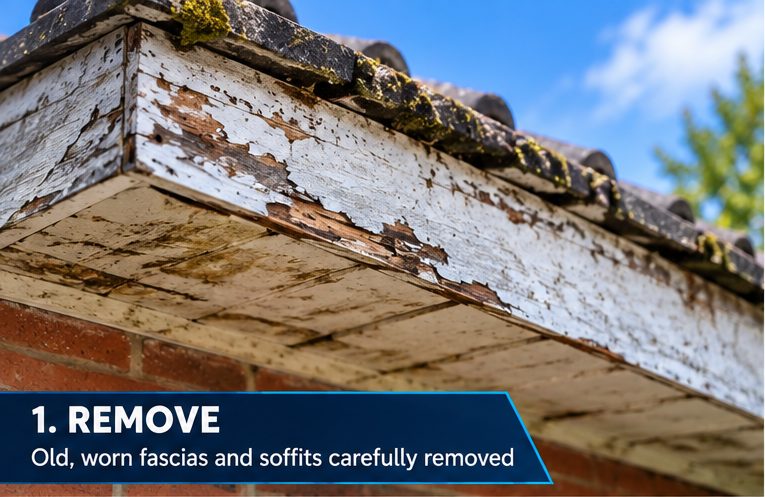
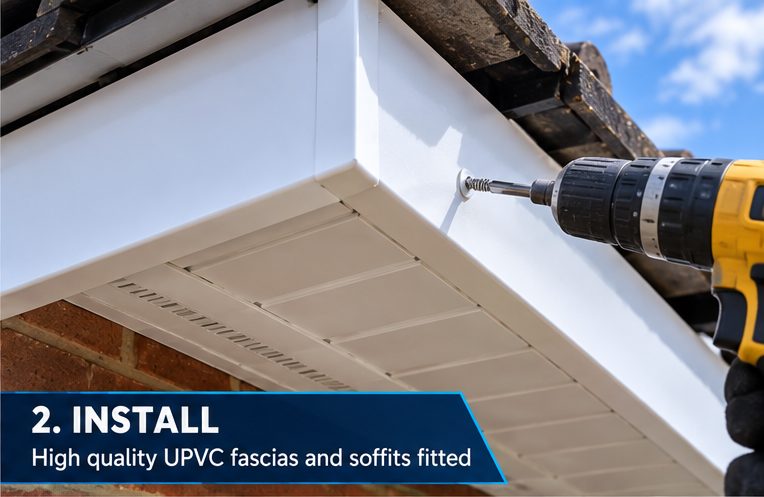
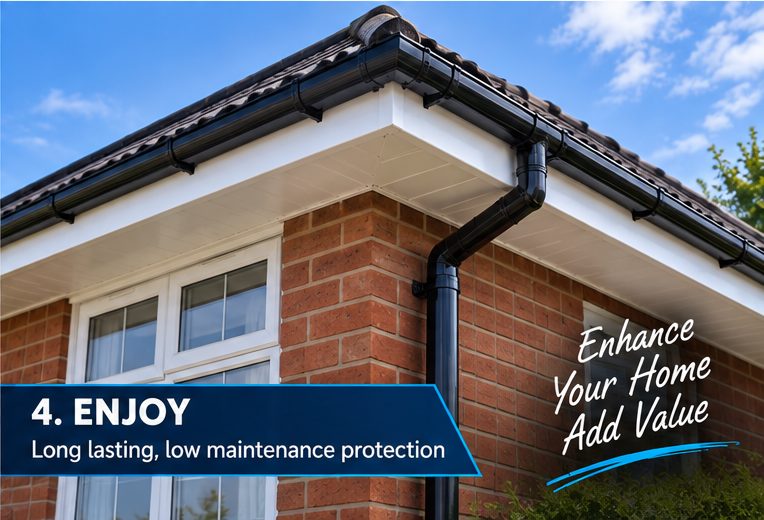
Images above are for illustration purposes only. Photographs of our own work are on the main roofline page and in the gallery.
Every UPVC board on a house is held up by its fixings, and within reach of salt air the fixings decide how the job ages more than the plastic does. Stainless steel pins and screws are the only sensible choice this close to the water. A plated fixing looks identical the day it goes in and then bleeds a brown line down a white fascia by the second or third winter, and once that has started the board is marked for good even though nothing structural has failed. It is a small difference in materials and a large one in how the front of the house looks.
Colour is the second question we get asked here. White UPVC is the most stable finish there is and it dulls very slowly, though on a west-facing wall the surface can chalk — run a finger along it and a fine white powder comes away. Anthracite grey, black and the woodgrain finishes are laminated foils rather than pigment through the sheet, which holds colour far better than the coloured plastics of thirty years ago, but a dark board facing the estuary and the afternoon sun still moves further than the identical board round the back. If you are adding to work done on the rear a few years ago, expect the new and the old to read slightly differently.
Then there is the wind. A gale coming off the water does not press on the house so much as get underneath it, lifting at the eaves and finding any panel that is not properly held. A soffit fixed at too wide a spacing will flex and drum on a rough night, and torn eaves felt behind the gutter lets wind-driven rain track back over the wall head instead of into the gutter. Both are worth dealing with while the boards are off, because neither is reachable once the new roofline is closed up.
The usual first sign is a stain rather than a break: a rust streak running down from one point on the fascia, or a green-black bloom on the render below a gutter joint that drips in every shower. On the exposed side the boards go dull before they go anywhere else, and a run of white fascia that has gone matt and slightly rough to the touch has been taking spray for a long time. None of that is urgent on its own, but it tells you which elevation to look at properly.
What matters more is behaviour in bad weather. If a gutter copes with steady winter rain and then floods over the front door during a squall, the problem is usually the volume arriving sideways off the roof rather than a blockage, and clearing it out will not change anything. A soffit that rattles in the wind, a bargeboard that has worked loose at the apex, or water appearing on the inside of a gable wall after a storm from one particular direction are all reasons to have somebody look before the next one.
Capping is a thin UPVC board laid over the existing timber, and whether it is honest work depends entirely on what the timber is doing. On the sheltered elevation of a Hoylake house it often is sound, and covering it is a reasonable job. On the side facing the estuary it is far less likely, because the board that has been soaking up driven rain for years is the one you cannot see the back of. Sealing wet timber behind plastic does not dry it out.
What decides it is the condition of the rafter ends and the back face of the fascia, and both of those need the gutter off to see. We would rather look at that first and tell you the house needs two different answers on two different sides than quote one specification for the whole building. Where the timber has gone, new bearers go on before any plastic does, so the gutter brackets end up screwed into something solid.
On an exposed coastal elevation the gutter has a harder job than its size suggests, because rain hitting a pitched roof at an angle runs off faster and concentrates at the low end. A standard half round run that is perfectly adequate at the back of the house can overshoot at the front, and the fix is usually a deeper section, a second outlet, or moving the outlet so the run is split rather than draining everything to one corner. It is a decision made by looking at the roof area above each run, not by habit.
Downpipes near the sea also collect what the wind brings: fine sand, salt crust and the grit that comes off an ageing roof covering. A shoe at the bottom that discharges onto a path rather than into a gully will silt up the surface drain in front of it, and a swan neck with a tight offset is where that material stops moving. Brackets, clips and the screws holding them are the same story as the fascia fixings — stainless, or you will see them in a couple of winters.
Fascias, soffits, bargeboards, guttering, downpipes, dry verge and eaves ventilation — and the roof above them when it needs attention at the same time.
“I had a leak in my vally had a number of roofers to come and take a look couldn’t find the problem Roofline’s solutions fixed the problem first time. Very happy with these guys thank you for the brilliant service”
Michael Price“Excellent work replacing ridge tiles, repointing chimney and repairing flashing. Also fixed other broken tiles. Clean and tidy job. Would definitely recommend.”
Neil“Excellent workmanship by Buddy Evans. I was impressed and amazed at how quickly the job was done. Obviously due to many years' experience. I've used several mediocre or bad roofers in the past and now I've finally found a good one.”
Czeslaw birukowskWritten for homeowners working out what their roofline actually needs, before anyone comes out.
Every town below has its own page, written around what the houses there are actually like at eaves level.
Describe what is happening and roughly where you are, and we will come back to you — usually the same day. If water is coming in now, please call instead.
Prefer to talk? Call 07464 259566 · WhatsApp 0044 7464 259566 · Email Evensbuddy@yahoo.com
We cover Hoylake from our base at Elton, just north of Chester.
2 Manley View
Elton
Chester
CH2 4QF
Almost all of our work happens at your property rather than here, so please call before travelling.
Monday – Friday — 24hrs — Emergency Call-Outs
Saturday — 8:00 – 19:00
Sunday — 8:00 – 19:00
Weekday emergency call-outs are answered around the clock. Weekend cover is 8:00 to 19:00.