★★★★★
“I had a leak in my vally had a number of roofers to come and take a look couldn’t find the problem Roofline’s solutions fixed the problem first time. Very happy with these guys thank you for the brilliant service”
Michael PriceSometimes the gutter really is the only thing wrong, and replacing it alone is the right call. The question is what the brackets are screwed into, because that is what decides whether the new run stays where you put it.
Guttering is not fixed to the house. It is fixed to the fascia board, and the fascia is fixed to the ends of the rafters. That chain is why a gutter question so often turns into a board question: the run can be perfect and still be pulling slowly away from the building, because the screws holding it are in timber that no longer grips.
So the useful version of "can I just do the gutter" is: what will the new brackets be screwed into, and is that thing sound? Where the answer is yes, a gutter-only job is entirely reasonable work and there is no reason to spend more. Where the answer is no, the new gutter is a cosmetic improvement with a short life and you will pay for the access twice.
There is a second, quieter cost to getting this wrong. If the fascia is later capped or replaced, the gutter has to come off again — on a capped board it is the gutter that helps hold the new board on. A gutter fitted this year and removed next year is not ruined, but the labour is spent twice over and the fittings rarely all survive.
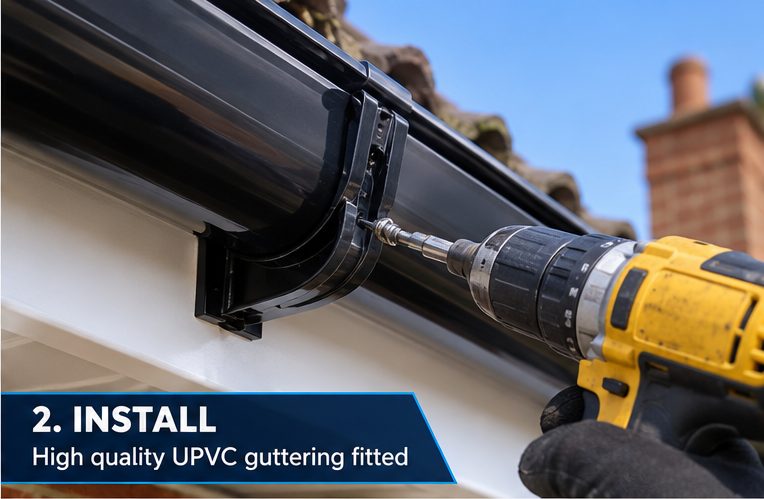
The clearest case is a house whose fascias are already UPVC and still in good order, with a gutter that has simply come to the end of its life. Older plastic goes brittle, crazes along the top edge and cracks at the clips, particularly on a south-facing elevation. The board behind it can be perfectly serviceable while the gutter is past it.
Damage is another. A cracked length from a fallen branch or a ladder put against the gutter rather than the wall, a stop end knocked off, a run that came down in a gale — that is a repair or a replacement run, not a roofline job.
Then there are the deliberate changes. Moving up a profile because the existing run cannot carry what an extension added to the roof. Adding a second outlet so a long elevation drains both ways. Changing colour because new windows have gone in and a white gutter now looks out of place above them. All of those are gutter decisions, and none of them require the boards to be touched provided the boards are sound.
And there is the case of a house re-roofed recently where new fascias went on at the same time. If the boards are only a few years old and the gutter was reused rather than renewed — which happens more than you would think — replacing the run alone is exactly right.
The commonest wasted job in this trade is a new gutter screwed into an old softwood fascia that has gone soft behind it. It is wasted because the failure everyone is trying to cure was never the gutter. Water has been getting behind the run for years, the back of the board has been wet for most of that time, and the brackets have been slowly opening up their own screw holes.
A new run on that board will look excellent for a season. Then the same brackets start to move in the same tired timber, the fall wanders, water stands in the low spots, and the joint that leaked before leaks again because the geometry has shifted. Nothing was fixed; the symptom was replaced.
It is also the wrong order of work. Everything that makes a roofline job expensive — getting to eaves height safely, and a crew being there at all — is shared between the gutter and the boards. Doing them on the same visit is the cheap way round. Doing the gutter now and the boards in two years means paying twice for the access and once for taking your new gutter off again.
The one thing that can make it the right choice anyway is money and timing rather than technique. If the board is going and there is no prospect of doing the whole job this year, a new run that gets water off the wall for now is a reasonable holding move — provided you know that is what you are buying, and nobody has told you it solves the problem.
Start with the line. Stand back far enough to see a whole elevation and look along the gutter against the brickwork above it. A run that dips between brackets, that has a visible sag in the middle, or that steps down suddenly at one point has brackets losing their grip. A run that is straight but overflows in one spot is more likely a fall or a blockage.
Then look at the gap. A gutter should sit tight to the fascia. If the back edge has tipped away from the board, or daylight shows in a strip between gutter and fascia along part of the run, the brackets are pulling out. Rust streaks running down the face of a white board from each bracket screw are the same story.
Then look at the board itself. Paint blistering or peeling along the bottom edge, a grey bloom where paint has gone entirely, green algae on the face, or a board that reads wavy rather than straight against the eaves line all say the timber has been wet for a long time. On a soffit, staining or a visible sag between fixings means the same.
Then look from inside. An upstairs window opened and looked along — not leaned out of — gives you a far better view of the top edge of the fascia and the back of the gutter than any amount of squinting from the lawn, and a phone camera zoomed in from the garden does the rest. Please do not go up a ladder for this. There is nothing at eaves level worth the risk, and photographs from the ground are enough for anyone to give you an opinion.
Finally, watch it rain. Heavy, steady rain tells you more in ten minutes than a dry inspection does in an hour: where the water leaves the run, whether it comes over the front edge or out of a joint, whether it appears behind the gutter at the wall — that last one usually means torn eaves felt rather than anything wrong with the gutter at all.
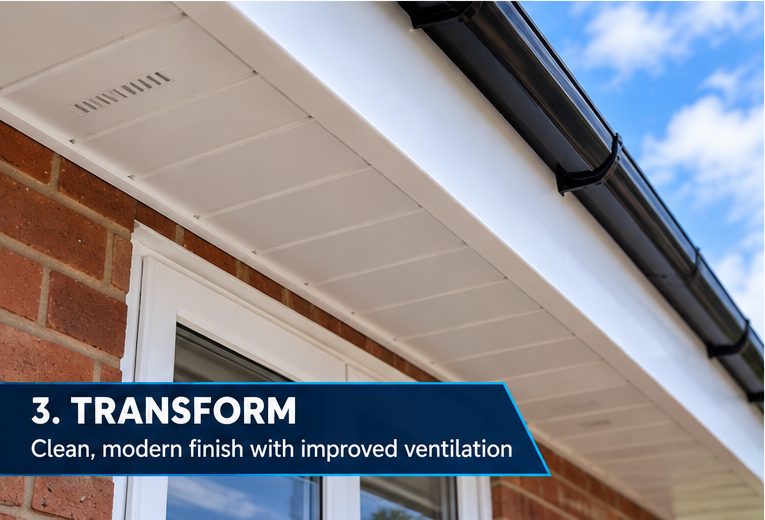
Houses are rarely uniform. The weather side of a building can have a fascia that is finished while the sheltered side is still sound, and there is no rule that says the whole house must be done at once. A sensible middle course is to replace boards and gutter together on the elevation that has gone and leave the rest, breaking at a corner or a stop end where the two meet rather than halfway along a run.
Before agreeing to a gutter-only job, ask one question of whoever is quoting: will you take a length of gutter off and look at the back of the board before you start? It takes minutes while they are up there, it is the only way to answer the question properly, and a photograph of what they find turns a guess into a decision.
And keep a note of what goes on. Profile, make and colour written on the paperwork means that if you do the boards in two years, the gutter can come off and go back on rather than being replaced a second time. That is the difference between a staged job and a job done twice.
The rest of the series, on the questions people ask most.
Every town has its own page, written around what the houses there are actually like at eaves level. Start with the main roofline page.
“I had a leak in my vally had a number of roofers to come and take a look couldn’t find the problem Roofline’s solutions fixed the problem first time. Very happy with these guys thank you for the brilliant service”
Michael Price“Excellent work replacing ridge tiles, repointing chimney and repairing flashing. Also fixed other broken tiles. Clean and tidy job. Would definitely recommend.”
Neil“Highly recommend. Very quick and efficient. Great communication. Went above and beyond to work the weekend to complete the work that needed to be done. Very happy with the results.”
Karen JonesDescribe what is happening and roughly where you are, and we will come back to you — usually the same day. If water is coming in now, please call instead.
Prefer to talk? Call 07464 259566 · WhatsApp 0044 7464 259566 · Email Evensbuddy@yahoo.com
We cover Chester, Cheshire, the Wirral and Flintshire from Elton, just north of Chester.
2 Manley View
Elton
Chester
CH2 4QF
Almost all of our work happens at your property rather than here, so please call before travelling.
Monday – Friday — 24hrs — Emergency Call-Outs
Saturday — 8:00 – 19:00
Sunday — 8:00 – 19:00
Weekday emergency call-outs are answered around the clock. Weekend cover is 8:00 to 19:00.