★★★★★
“I had a leak in my vally had a number of roofers to come and take a look couldn’t find the problem Roofline’s solutions fixed the problem first time. Very happy with these guys thank you for the brilliant service”
Michael PriceA price on its own tells you almost nothing. What makes a roofline quotation useful is the list of things it names — and, just as much, the short list of things it does not mention at all.
A roofline quotation arrives in one of two forms. One is a single line — replace fascias, soffits and guttering — followed by a figure. The other runs to a page and lists what is coming off, what is going on, in what profile and colour, over how many metres, on which elevations, using what access, with the rubbish taken where.
Only the second one can be checked, compared, or held to. It is also the only one that tells you whether the person who wrote it has actually walked round the building, because the detail that matters on a roofline is nearly all house-specific: the return over the bay, the dormer cheeks, the downpipe that discharges onto a path rather than into a gully.
None of this is about mistrust. It is that "fascias, soffits and guttering" covers at least four genuinely different jobs, at four different amounts of work, and the words on their own do not distinguish between them. The sections below are what a quotation should name, what tends to be left out, and what to ask.
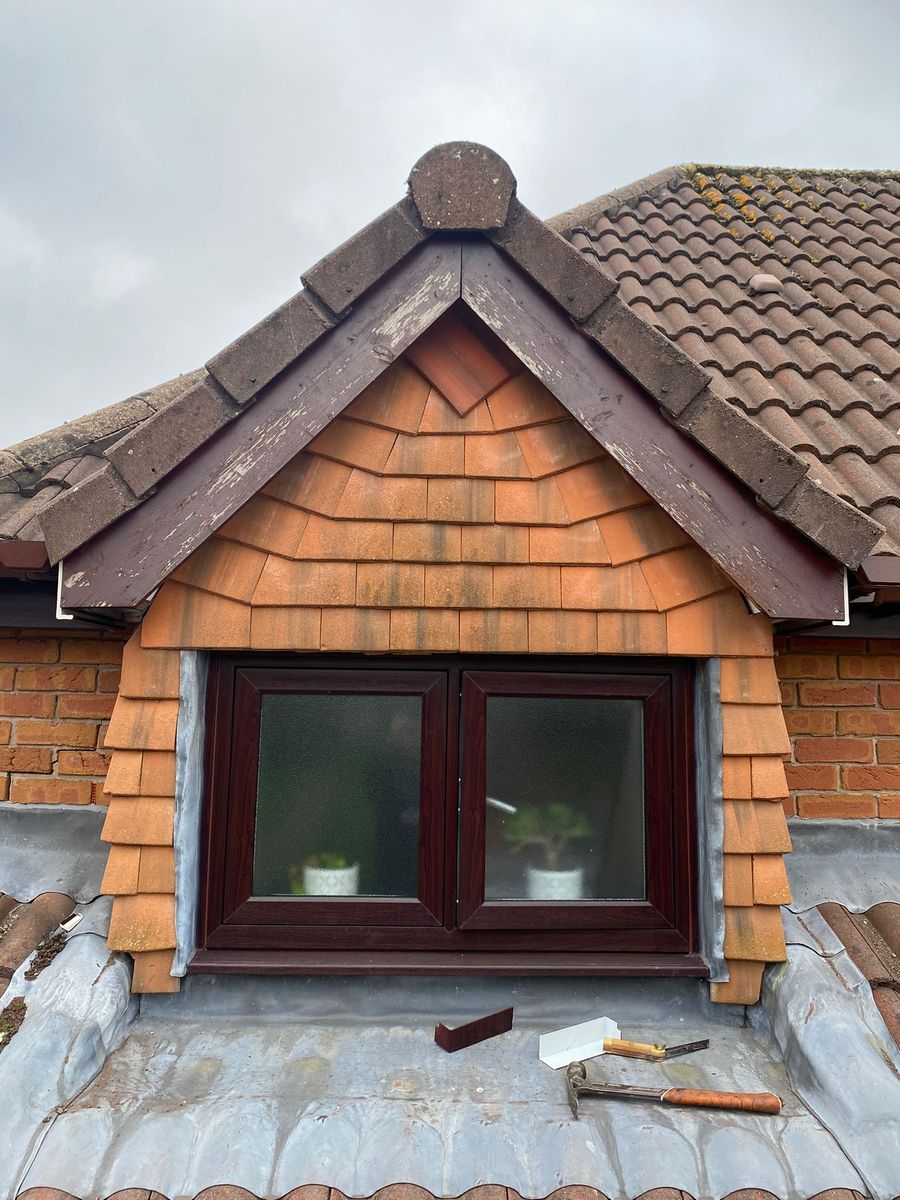
What is coming off, and from where. Elevations listed individually — front, rear, left gable, right gable, porch, bay, outrigger — with approximate metres against each. This is the item that makes two quotations comparable, and it is the one most often reduced to the word "house".
Replacement or capping, stated in those terms. A full replacement takes the old timber fascia off and fits a new board to the rafter ends. Capping leaves the timber in place and fits a thinner board over it. They are different in price, in thickness, in how they look at a party wall, and in what happens to the timber behind. A quotation that does not say which one it is has left out the single most important fact in it.
Profile, thickness and colour. Square edge, bullnose or ogee fascia; gutter profile named as half round, square line, deep flow or ogee with its nominal size; colour for boards, gutter and downpipe separately, because they need not match and often should not.
Soffit: vented or solid, and how. Continuous strip vent, circular vents at centres, or a vented board. If the existing soffits are solid timber with no ventilation and the loft is insulated, this is not an optional extra and it should not be priced as one.
Gutter brackets, fixings and outlets. Bracket centres, fixing type — stainless is worth naming on an exposed or coastal elevation — the number of outlets and where they are, and whether the downpipe route is unchanged or being moved. If the run is being resized or split, that belongs in writing.
Eaves protection and verge. Felt support trays where the old felt has torn back, and dry verge if the mortar at the gable has cracked. Both are cheap while the access is up and awkward afterwards, which is exactly why they should appear as named items you can decline rather than as an afterthought.
Timber repairs. Nobody can price rafter ends they have not seen, and a quotation that silently includes them is guessing. What it can do is state a rate or a method for dealing with them — the point is that the approach is agreed before the boards come off, not the figure.
Access. Tower, scaffold or ladders; who supplies it; whether a pavement licence is needed; how long it stands. On many jobs this is a substantial part of the work and it is not about the boards at all.
Removal and disposal. That the old fascia, soffit, gutter and downpipe leave with the installer. Cast iron in particular is heavy, and "we will leave it by the bin" is a real answer some people get.
Access is the first. A quotation for the boards and gutter that says nothing about how anybody reaches them can be perfectly honest and still turn into a conversation on the Monday morning, and scaffold is not a small item on a three storey house or one with a conservatory under the run.
Disposal is the second, and it shows up most on houses still carrying their original cast iron, which is heavy, slow to bring down and expensive to tip. The two things you do not want are a stack of old gutter left beside your bin and a skip arriving on your drive that nobody mentioned.
Ventilation is the third and the most consequential. Replacing a solid timber soffit with a solid plastic one is the cheapest version of the job and it leaves a roof space with no eaves airflow behind a brand new board. If ventilation is not named, assume it is not included and ask.
Then the small print that is not really small. Whether the figure includes VAT. What the payment stages are and when each falls due. Whether the business is insured for work at height on your property — Roofline Solutions is fully insured and will say so in writing if you ask. And how a variation is handled: who decides, who tells you, and whether you sign anything before it is carried out.
Last, the thing that is not an item at all — a start date and a number of working days. Its absence is not dishonest, but its presence tells you the job has been thought through rather than estimated from the pavement.
Have you taken a length of gutter off, or looked behind the fascia at any point? The answer decides how much the rest of the quotation is worth. A roofline cannot be fully assessed from the ground, and anybody who says otherwise is guessing about the only part that matters.
Is this capping or full replacement, and why that one on this house? A straight answer names what the timber is doing. An answer about how good the boards look afterwards has not addressed the question.
What ventilation am I getting, and what did the old soffits have? If the reply is that the new boards are vented, ask whether that is a continuous strip or a handful of round vents, and whether it suits the roof.
What happens if you find rot? You want a sequence: stop, show, agree, continue. Ask specifically whether you will be sent a photograph, because that single habit resolves most disputes before they exist.
Who moves the satellite dish, the alarm box and the cabling? Something is screwed to almost every fascia in the country and it is nobody's item until it is somebody's problem.
What is left behind when you leave? The gutter running clear, the ground cleared of offcuts and old nails, and the drive usable. It sounds obvious. Ask anyway.
Put them side by side and compare items rather than totals. The most common discovery is that one is a full strip and replacement and the other is capping, which is not cheating on anyone's part but is not the same purchase either. The second most common is that one includes the bargeboards on both gables and the other stops at the eaves.
Then look at the metres. If two quotations describe the same house with lengths that differ noticeably, one of them has missed an elevation — often the outrigger at the back, or a low return over a garage that is easy to overlook from the front garden.
Where the specification genuinely matches and the figures still differ, ask both what is driving it. Access is the usual answer, and sometimes one has priced scaffold where the other believes a tower will reach. That is a legitimate difference of judgement about your house, and it is worth hearing both.
And be wary of the quotation that is markedly lower with no explanation. It is not evidence of anything on its own, but it is a prompt to find the item the others have and it does not. More on what moves the number is in our guide to what drives the cost of new fascias, soffits and guttering.
The rest of the series, on the questions people ask most.
Every town has its own page, written around what the houses there are actually like at eaves level. Start with the main roofline page.
“I had a leak in my vally had a number of roofers to come and take a look couldn’t find the problem Roofline’s solutions fixed the problem first time. Very happy with these guys thank you for the brilliant service”
Michael Price“Excellent work replacing ridge tiles, repointing chimney and repairing flashing. Also fixed other broken tiles. Clean and tidy job. Would definitely recommend.”
Neil“Highly recommend. Very quick and efficient. Great communication. Went above and beyond to work the weekend to complete the work that needed to be done. Very happy with the results.”
Karen JonesDescribe what is happening and roughly where you are, and we will come back to you — usually the same day. If water is coming in now, please call instead.
Prefer to talk? Call 07464 259566 · WhatsApp 0044 7464 259566 · Email Evensbuddy@yahoo.com
We cover Chester, Cheshire, the Wirral and Flintshire from Elton, just north of Chester.
2 Manley View
Elton
Chester
CH2 4QF
Almost all of our work happens at your property rather than here, so please call before travelling.
Monday – Friday — 24hrs — Emergency Call-Outs
Saturday — 8:00 – 19:00
Sunday — 8:00 – 19:00
Weekday emergency call-outs are answered around the clock. Weekend cover is 8:00 to 19:00.