★★★★★
“Very professional efficient team great communication
Would definitely recommend made the process quick and easy will definitely look to keep for any future need
Thankyou”

On the Hoylake shore the wind decides how long a covering lasts. Leak tracing, re-formed edges and full EPDM replacement on garages, extensions, dormer tops and canopies — with the perimeter detailed for the weather it actually gets.
Hoylake sits on the corner of the peninsula where the Dee estuary opens into Liverpool Bay, and the weather arrives accordingly. There is very little between the shore, the links and the streets behind them, so wind that has crossed open water meets the first roofs it comes to at full strength. On a pitched roof that shows up as a slipped tile. On a flat roof it shows up at the perimeter, and that is the main reason flat roofing behaves differently here from the way it behaves a few miles inland.
The roofs themselves are a familiar mixture: rear extensions and kitchen additions behind the Victorian and Edwardian houses near the front, attached and detached garages on the interwar semis, dormer tops and cheeks on converted lofts, porch and bay canopies, and the occasional balcony deck. Most were covered in felt to begin with and a few in asphalt, and almost all of them are detailed at the edge in a way that was never asked to cope with this much lift.
Roofline Solutions repairs, overlays and fully replaces flat roofs in Hoylake and across the rest of the Wirral, and where we replace we replace in EPDM rubber. What the material is, how the deck under it should be built and how it is bonded down are all set out on the EPDM rubber roofing page. This page is about the part of the job an exposed roof here lives or dies by.
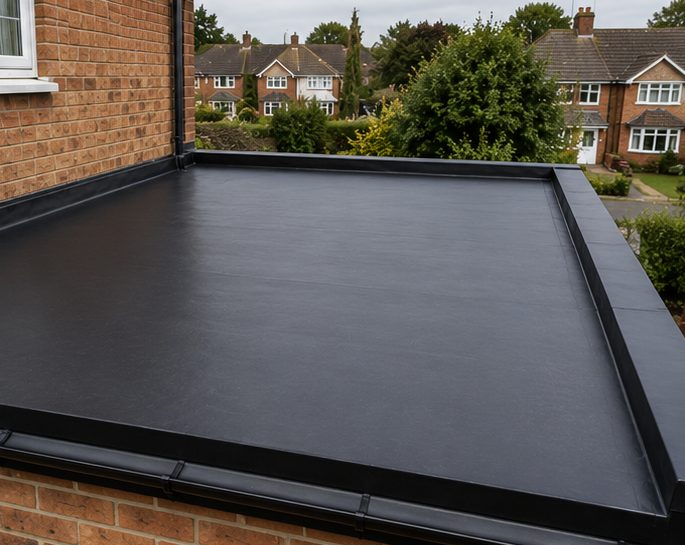
Images above are for illustration purposes only.
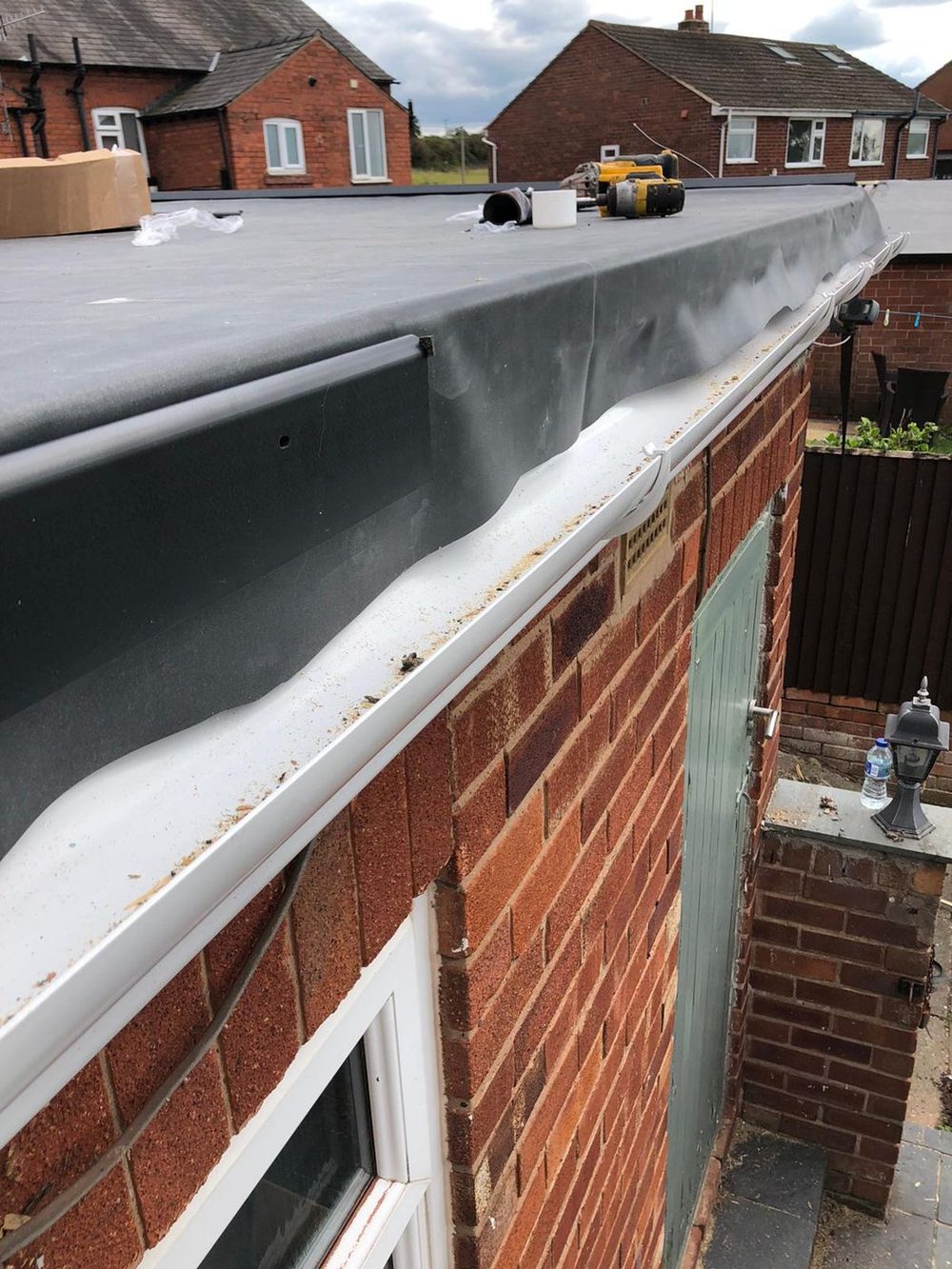
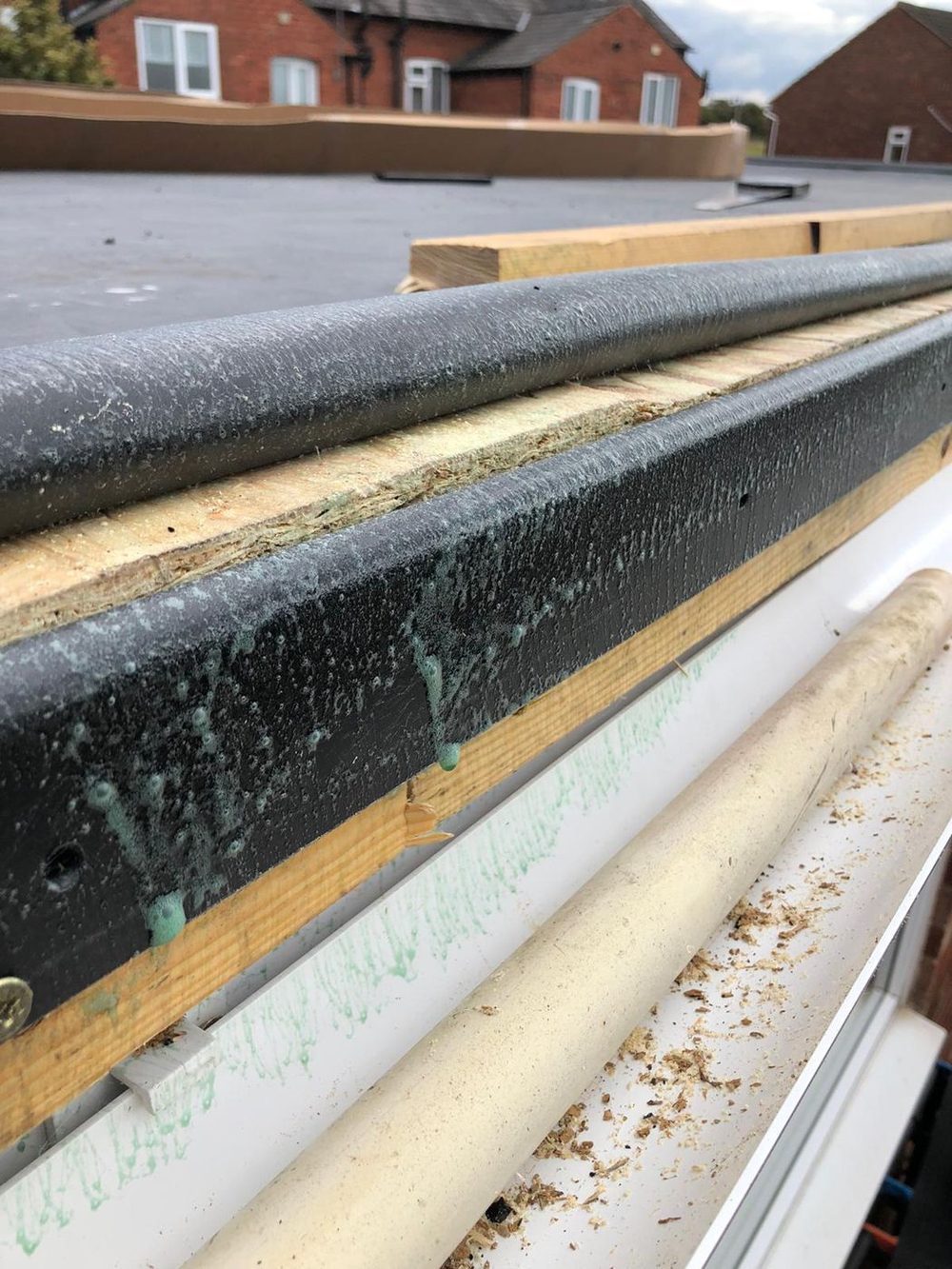
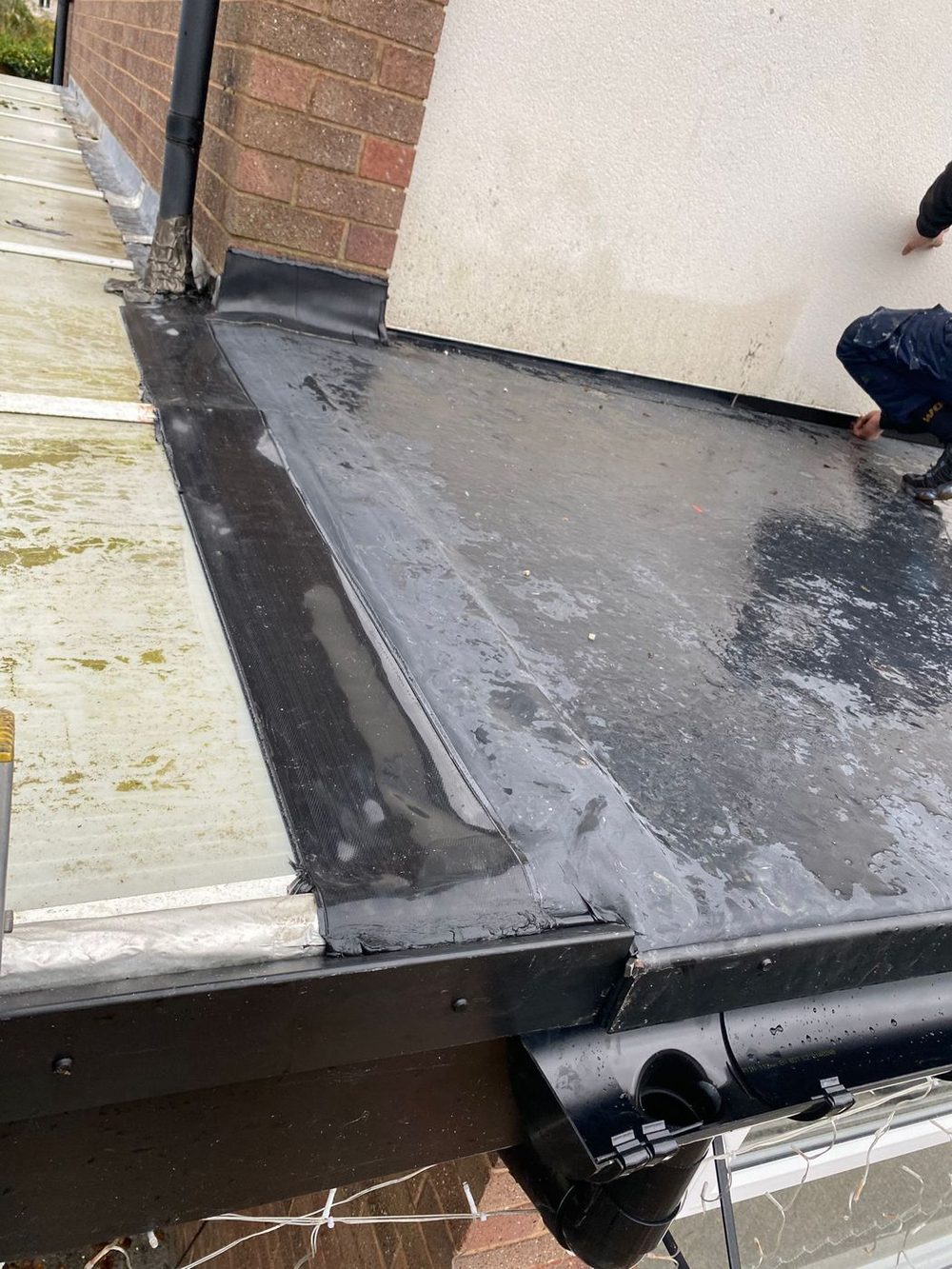
Photographs of our own flat roofing work. There are more on the main flat roof page and in the gallery.
Wind does not press down on a flat roof; it lifts it. Air moving across the surface drops in pressure and pulls upwards, and that suction is not spread evenly. It concentrates in a band around the perimeter and it is at its worst in the corners, where two edges meet. The middle of the roof, the part everybody stands and looks at, is the calm bit — which is why a covering in an exposed position almost never splits out in the field first.
What happens instead is a peel. A trim works loose on its fixings, or the bond around the perimeter was thin to begin with, or a corner was folded rather than properly formed, and one small lip of covering starts to flutter. Air gets under it. Every blow after that enlarges the opening, until a sheet still perfectly sound in the middle is hanging off the front edge after a night of south-westerlies. Old felt with a soft edge batten beneath it goes the same way, only quicker.
So on a roof this exposed, the perimeter is where the care belongs. That means a continuous bond around every edge and up every upstand in the contact adhesive that detail work is done with — a different product from the water-based adhesive used out in the field, and one that has to be left to flash off before the two faces are brought together. It means trims screwed at sensible centres into timber that is actually sound, and a deck fixed down along every edge rather than only where the boards happen to land. The why flat roofs leak at the edges guide takes that apart properly.
You can learn a surprising amount without leaving the garden. Sight along the trim line from one end: it should be dead straight, and a dip, a kink or a run standing proud of the fascia means fixings have moved. Look into the corners for covering that has curled or lifted away. Then look at the fascia and the brickwork immediately below the edge for a dark streak, because water that has got in under a trim runs down the face of the building rather than onto a ceiling, and that streak is often the first warning anybody gets.
Indoors, wind-driven rain gives itself away by timing. Damp that appears only when it blows hard from one particular direction, and stays dry through a week of steady drizzle, is water being pushed in through a detail rather than falling in through a hole. Go and look after the first real gale of the autumn rather than in spring when everything has dried out. If something has shifted, photograph it from an upstairs window and send it over on WhatsApp.
Plots here are reasonably generous: a drive, a side gate, a garage at the end rather than jammed against the boundary. A single-storey garage or outbuilding is normally simple enough to get onto. The moment the roof is at first-floor level, or has an open edge somebody has to work along, it wants a scaffold or a tower, and scaffolding is quoted separately so you can see it for what it is. A ladder is a way up; it is not a place to work from and there is nothing at the edge to stop a fall.
The other access question on this coast is the forecast, and it is not a small one. A sheeted scaffold behaves like a sail in an onshore wind. A sheet of rubber large enough to cover a whole roof in one piece is unmanageable in a stiff breeze, and it is supposed to be rolled out and left to relax flat before adhesive goes anywhere near it, which cannot be done with wind getting underneath it. Deck boards are no better. We watch the forecast and we will move a day rather than force one, because a covering bonded in a hurry on a bad morning is precisely the roof that peels later.
Everything a flat roof manages to do about water, it does because of what is underneath the covering, and in an exposed spot the way that deck is held down matters as much as what it is made of. Uplift pulls hardest around the perimeter, so the boards at the edge want screwing rather than nailing and bearing on all four sides, and the timber a trim is going to bite into has to be sound before anything is bonded to it. A board held along two sides will take the covering with it when it moves. Board type, thickness and joist spacing are set out on the EPDM rubber roofing page, which is where that whole build-up is described.
Above the deck it is the trims and the corners that decide things here. A trim wants screwing at close centres into timber that is genuinely sound, and lapping properly where two lengths meet, because an open joint at the edge is an invitation. Corners want forming rather than folding: a fold leaves a lip, and a lip is what the wind finds first. How far the covering should go up a wall, what the fall ought to be set at and how each of those details is made up in rubber all belong on the EPDM page rather than on this one. What to ask any roofer quoting on this coast is simply how the edge on the weather side is being held down, and what happens at the corners.
Leak tracing and repair, overlays where they are sensible, full strip-back and replacement in EPDM, new decks, corrected falls, trims, upstands and rooflight kerbs — and the pitched roof alongside when it needs it too.
“Very professional efficient team great communication
Would definitely recommend made the process quick and easy will definitely look to keep for any future need
Thankyou”
“A great team that really looked after us and have continued to support us. I wouldn’t hesitate to use roofline again or recommend them to family and friends. Buddy takes pride in his work and customer service.”
Samantha Merrick“The men were genuine and trustworthy. Turned up every time when they said they would, and phoned ahead. Very respectful and did an amazing job.,thank you x”
freda markhamWritten for homeowners working out what their flat roof actually needs, before anyone comes out.
Every town below has its own page, written around the flat roofs that are actually on the buildings there.
Describe the roof and roughly where you are, and we will come back to you — usually the same day. If water is coming in now, please call instead.
Prefer to talk? Call 07464 259566 · WhatsApp 0044 7464 259566 · Email Evensbuddy@yahoo.com
We cover Hoylake from our base at Elton, just north of Chester.
2 Manley View
Elton
Chester
CH2 4QF
Almost all of our work happens at your property rather than here, so please call before travelling.
Monday – Friday — 24hrs — Emergency Call-Outs
Saturday — 8:00 – 19:00
Sunday — 8:00 – 19:00
Weekday emergency call-outs are answered around the clock. Weekend cover is 8:00 to 19:00.