★★★★★
“Would highly recommend roofline solutions they arrived in time an explained to me what need to be done well spoken and polite”
Kyle Cummings
Flat roof repairs, overlays and full EPDM replacement in Widnes — and, where a ceiling is damp but nothing is actually leaking, working out whether the trouble is the covering at all or condensation under an unventilated cold deck.
A great deal of Widnes housing went up in the same stretch of the 1960s and 1970s — Hough Green, Hale Bank, Ditton, Farnworth — and with it came a particular kind of flat roof. Joists across the opening, a deck on top of them, felt on top of that, plasterboard underneath, and insulation added later between the joists at ceiling level. That build-up has a name. It is a cold deck, and it is called that because everything above the insulation is left out in the cold.
A cold deck can be made to work, but only if a continuous ventilated gap was left above the insulation and then kept clear. Very few of them still have one. Either there was never a gap, or the insulation was pushed hard up against the underside of the deck when somebody upgraded the ceiling, or the eaves it was meant to breathe through were boarded over when the roofline was replaced.
What you get then is a roof that behaves exactly as though it is leaking and is not. Getting that diagnosis right is the whole job in this town, because everything else follows from it: a new covering over an unventilated cold deck buys you a smart-looking roof and a ceiling that is still wet in February.
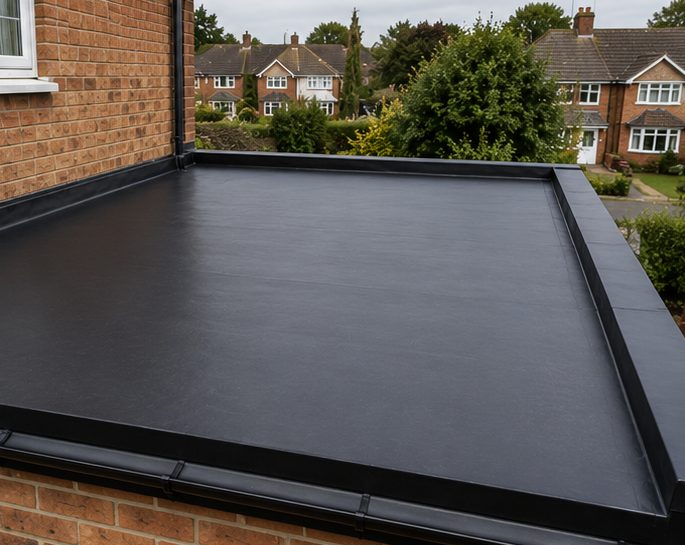
Images above are for illustration purposes only.
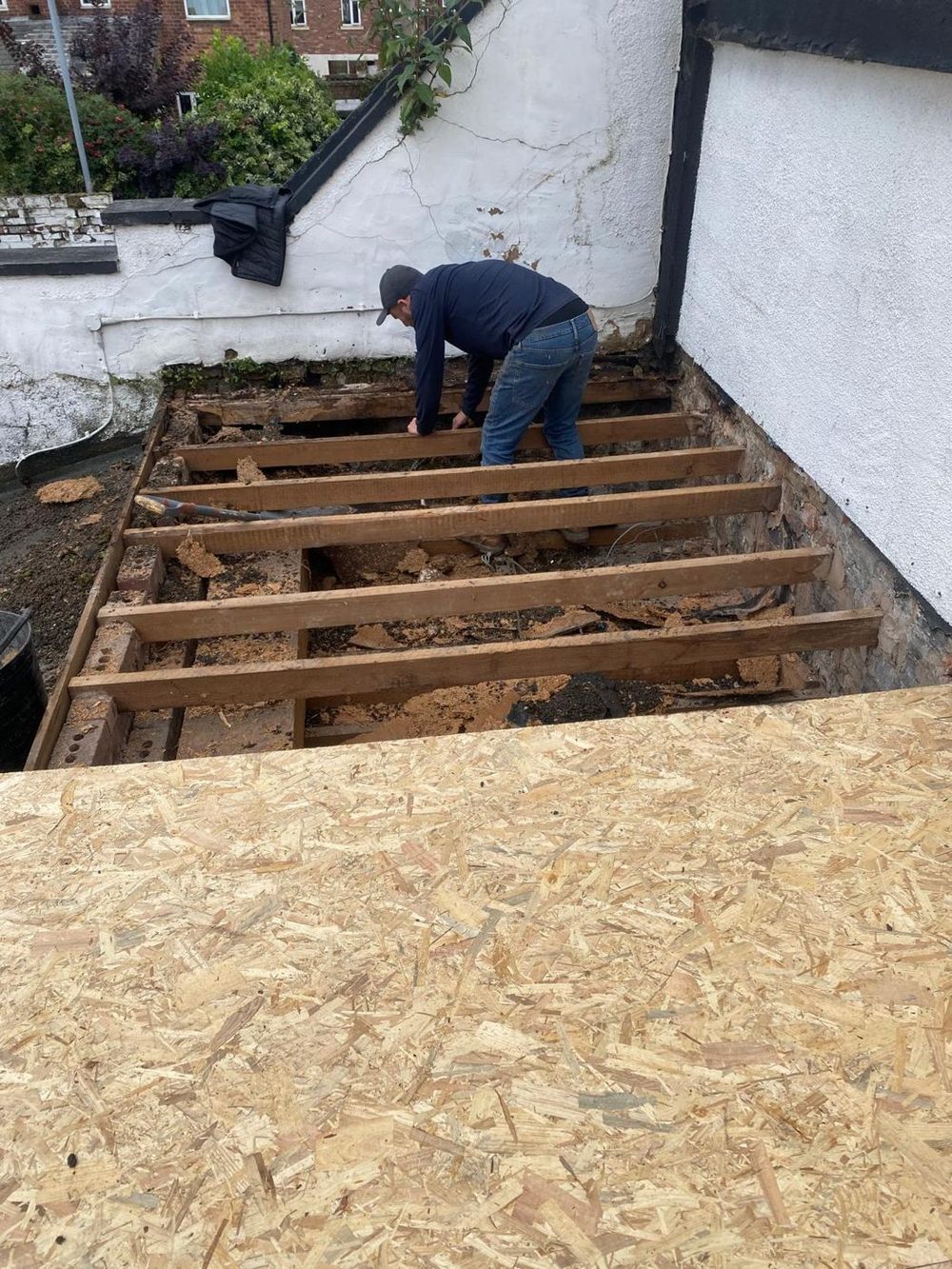
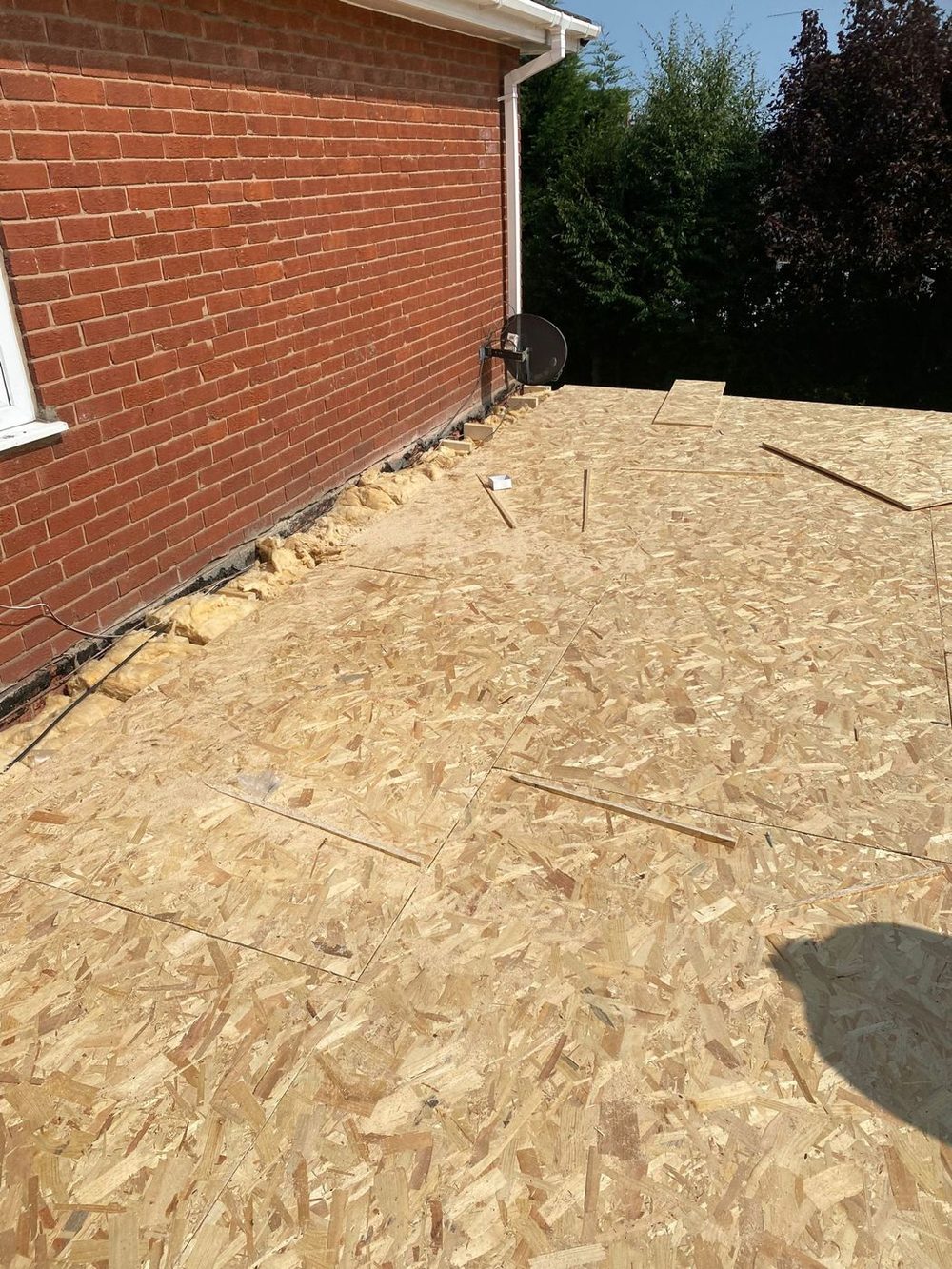
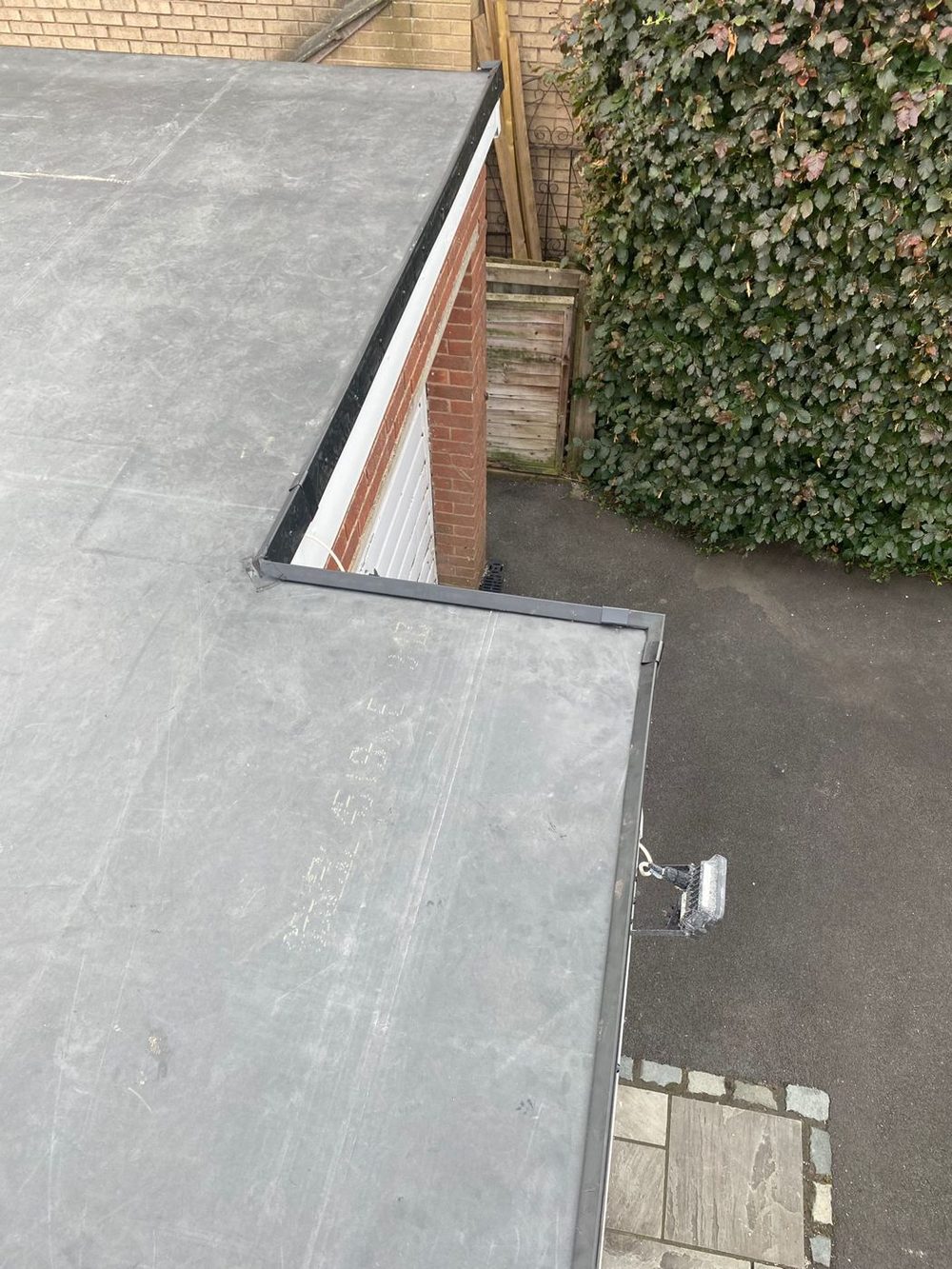
Photographs of our own flat roofing work. There are more on the main flat roof page and in the gallery.
Why one build-up sweats and the other does not is the subject of the warm deck or cold deck guide, and that is the page to read before you commission anything. What matters standing in a Widnes kitchen is recognising the symptom. Moist air from the rooms below works its way into the space above the insulation, meets joists and decking sitting at close to the outside temperature, and turns back into water on them. Nothing has come through the covering. The roof is making its own water, on the inside, and it does it hardest in the coldest weather.
In a house here that shows up as water forming on the joists in cold weather, dripping onto the back of the plasterboard, and drying out again when spring comes. Because it gathers along the timbers, the staining often comes through in stripes at joist centres rather than as one round patch, and the ceiling is worst above a kitchen, a bathroom or whichever room the washing gets dried in. Black mould in the corners and along the wall head usually joins in, because the same air is doing the same thing at every cold surface in the room.
Two mistakes tend to follow. The first is re-covering the roof, which changes nothing at all, because the water never came through the covering. The second is sealing the place up tighter still — closing the last air gaps, boarding over the eaves, painting the ceiling with something impermeable — which stops the roof breathing at precisely the moment it most needs to. The honest answer on most of these roofs is to deal with it when the covering is replaced, by changing the build-up rather than by treating the symptom.
Three questions separate them and you can answer all three without leaving the house. Does the damp appear during or just after rain, or does it appear in cold weather whether it has rained or not? Is it worse through winter and gone by midsummer? Is it directly above a kitchen, bathroom or utility, and does it come with mould rather than a clean brown tide mark? Rain coming through tends to leave a defined patch with a ring around it. Condensation tends to be diffuse, seasonal and mouldy.
It is not always one or the other, either. A roof can have a split at a lap and an unventilated deck at the same time, and putting one right leaves you with the other plus a bill you had not planned to repeat. The only way to be certain is to look from both sides: at the covering, the laps, the upstands and the outlets from above, and at the ceiling, the room and where the moisture is being generated from below.
Most flat roofs here are within easy reach. A kitchen or bathroom extension off the back of a semi, a link porch between house and garage, a detached garage on the drive — these are low, single-storey and workable from a tower or, on the lowest of them, without a full scaffold at all. Where the flat roof sits at first-floor level over a bay or a rear addition, a scaffold goes up and is quoted separately from the roofing.
The unusual part of a condensation call is that the survey is only half of it outside. We want to see the room underneath as well: what is generating the moisture, whether there is an extractor and whether it discharges outside rather than into the void, whether the ceiling is peppered with downlights, and whether the eaves were closed off when the soffits and fascias were done. Having somebody in the house matters more on these jobs than on a straightforward leak.
Strip one of these roofs and what is underneath tends to follow a pattern: insulation between the joists gone sodden, a deck blackened on its underside, and joists that are sound in the middle of the span but soft where they bear on the wall. Anything rotten is cut out and replaced before a new deck goes anywhere near it, and firrings go on top to build the fall back in. What board the deck should be and how it is fixed belongs with the material rather than being repeated here.
What goes above it is the decision that actually matters, and it is made on the building rather than out of habit. If the roof stays a cold deck, the ventilation path has to be real: a clear gap above the insulation the whole way across, open at two opposite sides so the air has somewhere to go, and nothing — not a wall plate, not a cross member, not a bag of loft quilt — blocking it halfway. If it becomes a warm deck instead, the insulation goes above the deck with the vapour control layer beneath it, the timber stays warm, and the ventilation question disappears. The EPDM rubber roofing page explains how each build-up is assembled and where the membrane sits in it.
Leak tracing and repair, overlays where they are sensible, full strip-back and replacement in EPDM, new decks, corrected falls, trims, upstands and rooflight kerbs — and the pitched roof alongside when it needs it too.
“Would highly recommend roofline solutions they arrived in time an explained to me what need to be done well spoken and polite”
Kyle Cummings“Brilliant company. Did a really good job worked hard, looks really good up to my expected standards which are high. Can highly recommend them.”
CHESHIRE PORCELAIN“Very pleased with Roofline
Efficient, reliable, fast and friendly”
Written for homeowners working out what their flat roof actually needs, before anyone comes out.
Every town below has its own page, written around the flat roofs that are actually on the buildings there.
Describe the roof and roughly where you are, and we will come back to you — usually the same day. If water is coming in now, please call instead.
Prefer to talk? Call 07464 259566 · WhatsApp 0044 7464 259566 · Email Evensbuddy@yahoo.com
We cover Widnes from our base at Elton, just north of Chester.
2 Manley View
Elton
Chester
CH2 4QF
Almost all of our work happens at your property rather than here, so please call before travelling.
Monday – Friday — 24hrs — Emergency Call-Outs
Saturday — 8:00 – 19:00
Sunday — 8:00 – 19:00
Weekday emergency call-outs are answered around the clock. Weekend cover is 8:00 to 19:00.