★★★★★
“Very professional efficient team great communication
Would definitely recommend made the process quick and easy will definitely look to keep for any future need
Thankyou”

Parapet flat roofs you cannot see from the pavement — outlets, hidden gutters, upstands and copings, repaired or fully replaced in EPDM rubber across Wallasey, Liscard and New Brighton.
A great deal of Wallasey is built with the wall carried up past the roof. Terraces and semis running back from the Mersey at Seacombe, through Liscard and Poulton and round to New Brighton, have front and party walls that continue above the covering as a parapet with a coping along the top. From the pavement you see brickwork and sky. The roof behind it might be immaculate or it might be a pond, and nothing at street level will tell you which.
The same idea turns up on rear additions, on the parades where there are flats above shops, and on the flat-roofed houses of the between-the-wars period that were built deliberately in that style. What every one of them has in common is drainage. With no open edge to shed water off, the roof has to get rid of it through something: an outlet through the parapet into a hopper, a chute or spout through the wall, or a gutter tucked behind the parapet running to a rainwater head at one end. Plenty of these buildings are a mixture, with a parapet to the street and an ordinary open edge and gutter along the back, and it is reliably the hidden side that catches people out — because an open edge that blocks spills over the front of the gutter where you can see it, and a parapet that blocks does not.
We repair and replace these roofs, and where we replace we do it in EPDM rubber; the membrane, the deck beneath it and how the details are formed are set out on the EPDM rubber roofing page. This page is about the thing that makes a parapet roof its own particular problem, which is that the roof and the way it drains are both out of sight.
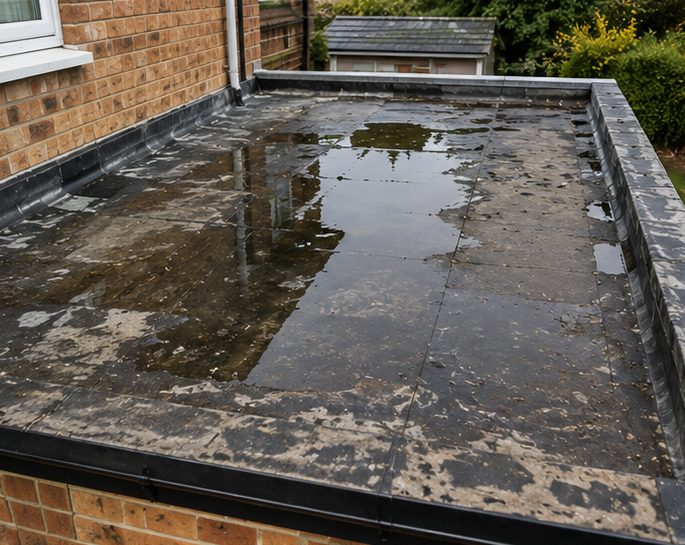
Images above are for illustration purposes only.
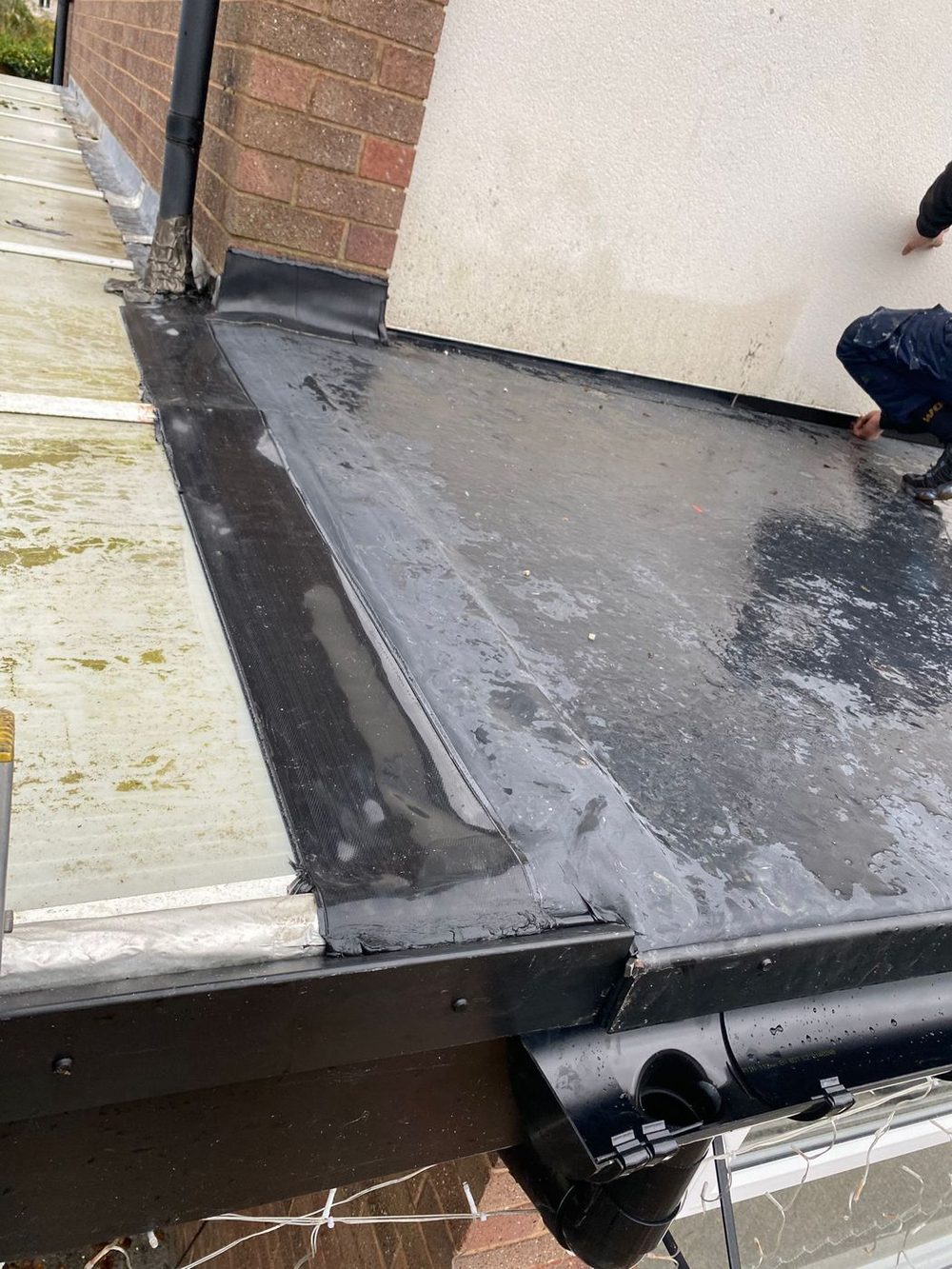
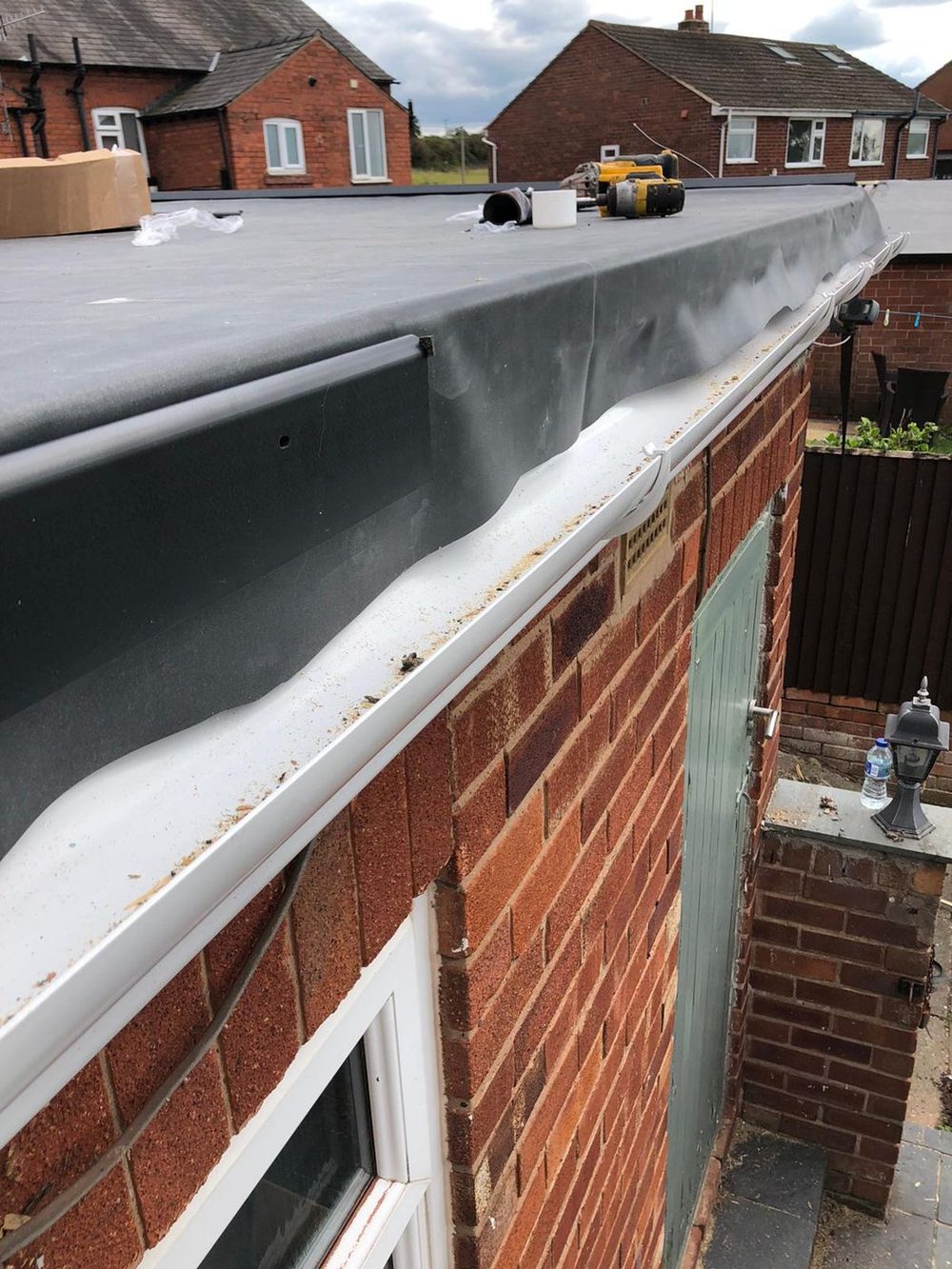
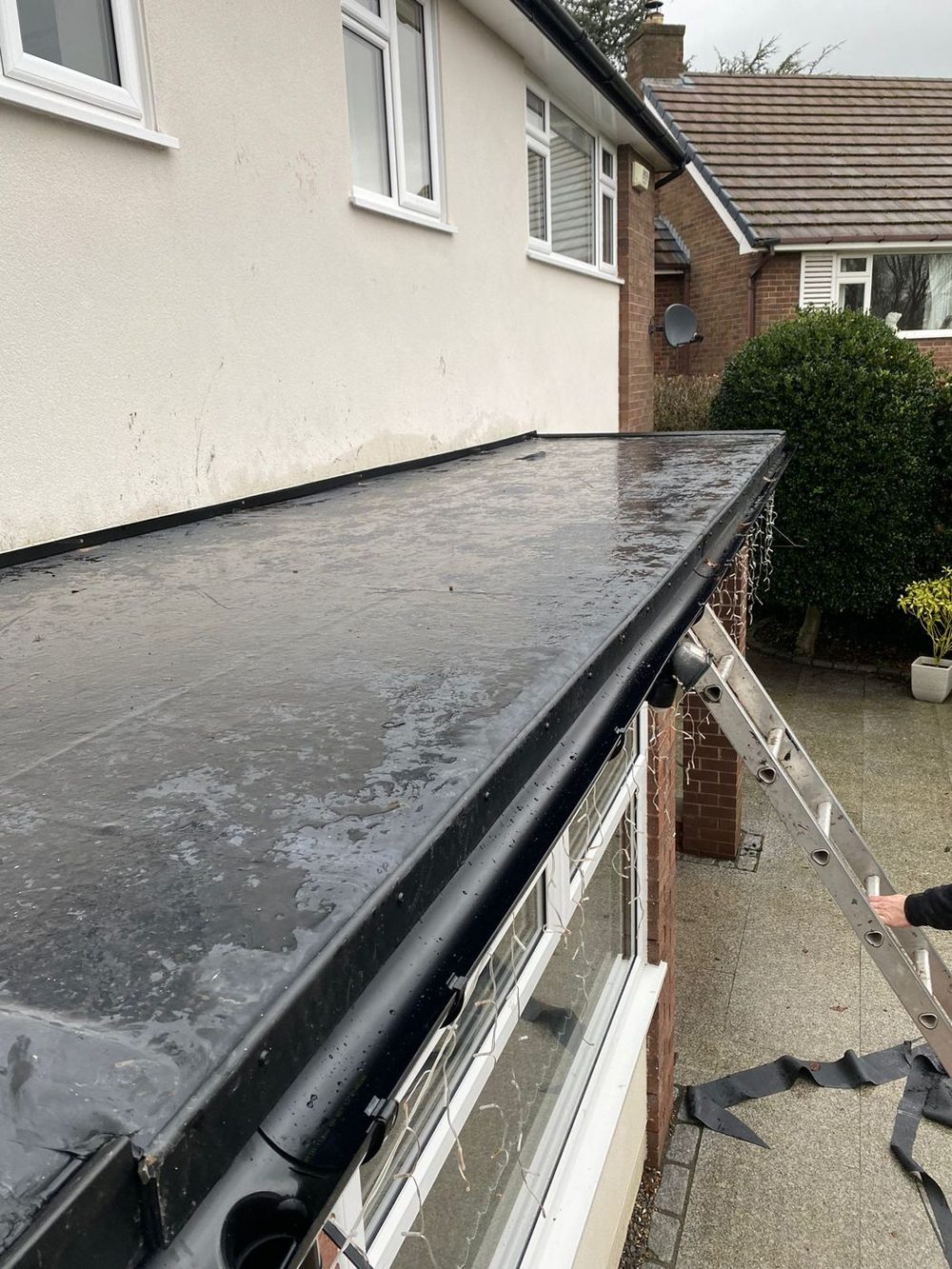
Photographs of our own flat roofing work. There are more on the main flat roof page and in the gallery.
On an open-edged roof, water leaves along a whole edge, and if one part of the gutter blocks the rest still works. A parapet roof has no such spare capacity. Everything leaves through one outlet, or two if you are fortunate, and that outlet is the only way out there is. Block it — a tennis ball, moss washed off the coping, leaves, nesting material, which this close to the shore is a regular event — and the roof stops being a roof and starts being a tank.
What happens next is the part people find surprising. The water level rises, and it does not have to rise far. Once it is above the top of the upstand it goes behind the covering and over the flashing at the wall, and from there it is inside the structure. The ceiling then gets wet somewhere with no relation to where the roof has failed, because the water travels along the deck and drops through at a joint. The simplest safeguard is a second opening: an overflow set a little above the outlet, through the parapet, so a blockage announces itself by spitting water down the outside of the wall instead of quietly filling the roof.
The parapet itself is the other half of it. Copings are jointed and those joints open; a parapet with a failed or bridged damp-proof course draws water through the masonry and delivers it to the inside face of the wall, which from the bedroom below looks exactly like a roof leak. The covering has to be taken up the inside face and finished 150mm above the finished roof surface, per BS 6229 and NHBC guidance, and held there properly rather than tucked under a coping and hoped for. Since none of this can be seen from the ground, what is under your flat roof is a useful read before you commission anything.
Watch the building while it is raining hard. A downpipe from a parapet hopper that stays dry during a downpour while the others run is the clearest signal there is, and it means water is not reaching it. Water running down the outside face of the wall below a hopper, or a vertical streak of staining and green growth on the brickwork, says the same. A tide line on the inside face of the parapet, visible from an upstairs window at the back, says the roof has been holding water at that depth.
Indoors, look at the top of the wall rather than the middle of the ceiling. Damp that begins high, in the corner where the parapet wall meets the ceiling, and works its way down the wall is typical of water coming over an upstand or through the parapet, and it behaves quite differently from a hole out in the open part of a roof. The things that block outlets do it in autumn and after a gale, so that is when to look. Send a picture through on WhatsApp rather than climbing up to see for yourself.
A parapet roof is almost always at first-floor level or higher and it has no open edge to work from, so a scaffold is not optional. The parapet is not edge protection either: it is often low, and the coping along the top of it can be loose enough to shift under a hand. Where the only frontage is the pavement, a scaffold standing on the footway needs a licence from the council, and sometimes a gantry so people can pass beneath it. Scaffolding is quoted separately, which on this sort of building is a real benefit, because access is the part that varies most between two roofs of the same size.
Where the roof is over a back addition, the way in is usually along a shared rear entry and over a yard wall, so everything is carried and nothing gets near a lorry. Where a parapet is shared with next door — and on a terrace it generally is — work at the party wall is worth squaring with the neighbour before it begins, particularly if the coping or the flashing on their side has to be disturbed. We would sooner knock on the door first than explain afterwards.
Falls on a parapet roof have to be positive towards the outlet, and they have to be right, because there is nowhere else for the water to go. That means setting the roof out so the low point sits at the outlet rather than somewhere out in the middle, and building in enough fall that deflection, tolerance and settlement still leave the finished surface running the way it was drawn. The figures BS 6229 works to are on the EPDM rubber roofing page. Where there is a gutter behind the parapet it needs a fall along its own length towards the rainwater head, and that is the detail most often missing.
The outlet is a component, not a hole. The covering is dressed into a proper outlet with a clamping flange or a bonded flashing rather than sealed round with mastic; the leaf guard over it is something that can be lifted and cleared by hand; and the pipe below wants to be reachable for rodding rather than buried in the structure where nobody can get at it. Upstands run the whole way round to their full height, including behind the coping, and corners are formed rather than folded. On a roof that has to hold water back as well as shed it, a folded corner is not a cosmetic point.
Leak tracing and repair, overlays where they are sensible, full strip-back and replacement in EPDM, new decks, corrected falls, trims, upstands and rooflight kerbs — and the pitched roof alongside when it needs it too.
“Very professional efficient team great communication
Would definitely recommend made the process quick and easy will definitely look to keep for any future need
Thankyou”
“A great team that really looked after us and have continued to support us. I wouldn’t hesitate to use roofline again or recommend them to family and friends. Buddy takes pride in his work and customer service.”
Samantha Merrick“The men were genuine and trustworthy. Turned up every time when they said they would, and phoned ahead. Very respectful and did an amazing job.,thank you x”
freda markhamWritten for homeowners working out what their flat roof actually needs, before anyone comes out.
Every town below has its own page, written around the flat roofs that are actually on the buildings there.
Describe the roof and roughly where you are, and we will come back to you — usually the same day. If water is coming in now, please call instead.
Prefer to talk? Call 07464 259566 · WhatsApp 0044 7464 259566 · Email Evensbuddy@yahoo.com
We cover Wallasey from our base at Elton, just north of Chester.
2 Manley View
Elton
Chester
CH2 4QF
Almost all of our work happens at your property rather than here, so please call before travelling.
Monday – Friday — 24hrs — Emergency Call-Outs
Saturday — 8:00 – 19:00
Sunday — 8:00 – 19:00
Weekday emergency call-outs are answered around the clock. Weekend cover is 8:00 to 19:00.