★★★★★
“Very professional efficient team great communication
Would definitely recommend made the process quick and easy will definitely look to keep for any future need
Thankyou”

Flat roofs that run up against rendered and pebbledashed walls in Flint, and the upstand detail that decides whether the render sheds water or traps it behind. Repairs, overlays and full EPDM replacement.
Look along a street in Flint, out towards Oakenholt or up around Flint Mountain and you will notice how much of the housing is rendered or pebbledashed rather than fair-faced brick. A good deal of it went on as a finish over the original wall at some point after the house was built, and it is against those elevations that the flat roofs sit — kitchen and utility extensions, garages, porches and bay canopies.
That junction is where most of the trouble lives. A flat roof against brickwork is reasonably straightforward, because you can cut a clean chase in a mortar joint and tuck a flashing into it. A flat roof against roughcast or pebbledash is a different proposition: the surface is coarse and uneven, the render may well be hollow behind, and anything stuck to the face of it is stuck to a finish rather than to the wall itself.
Then add the weather that comes up the Dee. The exposed elevations here take driving rain off the estuary, and driving rain does not simply fall on a wall, it is pushed into it. A wall that is wet all the way through to the back of the render behaves very differently at roof level from one that is merely damp on the face.
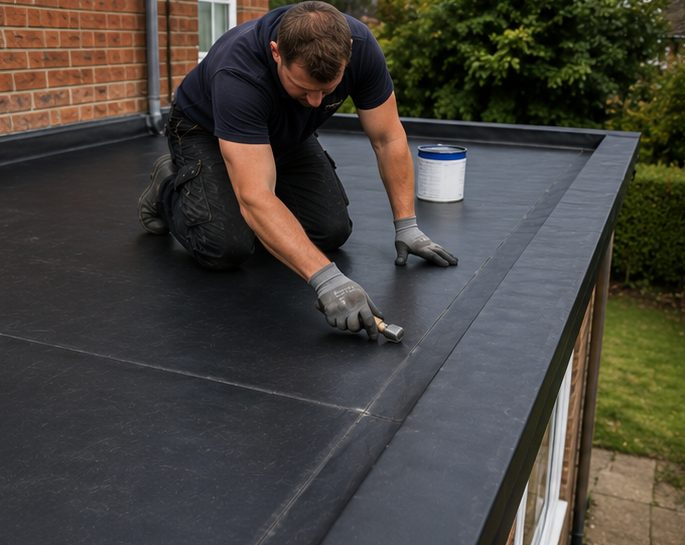
Images above are for illustration purposes only.
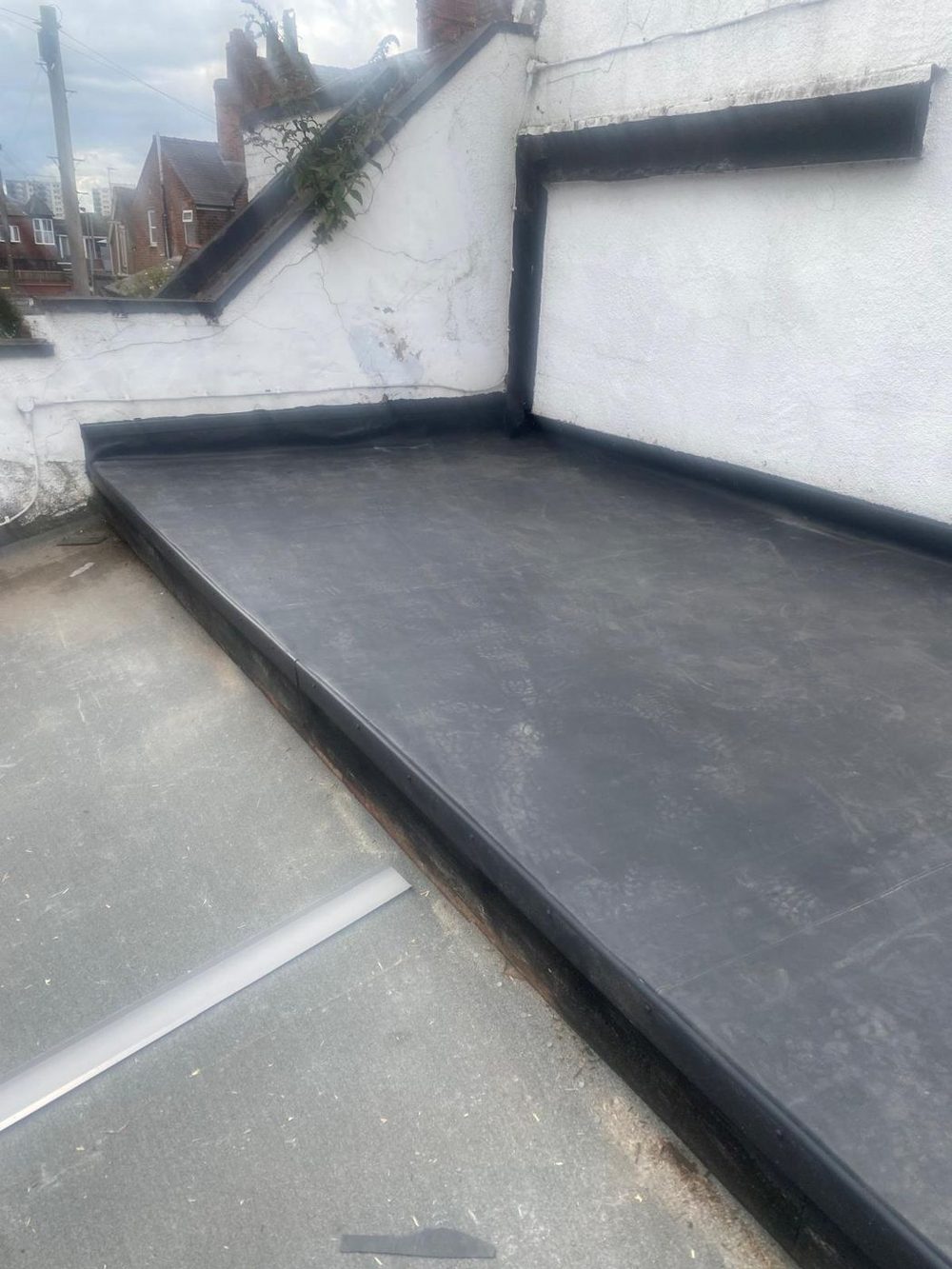
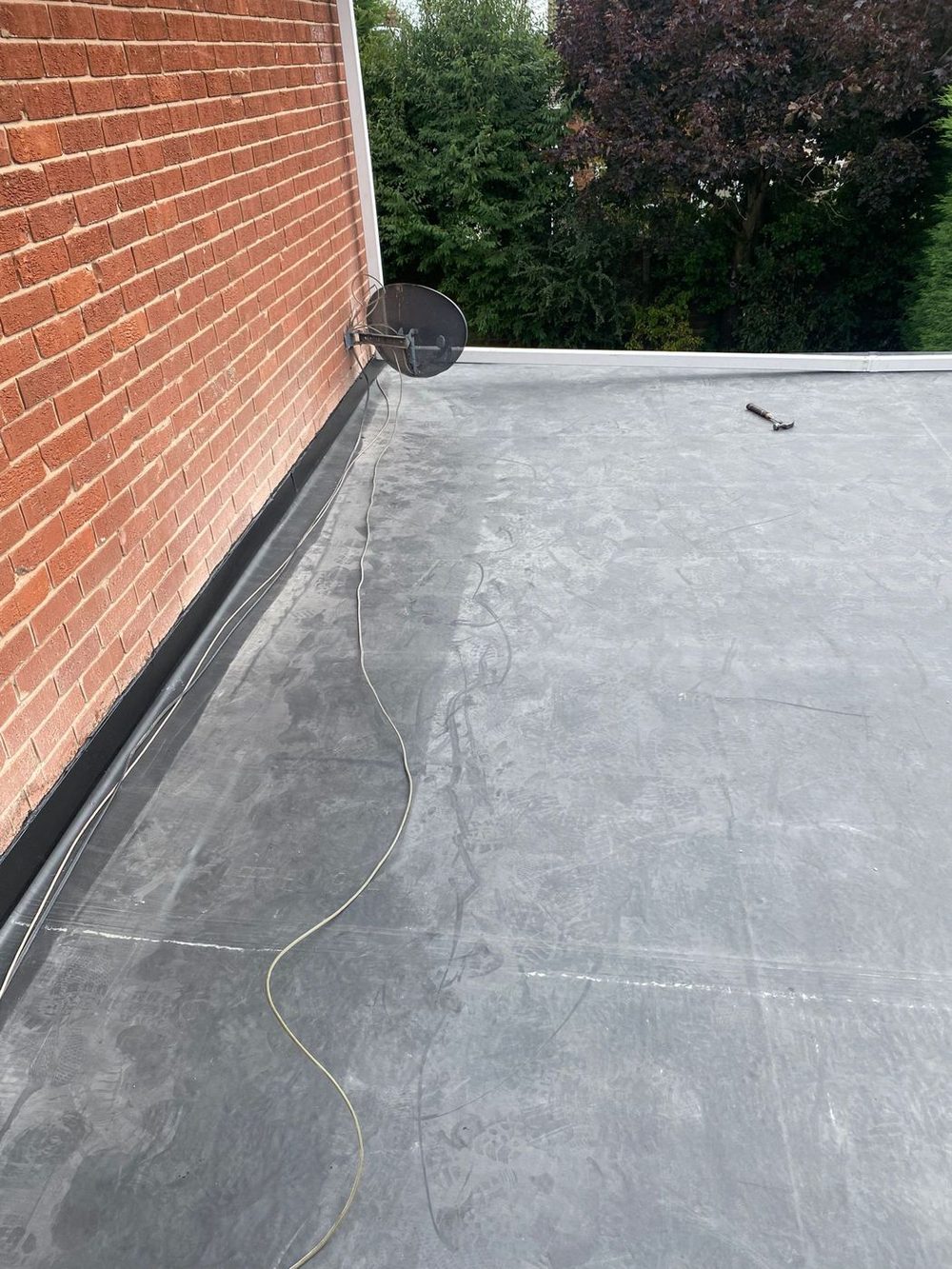
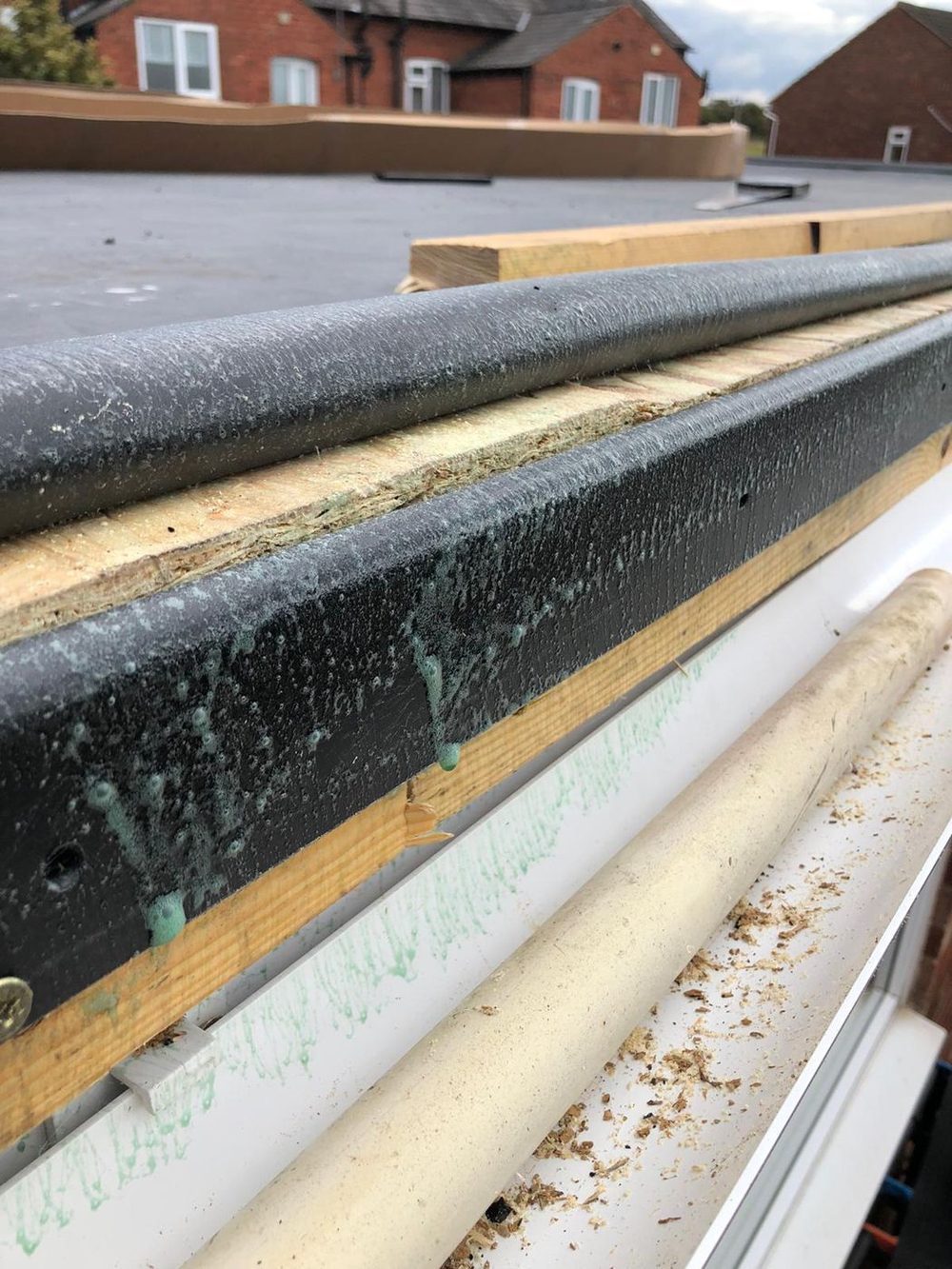
Photographs of our own flat roofing work. There are more on the main flat roof page and in the gallery.
The covering has to be carried up the wall as an upstand and held there, and the height is not up for negotiation: 150mm above the finished roof surface is what BS 6229 and NHBC guidance call for, because anything shallower can be overtopped by driving rain, by snow, or by a roof that is briefly holding water it should have shed. On a rendered wall, though, the argument is almost never about the height. It is about what happens at the top edge of that upstand.
Water running down a rendered elevation has to be thrown out onto the face of the upstand and not allowed in behind it. That means a chase cut into the render above the top of the upstand, with a cover flashing or a proper termination dressed into it and made good, so there is a hard edge that sheds. The two things that go wrong instead are render run straight down to the roof and stopped dead at deck level, and a bead of mastic smeared along a pebbledashed face it never had a chance of sticking to. Both of them let water track down behind the finish and arrive underneath the membrane.
The third thing to look at is what is going on behind the render itself. Roughcast that has blown, hairline crazing across a weathered elevation, or a bellcast that was never formed at the bottom of a panel, all let water into the render rather than off it. A roofer can form a textbook upstand into a wall that is feeding water into it from above and the ceiling inside will still go damp. That is why we look at the wall as well as the roof, and why why flat roofs leak at the edges is the guide we point people here at first.
The pattern is distinctive. Staining appears on the ceiling in a band along the wall that the roof abuts, rather than as a spot out in the middle of the room. The plaster at the top of that wall goes darker than the rest of it, and paint or paper lifts along the line where the ceiling meets it. The remainder of the ceiling stays perfectly dry, which is precisely what makes people assume the roof itself must be fine.
It has a season, too. A problem at the wall head is at its worst in a long spell of wind-driven rain off the estuary and quiet again in still weather, whereas a covering that has split will leak in any rain at all. If your damp patch arrives with the weather coming up the Dee and not with an ordinary downpour, the wall and the upstand are the place to start looking.
Wind is the practical constraint around here more than height is. A scaffold with debris netting on it is a sail, and on exposed plots near the estuary there are days when the sensible thing is to leave the sheeting off and work somewhere else. A large single sheet of rubber is also unmanageable in a stiff breeze: it has to be laid out, left to relax and then bonded flat, and none of that goes well across a cross-wind.
The plots themselves are usually generous. Open frontages, driveways, and enough room down the side of a house to stand a tower or a modest scaffold without crossing anybody else’s garden. Where the roof is a single-storey extension at the back and the old covering can go straight into a skip on the drive, the work is simpler and quicker. Where it is at first-floor level or has an open edge to work along, a scaffold is needed and it is quoted separately.
Against a rendered wall the sequence matters more than anywhere else on the building. The deck goes down first, then the upstand timber, then the covering, and only after all of that the flashing and the making good of the render above it. Repairing the render first and roofing afterwards means cutting into fresh work. Doing neither and trusting a tube of sealant means doing the whole thing again.
On the open edges the covering is dressed over a trim and, where there is a gutter, down into it, so water leaves the roof at a defined point rather than creeping back underneath the edge. The fall wants setting so that water runs to that edge and away from the abutment, and it wants designing steeper than the finished minimum so that deflection and settlement do not eat it. What the board and the falls should actually be, and how trims, corners and outlets are put together, is set out on the EPDM rubber roofing page.
Leak tracing and repair, overlays where they are sensible, full strip-back and replacement in EPDM, new decks, corrected falls, trims, upstands and rooflight kerbs — and the pitched roof alongside when it needs it too.
“Very professional efficient team great communication
Would definitely recommend made the process quick and easy will definitely look to keep for any future need
Thankyou”
“A great team that really looked after us and have continued to support us. I wouldn’t hesitate to use roofline again or recommend them to family and friends. Buddy takes pride in his work and customer service.”
Samantha Merrick“The men were genuine and trustworthy. Turned up every time when they said they would, and phoned ahead. Very respectful and did an amazing job.,thank you x”
freda markhamWritten for homeowners working out what their flat roof actually needs, before anyone comes out.
Every town below has its own page, written around the flat roofs that are actually on the buildings there.
Describe the roof and roughly where you are, and we will come back to you — usually the same day. If water is coming in now, please call instead.
Prefer to talk? Call 07464 259566 · WhatsApp 0044 7464 259566 · Email Evensbuddy@yahoo.com
We cover Flint from our base at Elton, just north of Chester.
2 Manley View
Elton
Chester
CH2 4QF
Almost all of our work happens at your property rather than here, so please call before travelling.
Monday – Friday — 24hrs — Emergency Call-Outs
Saturday — 8:00 – 19:00
Sunday — 8:00 – 19:00
Weekday emergency call-outs are answered around the clock. Weekend cover is 8:00 to 19:00.