★★★★★
“Would highly recommend roofline solutions they arrived in time an explained to me what need to be done well spoken and polite”
Kyle Cummings
Flat roofs on Neston’s older stone and soft-brick buildings — extensions, outbuildings and garage roofs where the upstand has to be formed against masonry that will not take a grinder.
Neston, Parkgate, Little Neston, Ness, Burton and Willaston have an older bone structure than most of the places we cover. A good deal of the building stock here is local sandstone rubble or soft handmade brick bedded in lime mortar, and a fair amount of what looks like plain brickwork from the street is render over something older and softer than it appears. That matters the moment a flat roof has to be fixed to it.
The flat roofs themselves are almost always later additions: a rear kitchen or garden room, a garage tucked between the house and a boundary wall, a store or workshop roofed flat, an extension put on long after the house was finished. So you get a modern roof dying into a wall that was built by entirely different rules, and the joint between the two is where nearly all the trouble starts. The field of the roof is usually the least of it.
What we do here is repair, overlay and full replacement, the same as anywhere, with one difference in emphasis: on this building stock the abutment detail decides whether the job lasts. Where a covering is renewed we renew it in EPDM rubber, and the material, the deck under it and the way trims and upstands are formed are covered on the EPDM rubber roofing page rather than gone over again here.
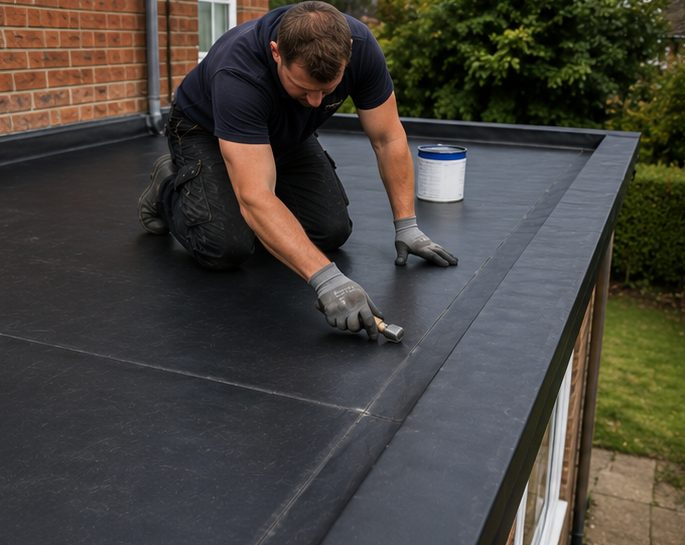
Images above are for illustration purposes only.
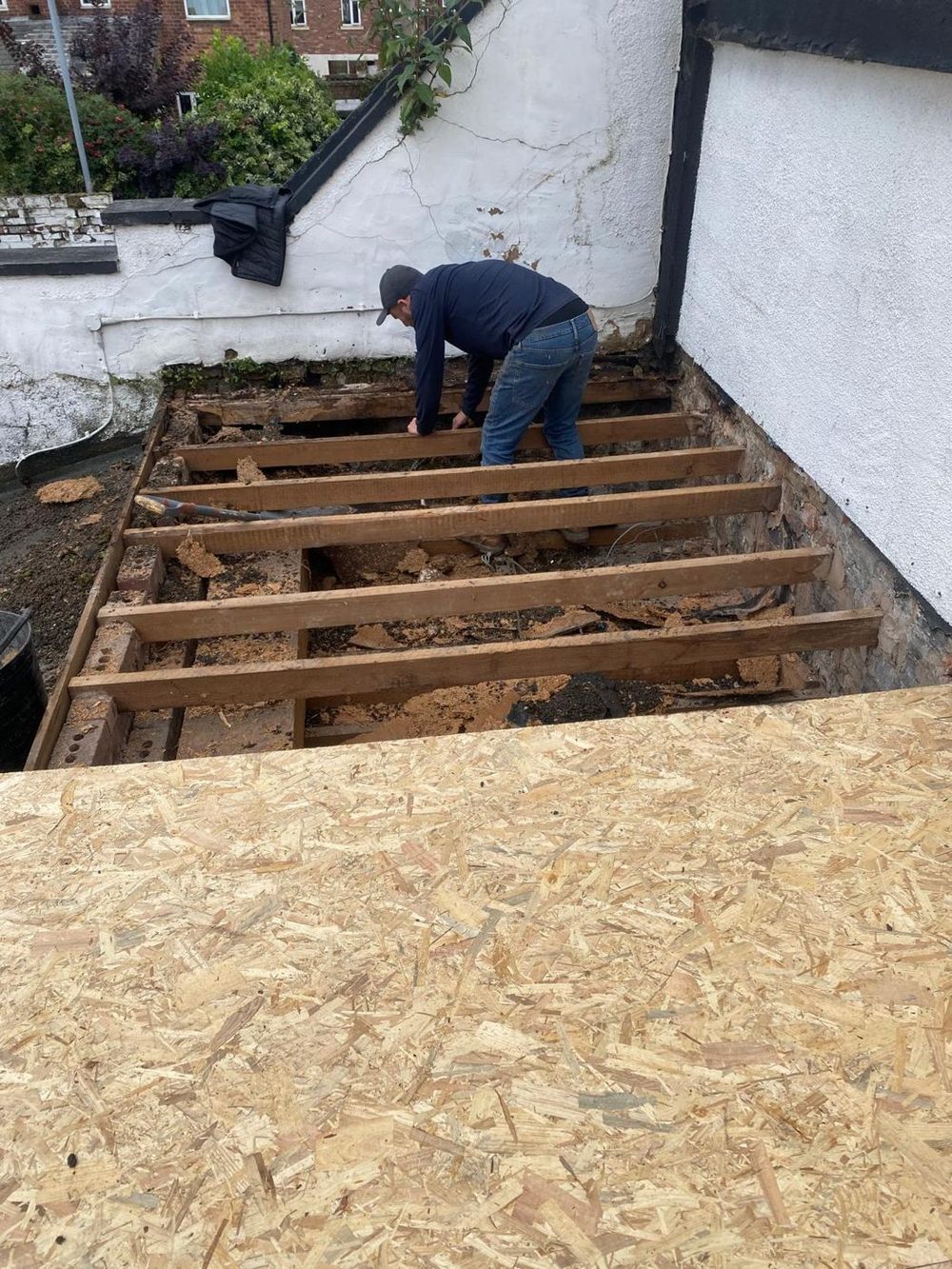
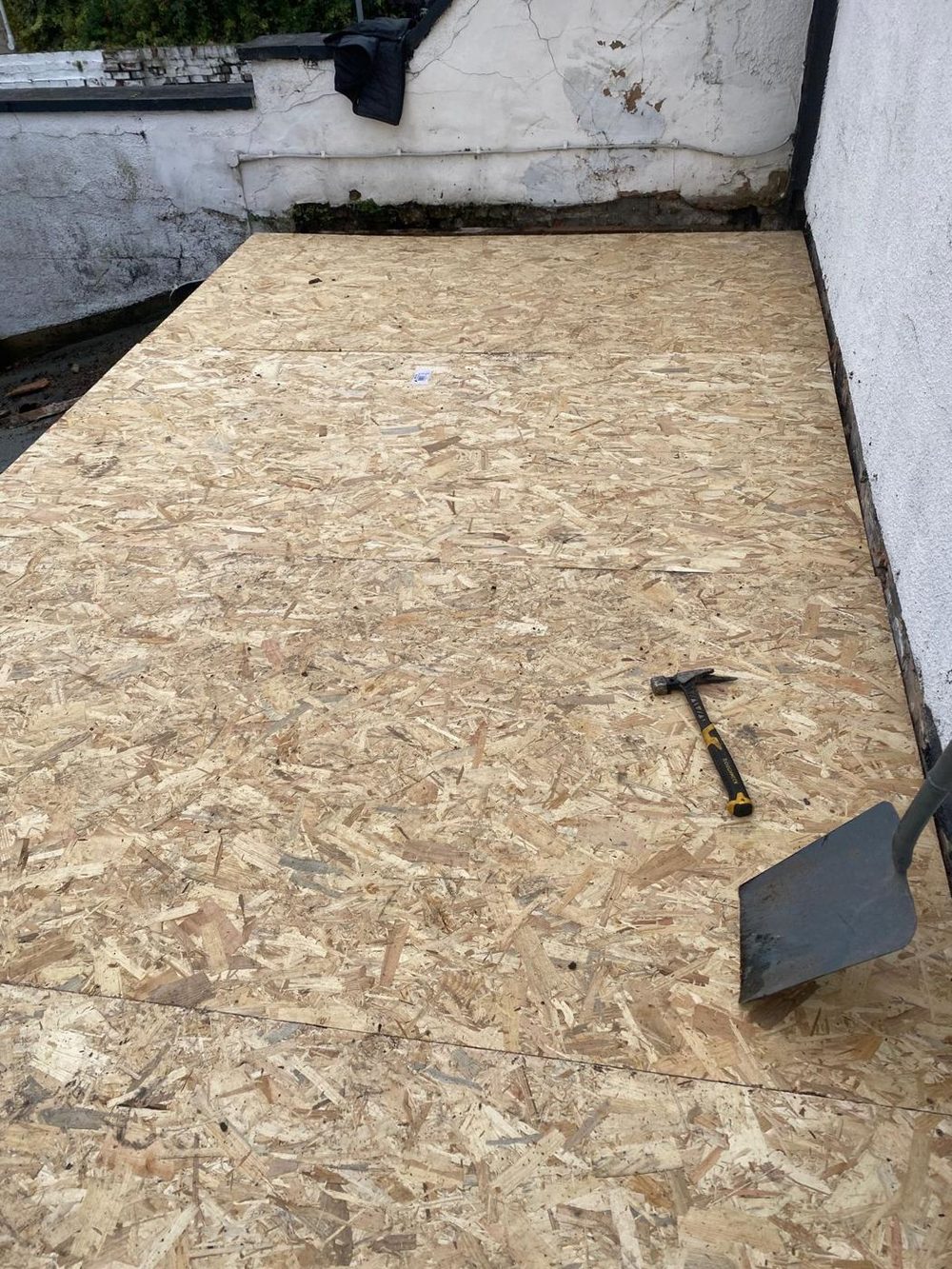
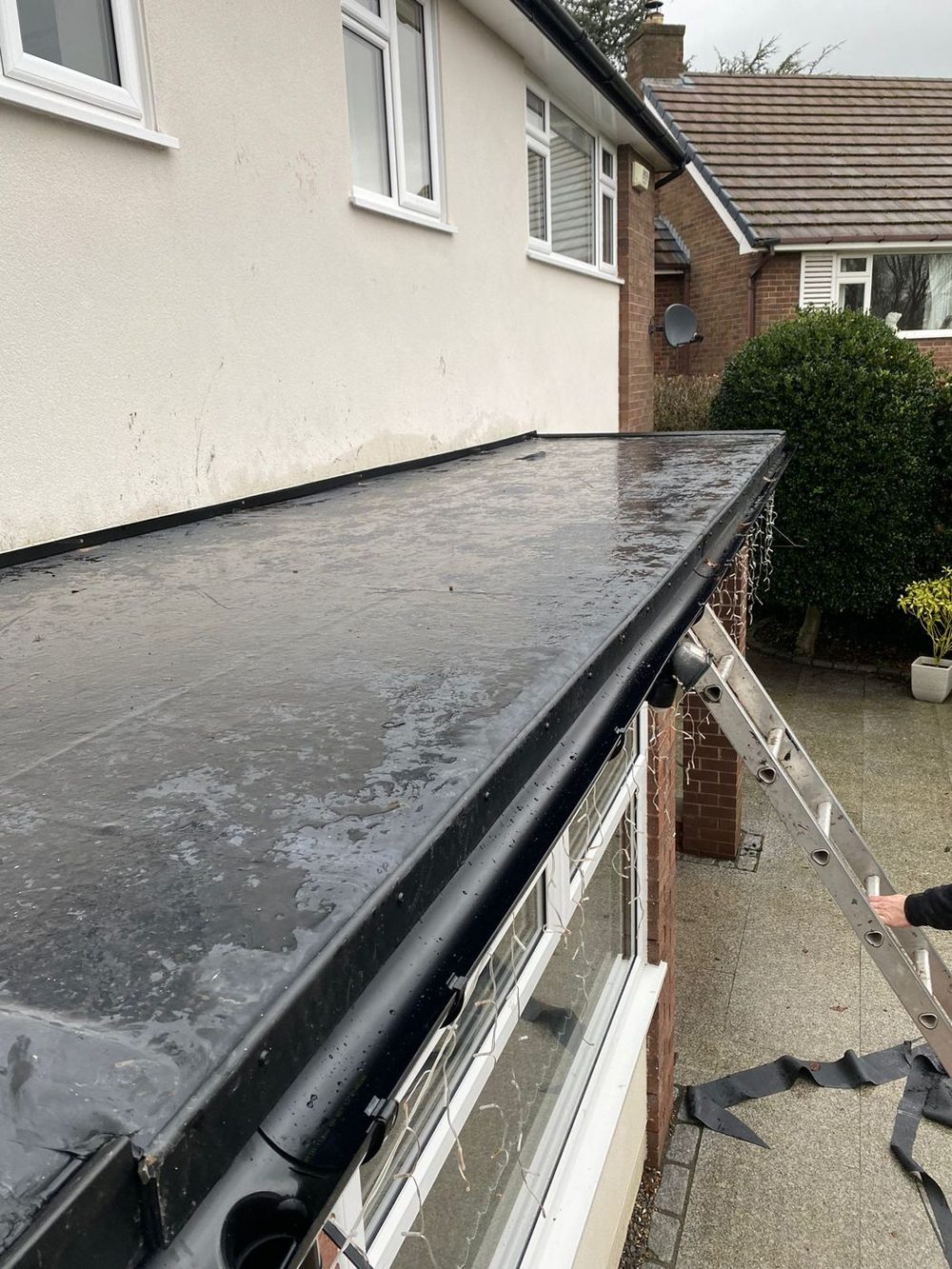
Photographs of our own flat roofing work. There are more on the main flat roof page and in the gallery.
Sandstone is lovely, and it is also soft, porous and laid in courses that will happily come apart if you attack them. Cutting a deep chase across the face of it with a grinder does not give you a neat slot: it opens the bedding planes, takes the arrises off the stone and leaves a scar nothing will put back. Old handmade brick in lime mortar behaves much the same way, only faster. This masonry will not forgive a detail designed for modern blockwork.
The hard cement fillet is the detail that does the most damage on a wall like that, and it is still being put on. A triangle of sand and cement run along the joint where the roof meets the wall looks solid on the day and is wrong in every other respect. It is rigid where everything around it moves, so it shrinks, cracks and lets water in behind. It does not breathe, so what gets in stays in. And when frost and salts do their work, the face that comes away is the stone’s, not the fillet’s.
The better answers work with the wall instead of through it. Rake out a mortar joint rather than cut the stone, and turn a separate cover flashing into it, repointed in a mortar that suits the wall rather than a hard cement one. Where the masonry is too rough or too friable even for that, the upstand is built against a timber kerb fixed back to the structure, so the covering has a straight, solid face to be carried up — a minimum of 150mm above the finished surface under BS 6229 and NHBC guidance. Why Flat Roofs Leak at the Edges goes through why this is where roofs give up.
Look along the line where the roof meets the wall before you look anywhere else. A fillet that has cracked, a flashing that has slipped out of its joint, open mortar above the roof line, or a dark band of damp on the masonry just above the covering are all the same message. So is a lump of loose render sitting on the roof, which usually means the wall has already begun letting go where something hard was fixed to it.
Indoors, this failure shows on the wall rather than the ceiling. A stain running down the inside face of the abutment wall, salt bloom on the plaster, paint lifting in a band at the height of the roof outside, or a hollow note when you tap the render below it. That is worth separating from a covering fault, because the answer can be raking out and repointing the joint and forming a proper flashing rather than renewing the roof at all.
Plots here vary enormously. The older streets in the town centre and the front at Parkgate have narrow frontages, tight kerbside parking and a long garden behind, so material often comes round or through rather than straight off the van. Roads in Little Neston, Ness and Willaston are generally more open and far easier to work from. We would rather look at the access and say what it needs than assume it and add to the job later.
Old walls change the scaffold decision too. Standing uprights on a garden wall, or tying a scaffold into soft stonework and perished lime mortar, is something to decide deliberately rather than by default, and sometimes the tie goes elsewhere or the scaffold is freestanding and weighted instead. Where a low store or garage is all that is involved, a tower is usually the answer. Scaffolding is quoted on its own, apart from the roofing work.
Old walls are rarely straight, rarely plumb and rarely square to anything. A new deck has to be scribed to the wall rather than cut to a measurement, and the gap left along it is packed and closed so it does not become a route for water or a home for anything. New boarding goes down as exterior-grade sheet on the joists, supported at every edge and noggined where board ends meet, and the build-up itself is set out on the EPDM rubber roofing page rather than argued out again here.
Falls are the other thing that often has to be corrected on an addition to an older building. On these the fall usually has to be turned away from the old wall, so that water is not being delivered against soft masonry at all, and that can mean firrings running the opposite way to the ones up there now and an outlet moved clear of the stonework altogether. Where the joists or their supports would have to change to achieve it, that is a structural engineer’s question rather than a roofer’s.
Leak tracing and repair, overlays where they are sensible, full strip-back and replacement in EPDM, new decks, corrected falls, trims, upstands and rooflight kerbs — and the pitched roof alongside when it needs it too.
“Would highly recommend roofline solutions they arrived in time an explained to me what need to be done well spoken and polite”
Kyle Cummings“Brilliant company. Did a really good job worked hard, looks really good up to my expected standards which are high. Can highly recommend them.”
CHESHIRE PORCELAIN“Very pleased with Roofline
Efficient, reliable, fast and friendly”
Written for homeowners working out what their flat roof actually needs, before anyone comes out.
Every town below has its own page, written around the flat roofs that are actually on the buildings there.
Describe the roof and roughly where you are, and we will come back to you — usually the same day. If water is coming in now, please call instead.
Prefer to talk? Call 07464 259566 · WhatsApp 0044 7464 259566 · Email Evensbuddy@yahoo.com
We cover Neston from our base at Elton, just north of Chester.
2 Manley View
Elton
Chester
CH2 4QF
Almost all of our work happens at your property rather than here, so please call before travelling.
Monday – Friday — 24hrs — Emergency Call-Outs
Saturday — 8:00 – 19:00
Sunday — 8:00 – 19:00
Weekday emergency call-outs are answered around the clock. Weekend cover is 8:00 to 19:00.