★★★★★
“Brilliant company. Did a really good job worked hard, looks really good up to my expected standards which are high. Can highly recommend them.”
CHESHIRE PORCELAIN
On a 1930s hipped semi the stack comes out of the slope with roof above it on every side, and one narrow lead trough behind it takes the lot. Back gutters, lead, pointing, heads and pots.
Bebington was built in long, steady runs between the wars. Higher Bebington, Storeton Road, Kings Lane, Town Lane, the streets around Spital and out towards Poulton went up through the 1920s and 30s as pairs of semis with bay windows, tile-hung or rendered panels and a roof hipped on every side — no gable ends, four slopes meeting at a short ridge, and a chimney stack that comes out of one of those slopes rather than off the end of the building.
That last detail is the one that matters. On a gable-ended house the stack often sits at the top of the wall with nothing above it. On a hipped roof there is nearly always roof standing above the chimney, and the slopes running up to the ridge funnel their water down onto the uphill face of the stack. Everything that lands on that wedge of tile arrives at one place, and one narrow lead trough behind the brickwork has to catch it and get rid of it sideways.
Roofline Solutions works on the whole of that junction as well as the stack above it: back gutters, aprons, soakers and stepped flashings, repointing, cutting off and re-forming heads, pots, cowls and guards, part rebuilds and removals down to roof level. We do not go inside the flue, so lining, sweeping and appliance work are for a HETAS or Gas Safe registered installer and a chimney sweep. Where the stack straddles the party line between two houses, there is more about that on the Birkenhead page.
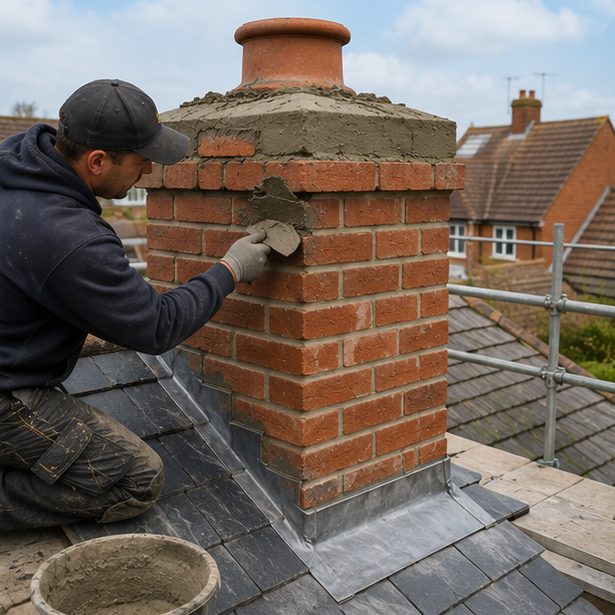
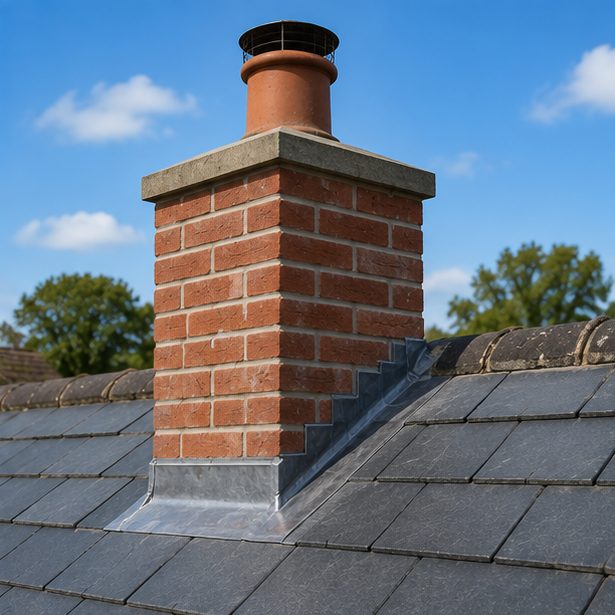
Images above are for illustration purposes only.
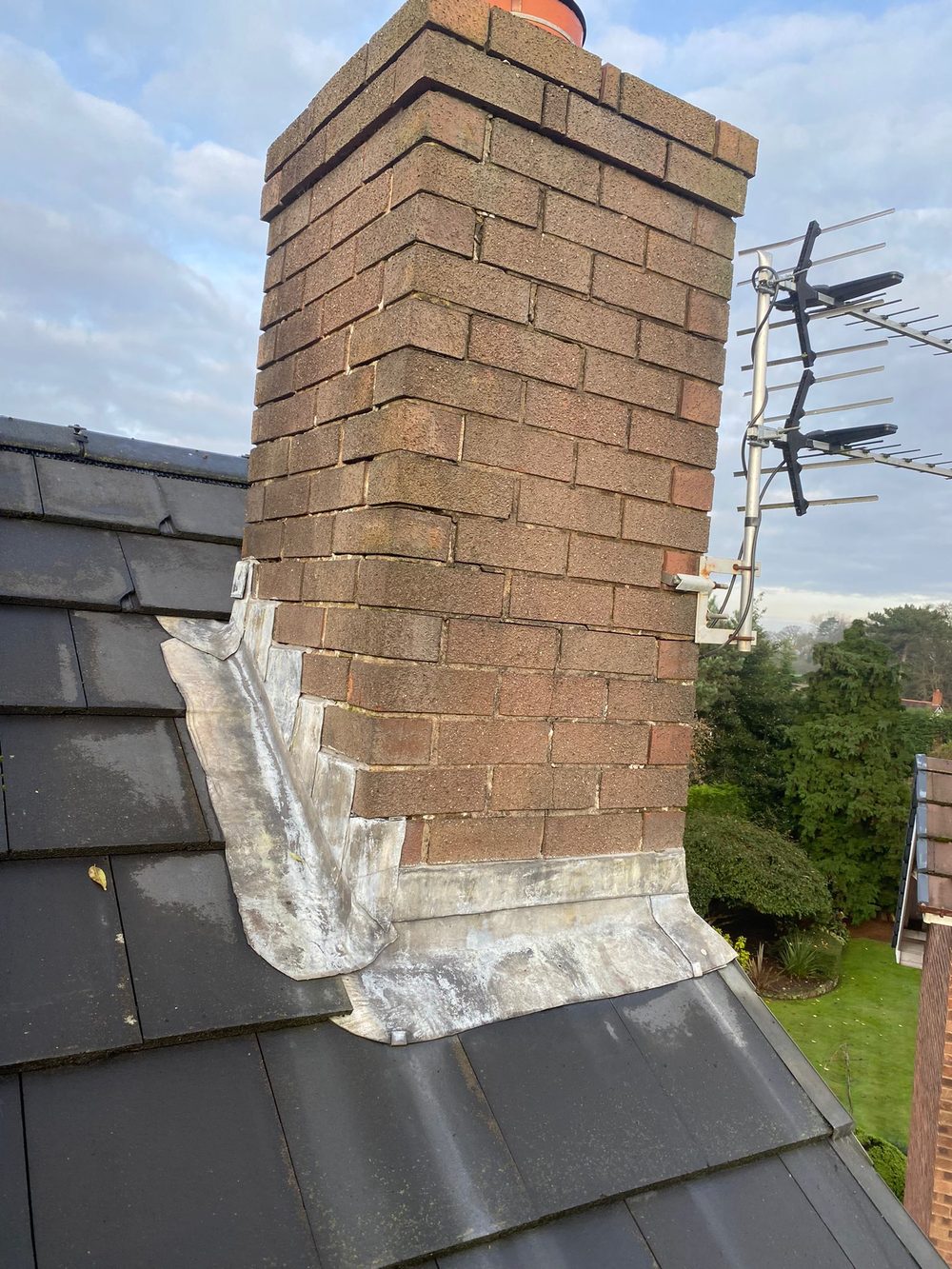
Photographs of our own chimney work. There are more on the main chimney repairs page and in the gallery.
A back gutter is the piece of lead behind a chimney on the uphill side, and on this shape of roof it is doing more work than anything else at the junction. Properly made it is a lined trough: a timber sole laid to a fall running out to each end, a tilting fillet so the lead rises rather than lying dead flat, an upstand turned into a bed joint and wedged, and a welted edge dressed out over the covering below. Water lands in it off the slope above, runs to each end and is delivered onto the roof past the side flashings. On a wide stack it is made in lapped pieces, because lead that long splits where it is fixed.
The room available for all that is whatever the builder happened to leave, and on an interwar semi it is frequently no more than a couple of hundred millimetres between the back of the stack and the tiles rising behind it. Into that gap goes a gutter with a fall, two upstands and a lap. It is no surprise that it was the detail most often skimped, and what turns up in its place is predictable: a flat strip of lead with no fall and no tilt, so water stands and creeps back through the laps; cut tiles bedded solid in mortar, which cracks within a couple of winters; an upstand tucked under a fillet rather than chased in; or flashing tape over the top of all of it.
Where the water then goes is what makes this the classic leak on these roofs. It passes over or behind the upstand into the brickwork at the point where the stack comes through, runs down inside the wall and surfaces on the chimney breast or the ceiling of the back bedroom. From indoors that looks exactly like a chimney needing repointing, and a good many of these stacks have been repointed on the strength of it and have gone on leaking. Two things follow. The back gutter is worth looking at before the mortar is, because it is the likelier culprit here. And a gutter that has leaked for years has kept the timber under it wet, so the sole board and the rafter ends want checking while it is open.
The two leak differently and you can often separate them from indoors. A back gutter leak is about volume: it appears in heavy rain whichever way the wind is blowing, it arrives quickly, and it stops not long after the downpour does. Water coming through the faces of a stack is about exposure: it follows driving rain from one quarter and takes days to dry back. If you can get into the loft with a torch while it is raining, look at the uphill side of the brickwork where the stack comes through. A wet band there, with tide marks on the rafters either side, is a back gutter.
From the ground you cannot see a back gutter at all, so you are looking for symptoms. A dark line of moss along the junction behind the stack means water is sitting there rather than running away. Mortar visible where lead ought to be, a tile obviously cut and cemented in above the chimney, or a strip of something black and shiny over the junction all point the same way. Look at the slopes either side of the stack as well: a back gutter discharges onto them, so a pair of washed streaks running down from the corners of the chimney is one that is working.
A hipped roof gives a scaffold nothing to lean against. There is no gable standing above the eaves, so the platform cannot simply be run up one end of the house; it has to be returned round the corner and out along the elevation until it reaches a stack sitting part way up a slope rather than at the ridge. It also has to stand far enough off the wall that the back gutter can be worked into from the platform rather than by kneeling in it. That is a different set-out from the same job on a gable-ended house, and it is why we want to see the roof before quoting.
The plot adds its own constraints. These semis usually have a drive down one side and a narrow passage down the other, and on a great many of them that passage has since been closed off by a garage or a side extension, so tube and boards come over a garage roof — boarded and propped first — or round through the house. Where the stack sits on the party line at the back, the platform will often overhang next door’s slope, so they need to know before anything is delivered. The covering is usually plain clay tile or an early concrete interlocking tile, neither of them safe to walk on.
When a back gutter is renewed the detail below it is renewed with it, because they are one piece of work. The side pieces run away down both slopes from the gutter’s ends: on plain clay tile that means soakers laid one per course with a stepped cover flashing chased in above them, and on interlocking concrete tile a single dressed cover flashing bossed over the profile instead, since a soaker cannot sit flat against a roll. The apron on the downhill face is dressed over the tiles below. Every piece is fixed along its top edge and left free underneath so it can move without tearing, and nothing is bonded down with mastic.
One thing specific to a hip is worth watching. Where the stack sits close to the hip itself, the back gutter has only a short run of slope to discharge onto before that slope turns away, so the outlet end has to be formed to throw water clear onto tiles rather than dribble it into the corner. At the top, most of these houses had two flues and most have been out of use since the back boiler went; sound pots are worth lifting and bedding back into a new head, and a flue that is finished with should be closed with something that still lets a little air through.
Repointing, flaunching, stack rebuilds and removals, lead aprons, soakers, stepped flashings and back gutters, pots, cowls and bird guards — and the roof around the stack when it needs attention at the same time.
“Brilliant company. Did a really good job worked hard, looks really good up to my expected standards which are high. Can highly recommend them.”
CHESHIRE PORCELAIN“Excellent work replacing ridge tiles, repointing chimney and repairing flashing. Also fixed other broken tiles. Clean and tidy job. Would definitely recommend.”
Neil“I had a leak in my vally had a number of roofers to come and take a look couldn’t find the problem Roofline’s solutions fixed the problem first time. Very happy with these guys thank you for the brilliant service”
Michael PriceWritten for homeowners working out which part of a chimney has failed, before anyone comes out.
Every town below has its own page, written around the stacks that are actually on the roofs there.
Describe what you can see and roughly where you are, and we will come back to you — usually the same day. If water is coming in now, please call instead.
Prefer to talk? Call 07464 259566 · WhatsApp 0044 7464 259566 · Email Evensbuddy@yahoo.com
We cover Bebington from our base at Elton, just north of Chester.
2 Manley View
Elton
Chester
CH2 4QF
Almost all of our work happens at your property rather than here, so please call before travelling.
Monday – Friday — 24hrs — Emergency Call-Outs
Saturday — 8:00 – 19:00
Sunday — 8:00 – 19:00
Weekday emergency call-outs are answered around the clock. Weekend cover is 8:00 to 19:00.