★★★★★
“Excellent work replacing ridge tiles, repointing chimney and repairing flashing. Also fixed other broken tiles. Clean and tidy job. Would definitely recommend.”
NeilBefore anybody quotes for chimney work, it is worth knowing whether the chimney is the source at all. This is how to narrow it down from indoors and from the garden, without going anywhere near the roof.
A mark on a bedroom ceiling shows where water finally left the structure. It does not show where the water entered it. In between those two points there is underlay, there are battens, there is a rafter and very often a purlin, and every one of those is laid at an angle or runs horizontally across the slope. Water lands somewhere above, soaks into timber, runs along the underside of it until a nail, a knot or a lap interrupts the run, and drips off there.
The practical result is that the entry point sits uphill of the damage, sometimes by a good deal more than a metre, and frequently a little to one side of it as well. Anyone who starts from “the hole must be directly above the wet patch” has already narrowed the search to the wrong part of the roof. It is better to treat the stain as the bottom of a trail and work back up it than to treat it as a target.
A chimney complicates that in one particular way. The stack is at or near the top of the slope, so almost the whole roof below it is downhill of the stack, and water that gets in at the stack can surface a long way from it. The same logic runs the other way, though, and this is the part that is worth holding on to: a stain appearing close to the chimney breast is not automatically the chimney. It is simply the place on that slope where a trail happened to end.
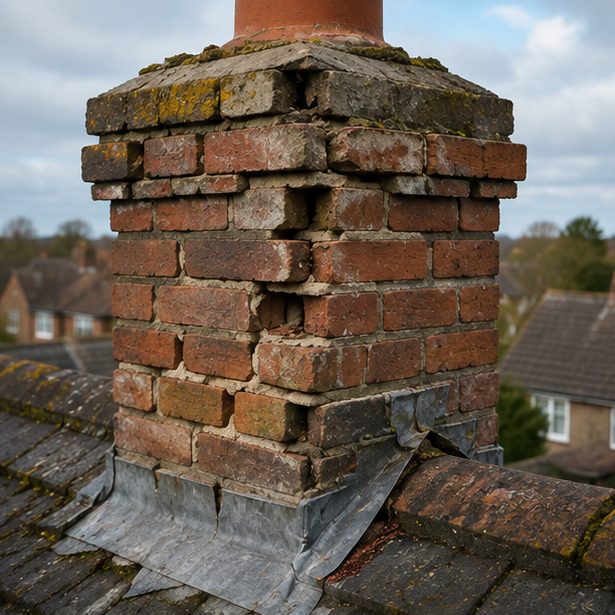
Image above is for illustration purposes only.
On an ordinary pitched roof there are six realistic sources within a few metres of a stack, and they behave differently enough to be told apart. They are the stack itself; the roof covering, meaning a slipped, cracked or delaminated slate or a tile with a broken nib; a valley where two slopes meet; a roof window; the wall of the house below the roof line; and water that is not weather at all, such as a cold-water tank, a pipe, a blocked gutter or condensation forming in the roof space.
A fault in the covering usually shows as one small spot that appears in any rain heavy enough to run, regardless of wind direction, and it stays in exactly the same place every time. A valley behaves quite differently, because a valley is carrying the water off two slopes at once. Valley trouble tends to want volume rather than wind, shows during long steady rain, and leaves a stain that is long and narrow and lines up with the valley rather than with the stack. A roof window most often shows at the top corners or along the head, and on a cold morning the water on the frame may well not be a leak at all.
Rain driven into the wall below the roof line is the one that gets mistaken for a chimney most often, because it can wet the same chimney breast. The signature is that it shows on an outside wall on more than one floor, it is worst on the face that takes the weather, and there is nothing wet in the roof space above it. And then there is the group that has nothing to do with rain: an overflowing tank, a weeping joint, a gutter that has filled with moss and is tipping water down the wall in every shower, or warm damp air condensing on cold underlay. If the ceiling is wet at the end of a dry fortnight, the roof covering is not the thing to be looking at.
Keep a note for a few weeks. The date, whether it rained, roughly how hard, and which way the wind was blowing, which you can take off a forecast page after the event if you did not notice at the time. That record is the single most useful piece of evidence in the whole business, and it is the one piece that nobody but the householder can collect, because it has to be gathered over time rather than in an hour on a Tuesday.
Read it three ways. If the damp only follows rain driven hard from one particular quarter, the water is going into an upright surface facing that way, and on a house in this part of the world that is usually something facing south-west. An exposed face of a stack qualifies; so does a gable, and so does a bare brick wall. If it follows heavy rain from any direction at all, look instead at something horizontal that is being asked to carry more than it can — a valley, a gutter, a flat area, a blocked outlet.
Then read the timing. Water that appears within an hour has taken a short and fairly open route, which usually means a gap in the covering. Water that appears half a day or a day afterwards has come through something absorbent, and masonry is the obvious candidate. A patch that goes on darkening for two days after the rain has stopped is brickwork releasing what it soaked up. And damp that is there irrespective of the weather is a different subject altogether, which is dealt with in damp on a chimney breast.
The roof space is where most of this gets settled, and it is the one place a householder can look properly and safely. Pick a wet day or the hour after heavy rain, take a good torch, and give your eyes a minute to adjust before you decide there is nothing to see. Do not climb onto the roof and do not put a ladder up the front of the house to get a closer look at the stack. A chimney stands at the highest and least forgiving point on a building, and there is nothing visible from up there that justifies the risk of getting there.
Inside, find where the chimney breast passes up through the roof space and look at the brickwork itself. A dark band across the courses, a white or fluffy bloom, or a wet trail running down one face are all worth noting, and so is which face they are on. Then look at what surrounds it: underlay that is perished or sagging with water in the fold, rusted nails, dark staining down a rafter, or a line of daylight. Follow any wet timber upwards to the highest point that is still wet and mark that spot with chalk or a strip of tape, because it is far more informative than the ceiling stain below.
Two other things are worth separating while you are up there. Water lying on top of the insulation has arrived from above; water on the underside of a rafter has run along it from somewhere else. And if there is a tank, look at it, look at its overflow, and look at the boards underneath it, because a slow tank leak imitates a roof leak convincingly and costs nothing to rule out. Photograph what you find with the flash on and note where you were standing when you took it. If the loft is boarded out or converted, none of this is available to you, and that is worth saying when you ring somebody.
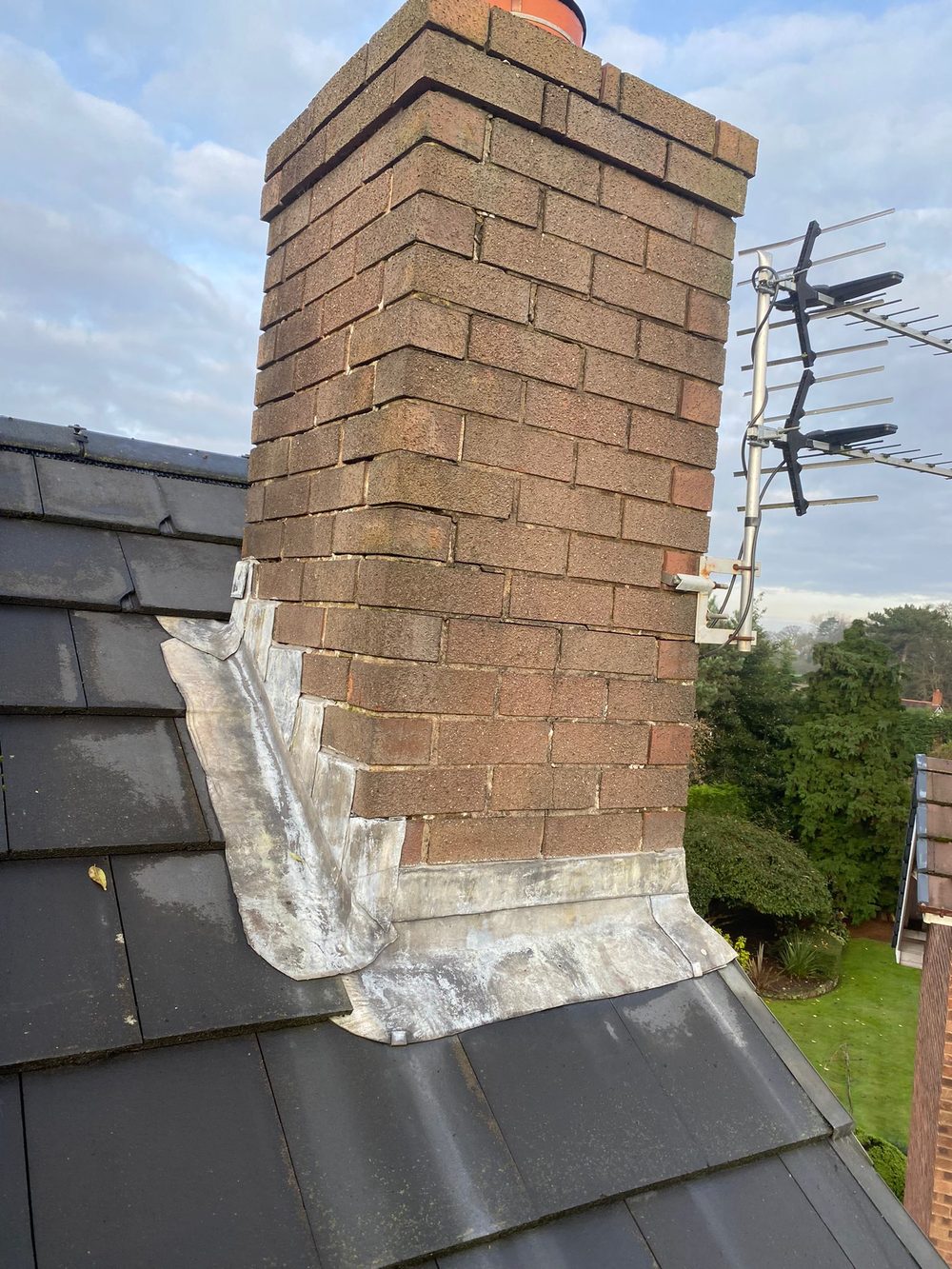
Photograph of our own work.
Three pieces of information turn a vague call into a plan: where the damp shows and when it first appeared, what sort of weather brings it on, and what the roof space looks like while it is happening. With those three, whoever comes out starts from a shortlist instead of starting from scratch, and you are far less likely to pay for work on a part of the roof that was never the problem.
Add photographs from the garden. Stand well back, zoom in on the stack, take it from two different directions, and take the roof around it as well as the stack itself. There is a separate piece on what is actually visible from down there and how to get a usable picture — see what to look for on a chimney from the ground — and it is worth doing before anyone arrives rather than after.
If the evidence does point at the stack, the next question is which part of it, and the usual answer is either the mortar or the lead at the roof junction. Those are covered in lead flashing or a cement fillet and repointing a chimney. If it points somewhere else, that is a result too: slipped slates, valleys and storm damage sit under roof repairs, and a leak around a roof window belongs with roof window work. Ruling the chimney out is every bit as useful as ruling it in.
The rest of the series, on the questions people ask most.
Every town has its own page, written around the stacks that are actually on the roofs there. Start with the main chimney repairs page.
“Excellent work replacing ridge tiles, repointing chimney and repairing flashing. Also fixed other broken tiles. Clean and tidy job. Would definitely recommend.”
Neil“The guys did a great job in repairing our chimney. They were reliable, friendly and efficient. Buddy kept me in the loop throughout the whole process and I would not hesitate to use Roofline again!”
Hollie Furnival“Highly recommend. Very quick and efficient. Great communication. Went above and beyond to work the weekend to complete the work that needed to be done. Very happy with the results.”
Karen JonesDescribe what you can see and roughly where you are, and we will come back to you — usually the same day. If water is coming in now, please call instead.
Prefer to talk? Call 07464 259566 · WhatsApp 0044 7464 259566 · Email Evensbuddy@yahoo.com
We cover Chester, Cheshire, the Wirral and Flintshire from Elton, just north of Chester.
2 Manley View
Elton
Chester
CH2 4QF
Almost all of our work happens at your property rather than here, so please call before travelling.
Monday – Friday — 24hrs — Emergency Call-Outs
Saturday — 8:00 – 19:00
Sunday — 8:00 – 19:00
Weekday emergency call-outs are answered around the clock. Weekend cover is 8:00 to 19:00.