Chimney repairs, repointing, leadwork and pot replacement across Chester, Cheshire and the Wirral by Roofline Solutions

Chimney Repairs Neston

Old Neston masonry is soft, and soft masonry wants a soft mortar. Repointing, flaunching, leadwork, pots and stack rebuilds, done in a mix chosen for the brick and stone that are already there.

★ 5.0 from 63 Google reviews
Repointing, flaunching, leadwork & pots
Fully insured
Free written quotations
Chester, Cheshire & Wirral
HomeChimney RepairsChimney Repairs Neston
Neston & Surrounding Areas

Chimney Work in Neston

Neston is largely built out of what lies underneath it. The red Triassic sandstone that runs the length of the Wirral ridge turns up in the older cottages, in field and garden walls, in church and chapel work, and in the base courses and copings of plenty of buildings whose upper storeys are brick. Add the handmade brick of the eighteenth and nineteenth century terraces at Parkgate, Little Neston and Ness, and you have a town where a great deal of the masonry is softer than most people assume.

Soft is not the same as weak, and it is certainly not a defect. Porous sandstone and underfired brick both work by letting water in and then letting it back out again. The material breathes, and provided the mortar breathes faster than the material around it, the wall goes on surviving winters indefinitely. The trouble begins the moment somebody puts a modern, strong, more or less waterproof mortar into an old wall and closes that route off.

Roofline Solutions works on the outside of chimney stacks across Neston, Parkgate, Ness, Burton and Willaston: repointing, re-forming flaunching, lead aprons, soakers, stepped flashings and back gutters, pots, cowls, part rebuilds and stack removals down to roof level. Flue lining, sweeping and appliance testing are somebody else’s trade and go to a HETAS or Gas Safe registered installer and a chimney sweep. Everything else is set out on the main chimney page.

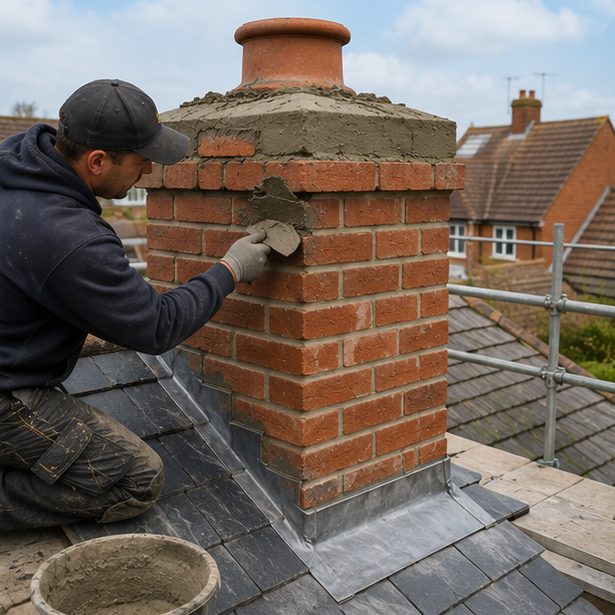
A roofer working fresh mortar into the joints of a red brick stack with a trowel, the new flaunching already formed around the pot above him

Images above are for illustration purposes only.

Our Own Work

Chimneys We Have Repaired

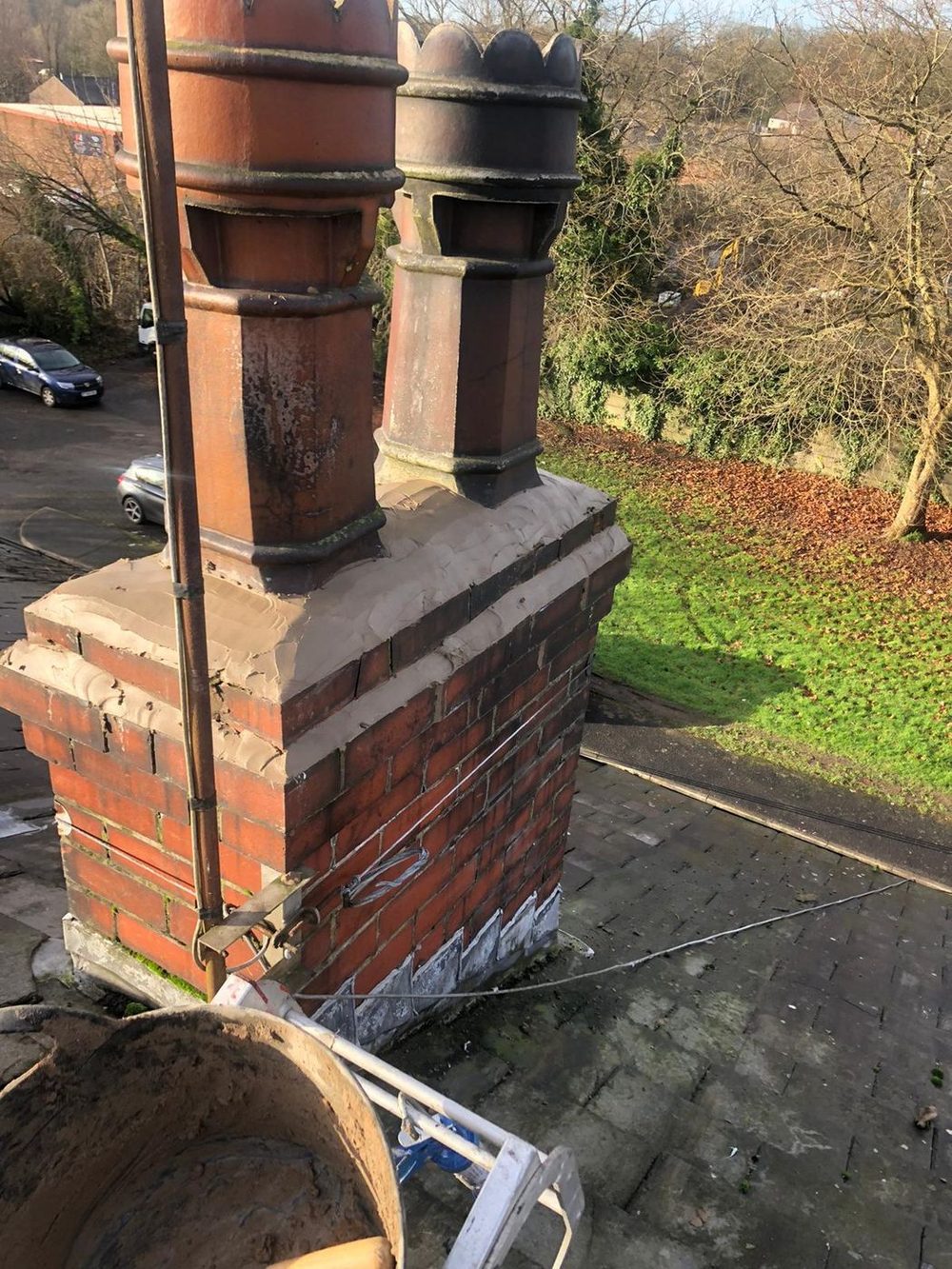
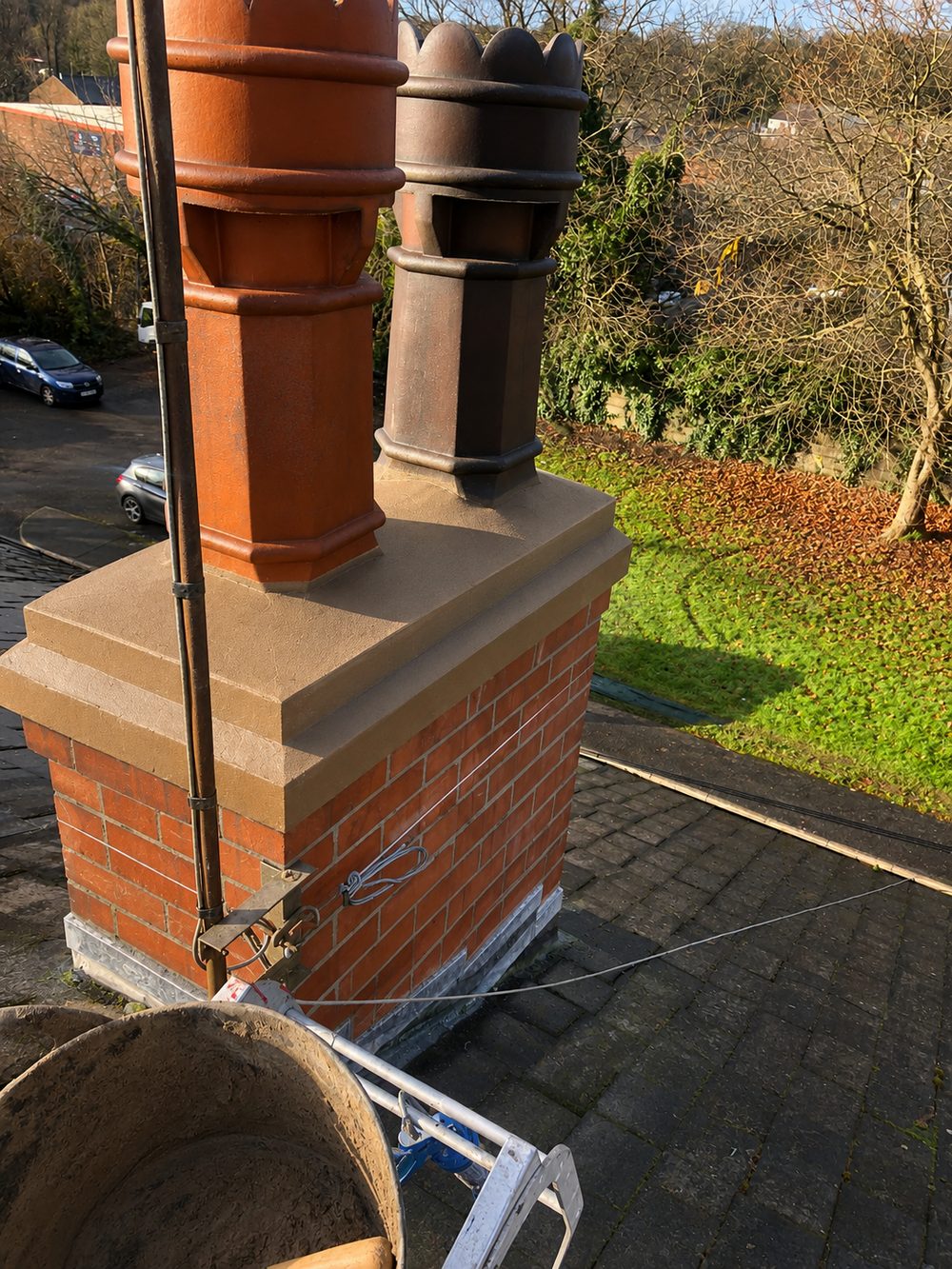
A tall Victorian stack part way through repointing, the two clay pots left standing and fresh mortar worked across the head courses The same stack finished — a new weathered head formed in two steps, the pots rebedded and the brickwork repointed throughout

Photographs of our own chimney work. There are more on the main chimney repairs page and in the gallery.

Why a Hard Cement Mix Ruins a Soft Stack

The rule is easy to say and broken constantly: the mortar must always be the weaker of the two materials in the wall. Joints are meant to be the sacrificial part of the structure. They take the movement, they take the salt, they take the freezing, and when they have had enough of it you rake them out and put fresh ones in, which on a stack is a scaffold and a couple of days. The brick and the stone are supposed to be left alone.

Point a soft stack in a strong sand-and-cement mix and the whole arrangement runs backwards. Water that used to leave through the joints now has to leave through the face of the brick or the stone, carrying dissolved salts with it. In a frost, water that cannot escape freezes just behind that face, and the face comes away. You see it here as a hard grey ribbon of pointing standing proud of brickwork that has eroded ten or fifteen millimetres behind it, and on sandstone as whole plates shearing off along the bedding planes.

The repair is a mix chosen to suit what is actually there rather than what happens to be in the van. On soft handmade brick and on sandstone that generally means a lime-based mortar, gauged and graded so that it sets slowly, stays permeable and can be worked back flush without smearing over the arris. It wants raking out to a proper depth, wetting down, filling in more than one pass where the joint is deep, and then protecting from sun, wind and frost while it cures — which is why the work is booked into settled weather instead of being squeezed into a cold snap.

How a Wrongly Pointed Stack Gives Itself Away

From the ground the tell is contrast. Look for pointing that is a different colour and a harder, flatter texture than everything around it, and for joints that stand out from the face rather than sitting slightly back within it. If the mortar lines read like a grid drawn on top of the brickwork, the brickwork behind them has already gone. On sandstone, look instead for a chalky white bloom, for arrises that have rounded off, and for thin plates lifting away from the block face.

Closer to the house, look at the ground and at the gutters. Sand and small flakes of brick face collecting on the flat roof of a bay, in a gutter, or on the path directly below the stack mean the face is coming off now rather than at some point in the past. Indoors, a damp patch on the chimney breast that worsens with driving rain off the estuary and then fades again points at the stack; one that sits there in every kind of weather is a different problem altogether, and worth saying so plainly.

Getting to the Stack in Neston

Access here is decided by the plot far more than by the roof. Along the High Street and the older Parkgate frontages the houses stand hard on the pavement with no side passage, so the scaffold goes up off the footway under a licence from Cheshire West and Chester Council, and the materials are carried in rather than driven in. Behind and around the town, out at Ness and Burton and along the lanes towards Heswall, there is usually room to stand a full scaffold in a garden.

Where there is room there is also, very often, soft ground and mature planting, and both of those matter. Scaffold standards need sole boards on a lawn or a border or they sink into it over a week, and a stack screened by a copper beech or a line of hollies has to be reached without butchering the tree to do it. On an old roof, hand-made clay tiles and thin natural slates are brittle and the battens under them are often original, so the stack is worked from the scaffold and the covering is kept off wherever it can be.

Leadwork, Pots and Cowls in Neston

Leadwork on soft masonry asks for a lighter touch than on a hard modern wall. The chase for an apron or a stepped flashing is cut into the bed joint and never into the face of a sandstone block, because a raking disc run across stone leaves a scar that cannot be pointed out afterwards. Where a stack is stone rather than brick the courses are deeper and considerably less regular, so the steps get set out to the joints that exist rather than forced into a neat, even staircase that the wall was never built to give.

Pointing the lead back in follows the same rule as everything else on the stack. The wedges are lead, and the mortar over them is the same soft mix used elsewhere, not a hard fillet that will crack across within a season. At the top, an original clay pot is worth keeping and rebedding rather than replacing, and if a cowl is going on it wants to be a pattern that suits the pot rather than a stainless drum clamped over the top of it. A bird guard is frequently all that anybody actually needs.

Please do not go up to look. A chimney is at the highest point of the roof and the ground below it is usually a path or a drive. Call 07464 259566 and describe what you can see from the garden, or send a photograph on WhatsApp — a phone zoomed in from below shows us more than you would think.

What We Do

Chimney and Roofing Services in Neston

Repointing, flaunching, stack rebuilds and removals, lead aprons, soakers, stepped flashings and back gutters, pots, cowls and bird guards — and the roof around the stack when it needs attention at the same time.

Customer Reviews

What Our Customers Say

5.0
★★★★★
63 Google reviews
★★★★★

“I needed help removing a chimney.
Buddy discussed the options available to me, taking into account my budget, timeline and DIY ability.
We settled that his team would remove the chimney to the roofline, using scaffolding and ladders.
He gave a detailed description of the steps his team were going to take, how long it would take them, and provided a fair quote.
His team were pleasant and worked efficiently. They got the job done in the estimated time and I was happy with the end result.”

Bernadett Tildy
★★★★★

“Excellent workmanship by Buddy Evans. I was impressed and amazed at how quickly the job was done. Obviously due to many years' experience. I've used several mediocre or bad roofers in the past and now I've finally found a good one.”

Czeslaw birukowsk
★★★★★

“Very professional efficient team great communication
Would definitely recommend made the process quick and easy will definitely look to keep for any future need
Thankyou”

Harry Morgan

Leave Roofline Solutions a Google review →

Advice Centre

Chimney Guides

Written for homeowners working out which part of a chimney has failed, before anyone comes out.

FAQs

Chimney Repairs Neston — Questions

How do I know whether my stack has been pointed in the wrong mix?
Look at whether the joints stand proud of the brick or the stone. Old mortar weathers back a little; hard cement does not, so when the face behind it erodes you are left with a raised grid standing off the wall. Colour is the other clue, because a grey band against warm red brick or sandstone is almost always a later cement repair. If you can scratch the wall with a key but not the mortar, the mix is too strong for it.
What is lime mortar, and is it slower to work with?
It is mortar in which lime does the binding instead of, or as well as, a large proportion of cement. It sets more slowly, stays more permeable and remains slightly flexible, which is exactly what an old soft wall needs of it. Slower is the honest answer: it wants frost-free, non-baking weather while it cures and it is protected while it does so. That is a scheduling matter rather than a reason to avoid using it.
Can a sandstone stack be repaired, or does it have to come down?
Usually repaired. Raking out and repointing the joints, replacing the occasional block that has delaminated badly and re-forming the head will take most stone stacks a very long way. Rebuilding comes into it when the stone has broken down through its thickness or the stack has moved on its base. Any replacement block should be laid the same way up as it sat in the quarry, or it will flake exactly as the last one did.
Should the flaunching be lime as well?
Not necessarily. Flaunching sits fully exposed on top of the stack with nothing over it and its whole job is to shed water, so it is normally made stronger than the wall pointing and gauged rather than left as pure lime. What matters more is the shape: formed to a fall with a drip at the edge, thicker at the pot than at the perimeter, and the pots bedded back while it is still green. A flat flaunching holds a puddle whatever it is mixed from.
Do you match the mortar colour to the rest of the wall?
As closely as the sand allows, because mortar colour comes mostly from the sand in it. The match is therefore made by choosing a sand rather than by adding a dye, which fades unevenly. On older work around here that tends to mean a warm, slightly gritty sand rather than the sharp grey builder’s sand that comes as standard. We would far rather put a sample panel on the stack and have you look at it first.
Where We Work

Chimney Repairs Across Cheshire & the Wirral

Every town below has its own page, written around the stacks that are actually on the roofs there.

Free Quotation

Tell Us About the Chimney

Describe what you can see and roughly where you are, and we will come back to you — usually the same day. If water is coming in now, please call instead.

Prefer to talk? Call 07464 259566 · WhatsApp 0044 7464 259566 · Email Evensbuddy@yahoo.com

Find Us

Roofline Solutions, Elton, Chester

We cover Neston from our base at Elton, just north of Chester.

Where We Are

2 Manley View
Elton
Chester
CH2 4QF

Almost all of our work happens at your property rather than here, so please call before travelling.

Opening Hours

Monday – Friday — 24hrs — Emergency Call-Outs
Saturday — 8:00 – 19:00
Sunday — 8:00 – 19:00

Weekday emergency call-outs are answered around the clock. Weekend cover is 8:00 to 19:00.