★★★★★
“Excellent work replacing ridge tiles, repointing chimney and repairing flashing. Also fixed other broken tiles. Clean and tidy job. Would definitely recommend.”
Neil
On a Birkenhead terrace the stack usually straddles the party wall, so half of it is next door’s. Repointing, flaunching, leadwork, pots and rebuilds, with the ownership worked out before anybody goes up.
Birkenhead was laid out quickly and built densely. The grid around Hamilton Square, the long rows running out through Tranmere, Rock Ferry, Claughton and the North End, and the later streets behind Prenton and Oxton all went up as terraces and tight semis for people working the docks and the yard. Terraced building means party walls, and party walls mean party stacks.
On most of those roofs the chimney is not one household’s property at all. The party wall carries on up through the roof and becomes the stack, flues from both houses rise inside the same block of brickwork, and the boundary runs somewhere through the middle of it. The stack was built as one object and it fails as one object, but it is owned by two people who have probably never discussed it.
Everything on this page is outside work: repointing, re-forming flaunching, renewing lead aprons, soakers, stepped flashings and back gutters, pots, cowls and bird guards, part rebuilds, and taking a stack down to roof level where both sides want it gone. Lining a flue, sweeping it or commissioning an appliance is not roofing and goes to a HETAS or Gas Safe registered installer and a sweep. The roof around the stack is covered under roof repairs.
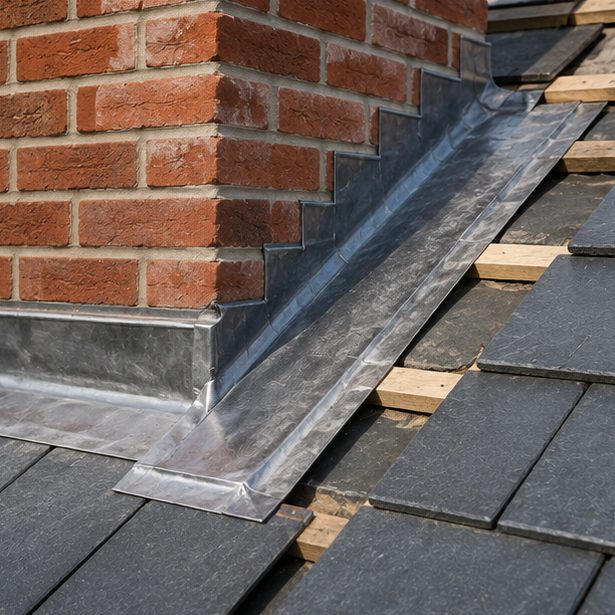
Images above are for illustration purposes only.
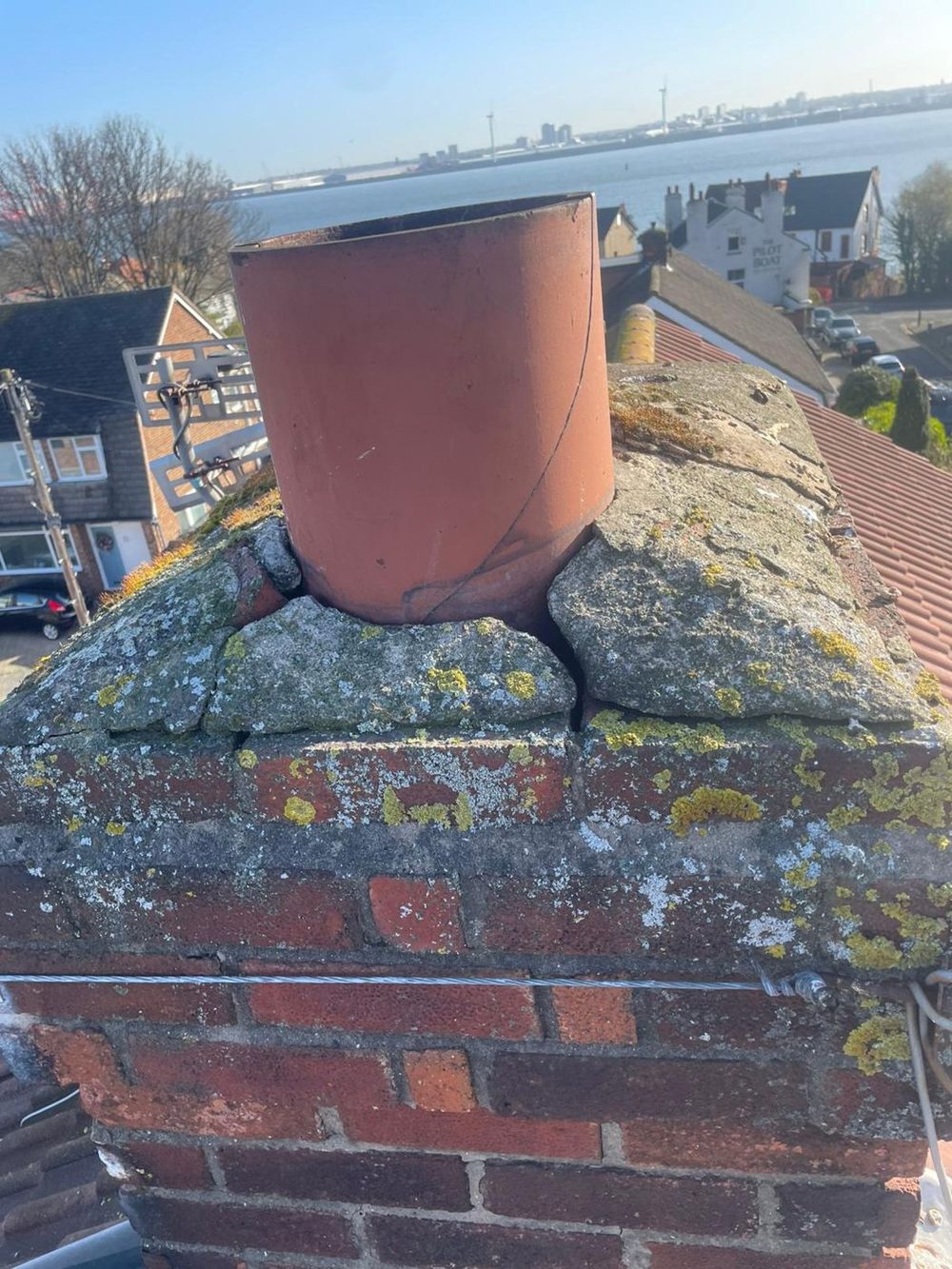
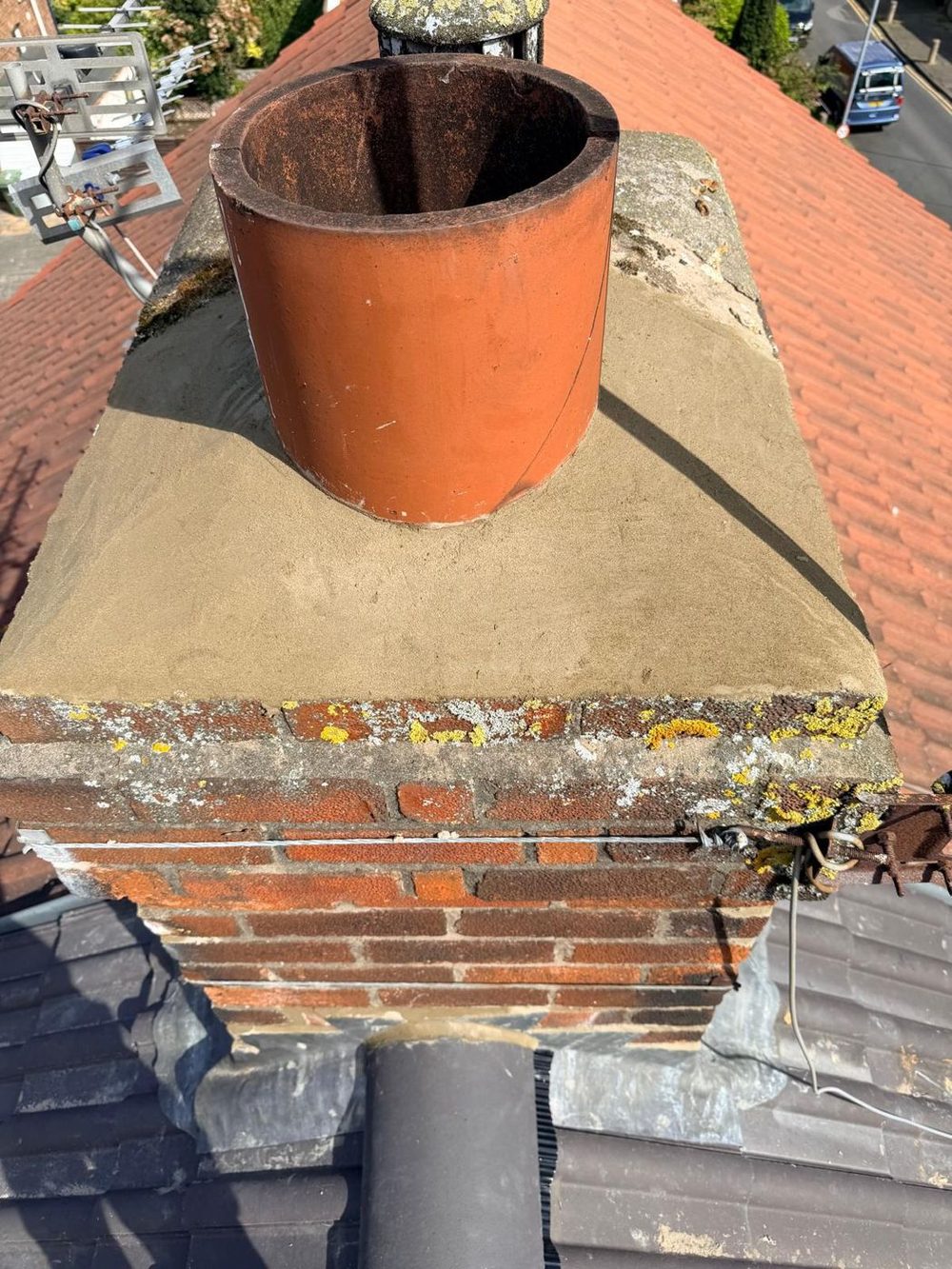
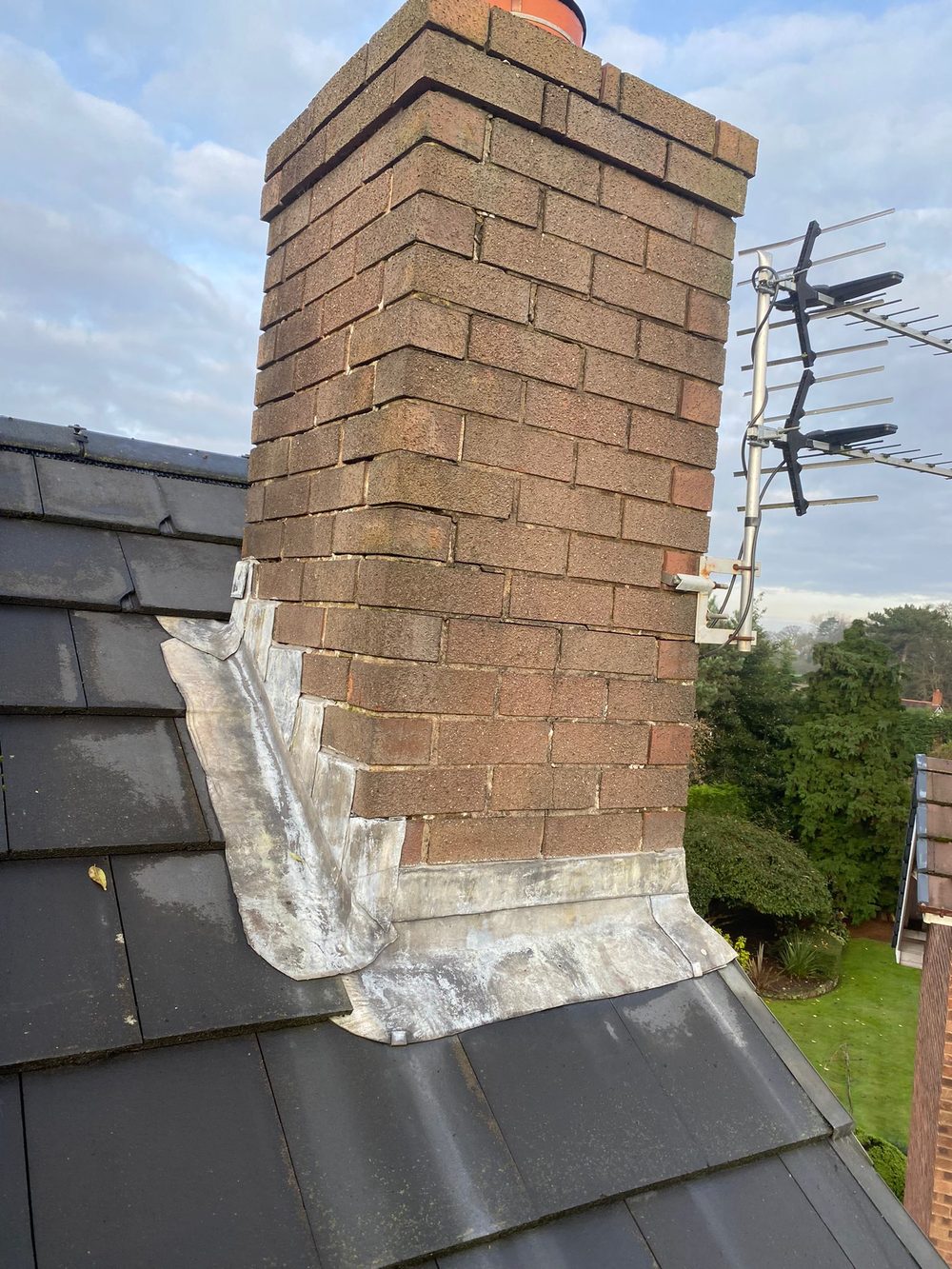
Photographs of our own chimney work. There are more on the main chimney repairs page and in the gallery.
Nobody owns a party stack in halves you could draw with a ruler. In most Victorian terraces the flues cross over inside the brickwork as they rise, so the flue from your front room may well come out at the far side of the head and your neighbour’s at yours. The pots are the most reliable guide to which flue belongs where, but the masonry underneath them is genuinely shared, which means water getting in on their face comes out on yours.
For ordinary repair that is a practical problem rather than a legal one. Pointing two faces of a four-faced stack is not a repair, it is half of one, and most of the benefit is thrown away because the wall is continuous through the middle. The sensible route on a terrace is a conversation with the neighbour before anybody quotes, so the stack is done once as a single job with the scaffold and the mortar shared between two households rather than twice, two years apart.
Where it does become a legal question is anything that cuts into, rebuilds or removes the stack. Work to a party structure can be notifiable under the Party Wall etc. Act 1996, and that is worth establishing before a scaffold is ordered rather than afterwards. A shared stack also cannot be taken down by one side alone: while your neighbour’s flue is still serving a fire or a boiler, the stack stays. Anything below roof level — breast removal, gallows brackets, propping — belongs to Building Control and a structural engineer and never to a decision made on a roof.
The awkward thing about a mid-terrace party stack is that two of its four faces look out over a view you do not have. From your own back garden you see one long face and one end. From the street you get the other end and, if the row steps down a hill, a sliver of the far face. The rest is visible only from next door or from the air, which is why so many terrace stacks are first diagnosed from inside somebody else’s loft.
What you can check is still worth checking. Cracked or missing mortar around the pots on the head. A pot that is tilting, or one that has gone altogether and been replaced with a slab. A grey cement fillet at the roof junction where there should be a lead apron and a stepped flashing. And indoors, a stain on the chimney breast in the back bedroom, or a damp patch on the party wall itself, which on a shared stack can mean the water is entering on a face you have never once laid eyes on.
Scaffolding a party stack is a permissions job as much as a scaffolding job. The stack sits over the boundary, so the platform nearly always has to stand or tie on both sides of it, and that needs the neighbour’s agreement in advance, because a scaffold cannot be tied into brickwork that is not yours without asking first. On a mid-terrace with no side passage the tube and boards come through the house or over a back yard wall, and that has to be arranged rather than assumed on the morning.
The street is the other constraint. Terraces here mostly have the front wall on the footway with residents’ parking down both sides, so a pavement scaffold needs a licence from Wirral Council and the bay underneath it has to be suspended for the duration. Where a rear yard is big enough, the scaffold goes up at the back instead, which is quicker and always less disruptive. We look at both when we survey, and at how the row behaves towards Wallasey where the plots open out.
A full lead set at a party stack physically crosses the boundary and there is no way round that. The front apron runs across the downhill face, the soakers interleave with the slates course by course up both sides, and the back gutter behind the stack spans the entire width of the brickwork and discharges onto whichever slope it can reach. On a shared stack that means dressing lead onto two households’ roof coverings, so both of them need to know it is happening before it does.
These terraces are mostly roofed in natural slate, and slate is the covering soakers were invented for: one piece of lead per course, hidden under the slate, with a stepped cover flashing chased into the bed joints above it. If what is up there instead is a mortar fillet run round the base of the stack, it will have cracked, and on a shared stack it will be feeding water into brickwork that both houses depend on. Your pots and your neighbour’s sit in the same bed of flaunching, which is why re-forming a head is always a whole-stack job.
Repointing, flaunching, stack rebuilds and removals, lead aprons, soakers, stepped flashings and back gutters, pots, cowls and bird guards — and the roof around the stack when it needs attention at the same time.
“Excellent work replacing ridge tiles, repointing chimney and repairing flashing. Also fixed other broken tiles. Clean and tidy job. Would definitely recommend.”
Neil“Would highly recommend roofline solutions they arrived in time an explained to me what need to be done well spoken and polite”
Kyle Cummings“The men were genuine and trustworthy. Turned up every time when they said they would, and phoned ahead. Very respectful and did an amazing job.,thank you x”
freda markhamWritten for homeowners working out which part of a chimney has failed, before anyone comes out.
Every town below has its own page, written around the stacks that are actually on the roofs there.
Describe what you can see and roughly where you are, and we will come back to you — usually the same day. If water is coming in now, please call instead.
Prefer to talk? Call 07464 259566 · WhatsApp 0044 7464 259566 · Email Evensbuddy@yahoo.com
We cover Birkenhead from our base at Elton, just north of Chester.
2 Manley View
Elton
Chester
CH2 4QF
Almost all of our work happens at your property rather than here, so please call before travelling.
Monday – Friday — 24hrs — Emergency Call-Outs
Saturday — 8:00 – 19:00
Sunday — 8:00 – 19:00
Weekday emergency call-outs are answered around the clock. Weekend cover is 8:00 to 19:00.