★★★★★
“Excellent work replacing ridge tiles, repointing chimney and repairing flashing. Also fixed other broken tiles. Clean and tidy job. Would definitely recommend.”
Neil
Six pots in one bed of flaunching is an ordinary Wallasey roof, and when that bed goes, all six are loose at once. Pointing, flaunching, pots, cowls, lead and head rebuilds, worked from a scaffold.
Wallasey filled up between about 1890 and the First World War, and the roofs still show it. Liscard, Egremont, Seacombe, Poulton and the streets behind New Brighton went up as substantial bay-fronted houses at a time when every room had a fireplace in it — front and back parlour, dining room, kitchen range, three or four bedrooms and often a servant’s room in the attic.
Every one of those fireplaces needed its own flue, and every flue needed its own pot. The result is the thing that defines a Wallasey skyline: broad, tall stacks carrying four, six or eight pots in a single row, sat high on steep slate roofs. The pots were never purely functional either. They were chosen and paid for as part of the architecture — tall moulded cans, octagonal and roll-topped patterns, buff and black salt glazes alongside the red — and a builder set them out in a line because the line was meant to be looked at.
This page deals with the outside of those stacks: repointing, re-forming the flaunching that all those pots sit in, replacing and rebedding pots, cowls and bird guards, lead at the roof junction, head rebuilds and stack removals. It is not flue work. Lining, sweeping and appliance testing belong to a HETAS or Gas Safe registered installer and a chimney sweep, and we will point you at one rather than take the job. There is more on the main chimney page, and the neighbouring town page is Wirral.
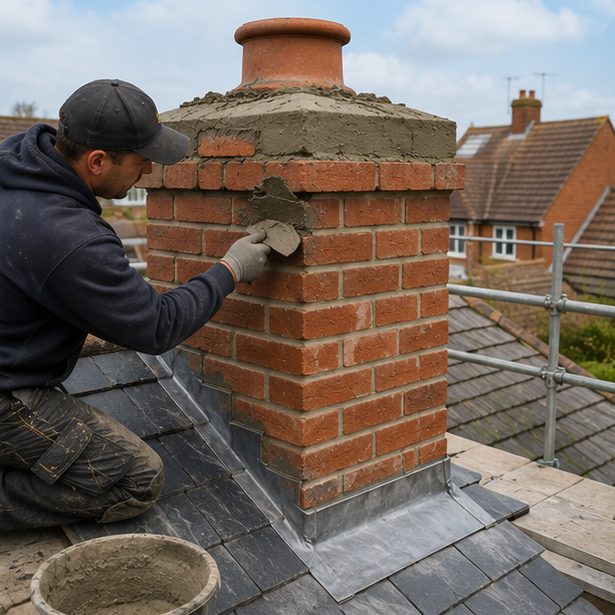
Images above are for illustration purposes only.
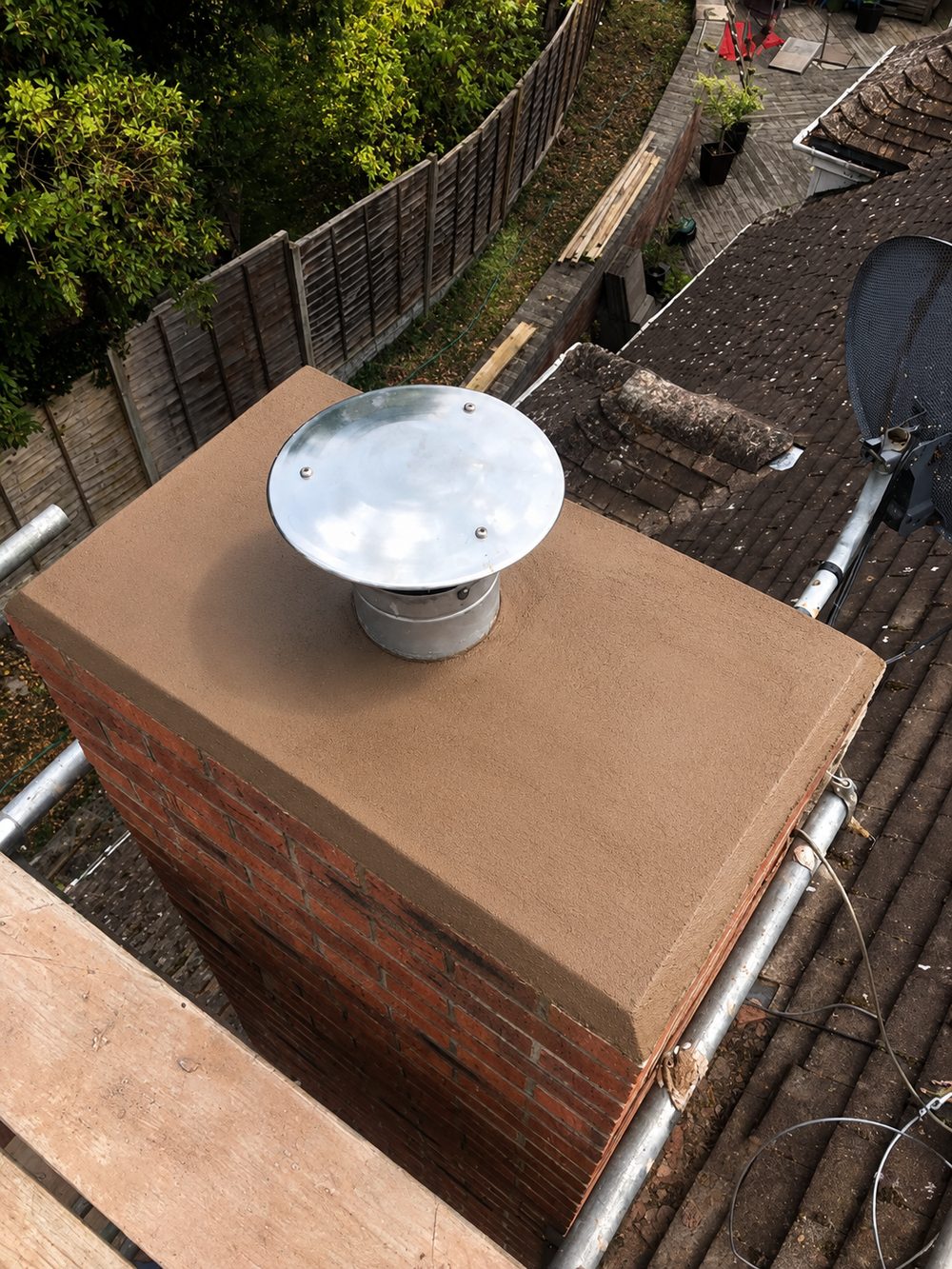
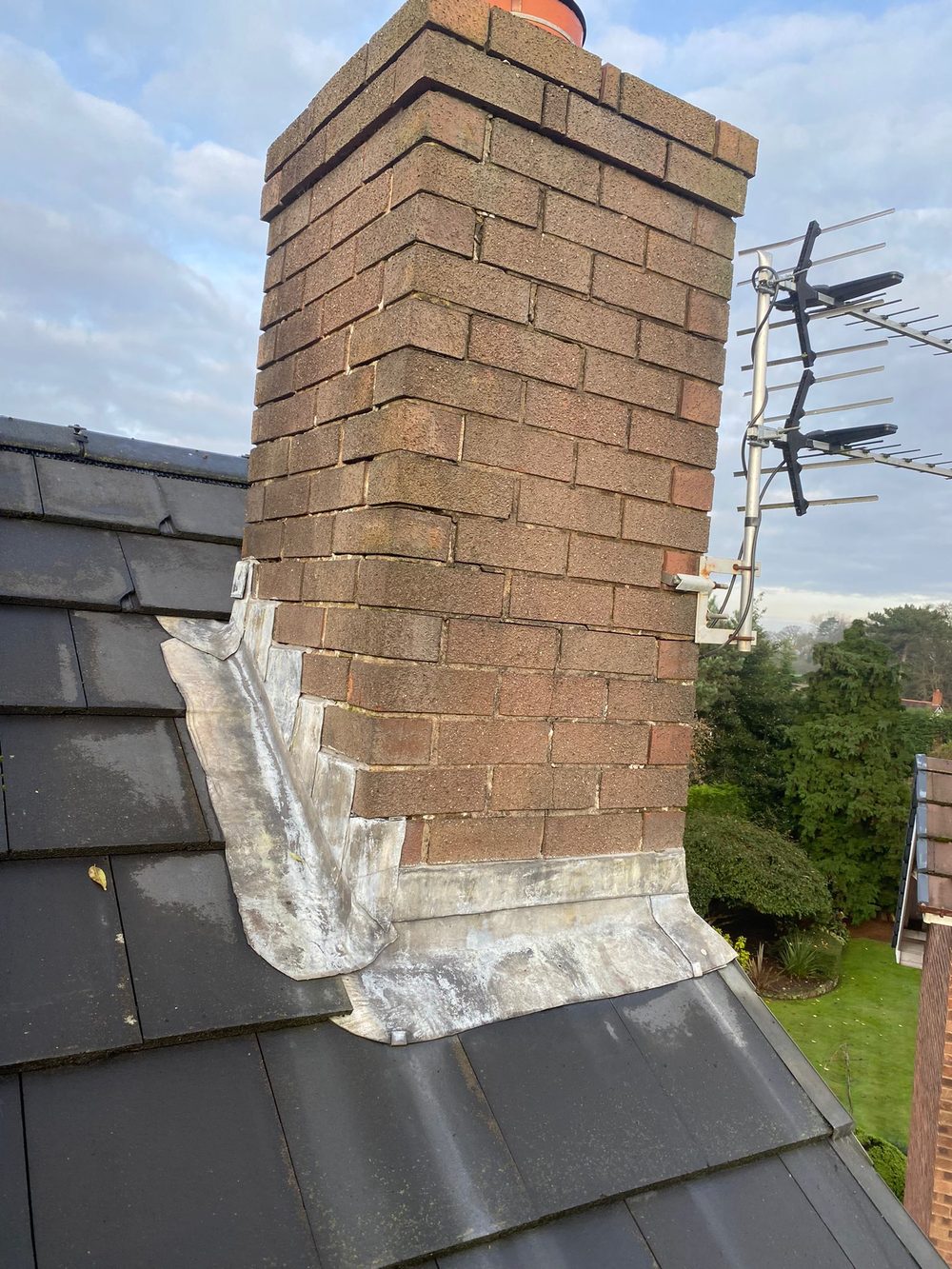
Photographs of our own chimney work. There are more on the main chimney repairs page and in the gallery.
A multi-pot head is not the same object as a single-pot one, and the difference is structural rather than decorative. All of those pots are bedded into one continuous sloping bed of mortar spanning the whole top of the stack. That bed is what holds every pot upright, and each pot in turn is braced by the mortar packed against its neighbours. It works very well while it is intact. When it lets go, it does not let go under one pot — the whole head fails together, and a row of six tall cans on a steep roof above a street is a different order of problem from one loose pot on a bungalow.
Underneath the bed, the stack is divided internally by withes: the thin brick partitions, a single brick on edge, that separate one flue from the next all the way up. They are the reason a wide stack is not a solid block and the reason the head has to be treated opening by opening. It is also why nobody should simply lift the pots off and trowel the whole top over. Each flue opening has to be dealt with on its own terms — kept live, or closed off at the top course and left able to breathe — and the withes near the head are often the first brickwork in the stack to have gone soft, because they are thin, they are wet and they are sooty on both sides.
Most of these flues have been out of use for fifty years, and the temptation is to strip the pots and flatten the head into a slab. It is quicker and it looks tidy from the scaffold, and it takes the character off the house permanently. The better job keeps the pots: they come off while the head is re-formed, the sound ones go back into the new flaunching, and the redundant ones are finished with a cap or a guard that suits their profile. Where one is broken beyond saving, it is worth hunting a salvaged pot of the same pattern and height, because a single plain can in a row of six moulded ones is the first thing anybody sees.
A row of pots gives you a reference that a single pot cannot: they should all stand at the same height, in the same line, and dead upright. One leaning out of true, one sitting visibly lower than the rest, or a gap of dark shadow where the mortar has fallen away from a base all mean the bed has failed around it. Cracks in a pot usually start at the rim and run down, and lichen or moss growing across the head is a fair sign that the mortar up there is holding water rather than shedding it.
Look for the substitutes as well, because they are common on these roofs and they are rarely good news. A pot replaced with a plastic cap, a paving slab laid across two openings, or a sheet of tin wired down means an earlier problem was closed rather than repaired. Jackdaws are the other thing to watch for around Liscard and New Brighton: sticks showing above a rim in spring mean a flue has been filled, and pieces of flaunching turning up in a valley or a gutter below the stack mean the head is shedding itself a bit at a time.
These are tall houses, and the scaffold reflects it. A three-storey bay-fronted Edwardian house with attic rooms puts the stack a lift or two higher than the same job on a semi, and the front gardens are usually too shallow to take the base, so the platform goes up off the footway with a licence from Wirral Council and the residents’ parking bay under it suspended. Where there is a rear entry or a yard big enough, working from the back is quicker and disturbs far fewer people.
Getting the pots down is its own piece of planning. A tall clay pot is heavy, awkward and brittle, and six of them cannot be handed down a ladder or sent down a chute; they come off one at a time and are lowered, which is a slow morning nobody should be rushing. Anything being kept is set aside on boards rather than stood on the slates, where it will slide. The other constraint is the weather off the river at New Brighton, which will stop mortar work on an exposed frontage on days when a sheltered street in Birkenhead is perfectly workable.
A six-flue stack is wide, and width is what makes the leadwork here different. The back gutter behind a stack more than a metre across cannot be a single dressed piece; it is lapped, and on the widest stacks it is formed over a timber tilt with a fall running out to each side so the water is delivered onto the slope rather than sitting behind the brickwork. That gutter is invisible from the ground and it is the commonest place for one of these stacks to be letting water in while everything on show looks sound.
The rest of the set suits natural slate, which is what most of these roofs are: soakers laid one per course and hidden under the slate, a stepped cover flashing chased into the bed joints above them, and a front apron across the downhill face. At the top, a cowl on a decorative pot wants choosing with the pot in mind. A terracotta or black pattern that sits inside the rim disappears; a bright stainless drum clamped over a moulded buff can does not. Bird guards need sizing to the actual rim rather than bought by the boxful, because the pots on one of these heads are not always the same diameter as each other.
Repointing, flaunching, stack rebuilds and removals, lead aprons, soakers, stepped flashings and back gutters, pots, cowls and bird guards — and the roof around the stack when it needs attention at the same time.
“Excellent work replacing ridge tiles, repointing chimney and repairing flashing. Also fixed other broken tiles. Clean and tidy job. Would definitely recommend.”
Neil“I needed help removing a chimney.
Buddy discussed the options available to me, taking into account my budget, timeline and DIY ability.
We settled that his team would remove the chimney to the roofline, using scaffolding and ladders.
He gave a detailed description of the steps his team were going to take, how long it would take them, and provided a fair quote.
His team were pleasant and worked efficiently. They got the job done in the estimated time and I was happy with the end result.”
“Highly recommend. Very quick and efficient. Great communication. Went above and beyond to work the weekend to complete the work that needed to be done. Very happy with the results.”
Karen JonesWritten for homeowners working out which part of a chimney has failed, before anyone comes out.
Every town below has its own page, written around the stacks that are actually on the roofs there.
Describe what you can see and roughly where you are, and we will come back to you — usually the same day. If water is coming in now, please call instead.
Prefer to talk? Call 07464 259566 · WhatsApp 0044 7464 259566 · Email Evensbuddy@yahoo.com
We cover Wallasey from our base at Elton, just north of Chester.
2 Manley View
Elton
Chester
CH2 4QF
Almost all of our work happens at your property rather than here, so please call before travelling.
Monday – Friday — 24hrs — Emergency Call-Outs
Saturday — 8:00 – 19:00
Sunday — 8:00 – 19:00
Weekday emergency call-outs are answered around the clock. Weekend cover is 8:00 to 19:00.