★★★★★
“I had a leak in my vally had a number of roofers to come and take a look couldn’t find the problem Roofline’s solutions fixed the problem first time. Very happy with these guys thank you for the brilliant service”
Michael Price
A rebuilt head is only as good as the brick it is rebuilt in, and the Wirral has no single brick. Repointing, flaunching, leadwork, pots, part rebuilds and stack removals across the peninsula.
The Wirral is not one kind of place and it has never been built in one kind of brick. Within a few miles of each other there are Georgian and early Victorian houses in soft handmade red, the hard pressed reds of the railway suburbs, the sandstone and half-timbering of Port Sunlight, interwar semis in sand-faced stock, vast post-war estates in Fletton commons, and late-century development in wirecut brick that came off a machine. Twenty streets can hold five centuries of brickmaking.
That matters far more than it sounds, because the commonest substantial chimney job is not a full rebuild but a part one. The top of a stack takes nearly all the punishment, so the usual repair is to take the head and the upper courses down to sound brickwork and rebuild from there, keeping the original pots. The stack then becomes two things joined in the middle: a century of weathered original work, and a new piece sitting on top of it against the sky.
Roofline Solutions covers the whole peninsula for the outside of the stack — pointing, flaunching, lead aprons, soakers, stepped flashings and back gutters, pots, cowls and bird guards, part and full head rebuilds, and removals down to roof level. Lining a flue, sweeping it or commissioning an appliance is not roofing and is left to a HETAS or Gas Safe registered installer and a sweep. Individual towns have their own pages, from Birkenhead round to West Kirby.
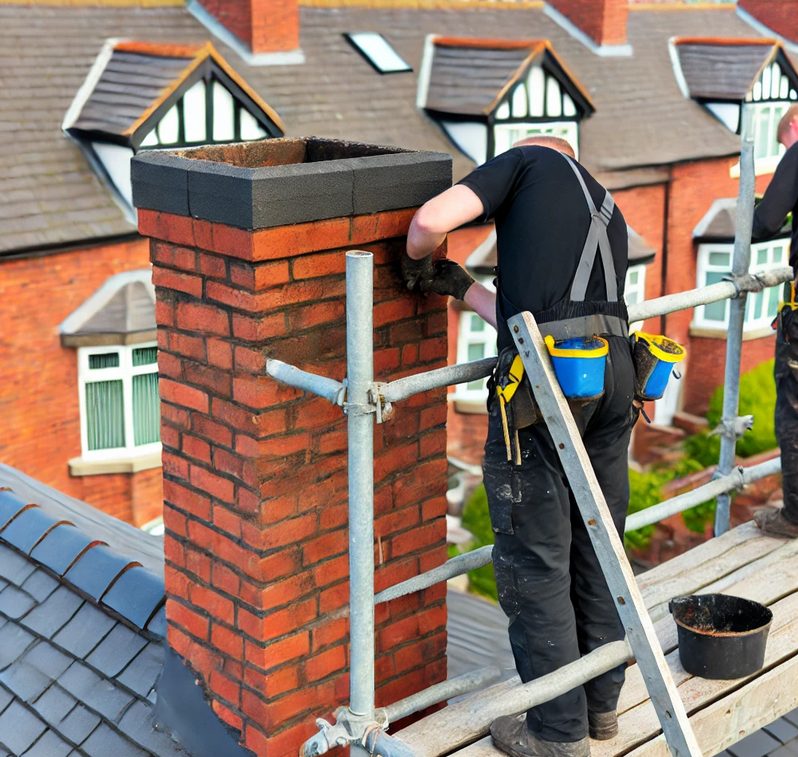
Images above are for illustration purposes only.
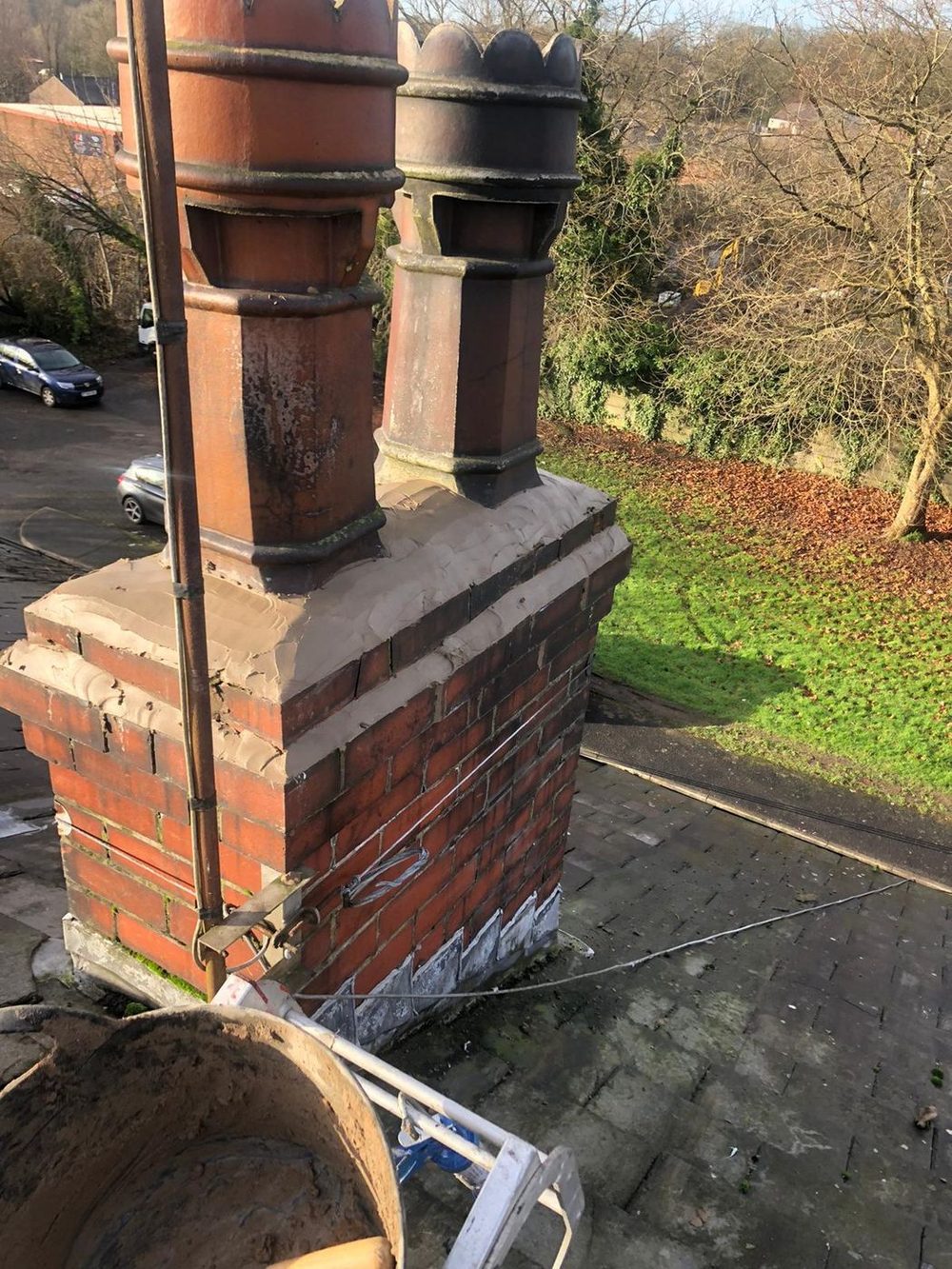
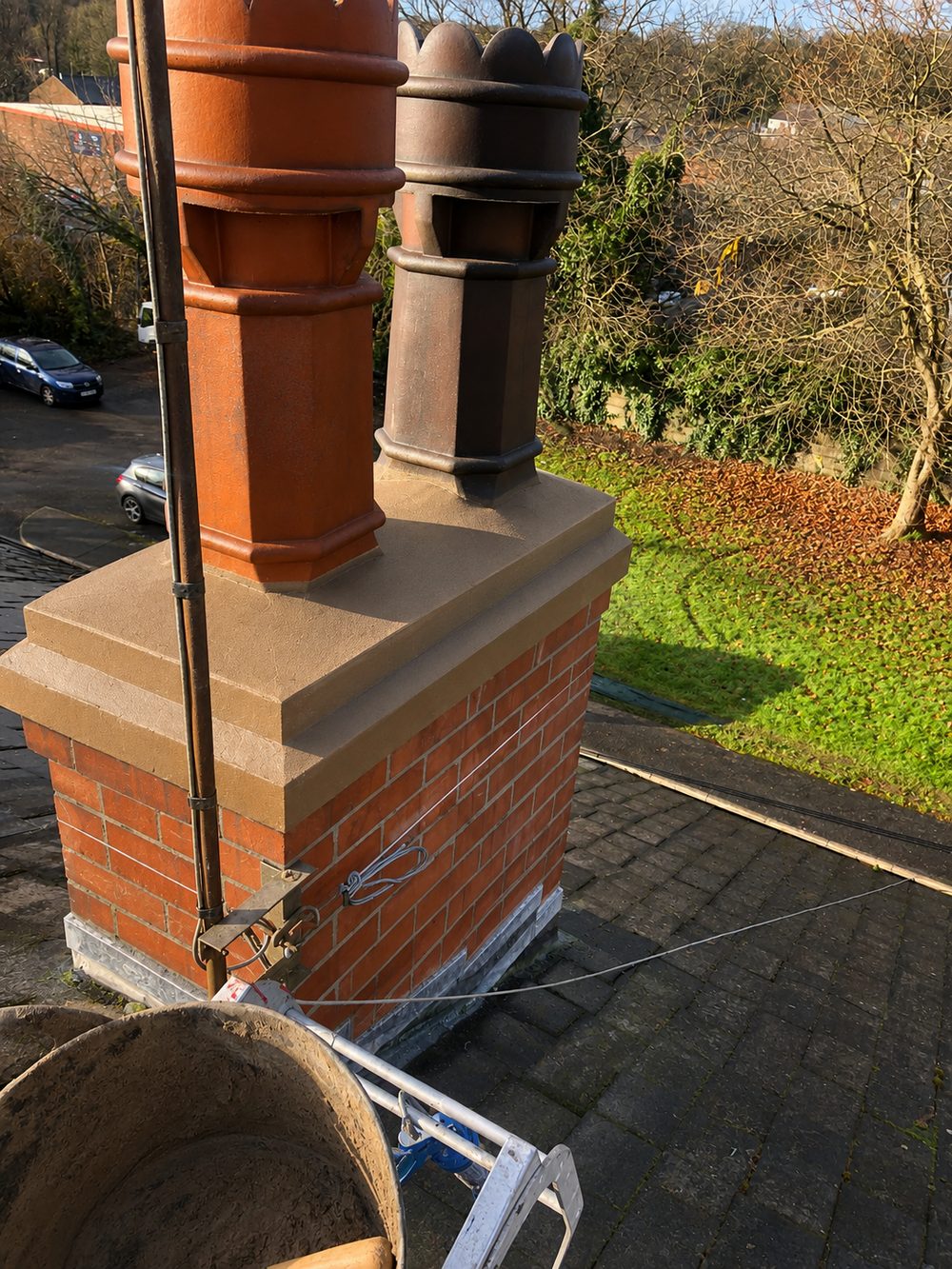
Photographs of our own chimney work. There are more on the main chimney repairs page and in the gallery.
A new head in the wrong brick is visible from the far end of the street, and it is visible for the rest of the building’s life. Three things give it away, and size is the first. Old bricks were made to imperial dimensions and they are not all the same; a nineteenth-century brick is commonly a few millimetres deeper than the 65mm metric brick that a merchant will sell you today. Over eight courses that difference adds up to most of a course, so the new work either sits at a different gauge from the old or the joints have to be fattened to hide it, and both of those read as wrong even to somebody who could not say why.
Texture and colour are the other two. A machine-made wirecut brick has sharp arrises, a flat even face and a consistent colour, while a pressed or handmade brick has soft edges, a sanded or creased face and a colour that varies brick to brick across the wall. Put one above the other and the new work looks like a patch even when the shade is close, because the eye picks up the evenness rather than the hue. Nor does a hundred years of weather solve it: the old work is stained and the new is not, and they do not converge.
The answer is usually reclaimed brick of the right period and the right size, chosen for the range of colour in the batch rather than the average of it, and laid in the same bond with the same joint thickness and the same profile as the original. Two cautions go with that. A reclaimed brick must be sound and frost-resistant, because a soft common salvaged out of an internal wall will not last a winter on top of a chimney. And there is a trick worth asking for: on a part rebuild the bricks that come off the stack are the perfect match by definition, so where they are still hard they get cleaned off and re-laid on the faces that show, with the new brick kept for the back, the inside of the flue or below the lead line.
Plenty of Wirral stacks have already had something done to them, and the previous attempt tells you what you are inheriting. Look for a band of different brick in the top few courses, for a head that is visibly narrower than the stack below it because only one skin was rebuilt, for a concrete slab laid across the top in place of a formed flaunching, and for a grey collar of hard cement render wrapped round the upper courses to hold together whatever is behind it.
The pots are the other record. Original moulded pots swapped for plain squat terminals, or a row where one is obviously a different height and colour from the rest, means somebody has been up there. None of that is automatically bad work. What it does mean is that the cause may never have been dealt with, that there is probably no damp-proof tray in the stack, and that the next repair needs to look at what is under the patch rather than simply tidying the outside of it.
Access on the peninsula varies more than anywhere else we cover, and it is decided house by house rather than town by town. A detached house on a wide plot takes a full scaffold off the drive in a morning; a mid-terrace with no side passage needs a carry-in or a pavement licence from Wirral Council, with a parking bay suspended for the duration. The survey settles that before a date is offered, because access is the part of a chimney quotation that most often changes the shape of the job.
A part rebuild adds two things a repoint does not. The brick has to arrive and be stored somewhere — a pallet of reclaims is heavy and needs hard standing, not a lawn — and the old stack has to come down and go away. Bricks are lowered rather than dropped, the scaffold is boarded and fanned where there is a conservatory, a path or a neighbouring roof underneath, and the amount of rubble that comes out of even a modest head surprises most people. Where it is going is agreed in advance.
On a part rebuild the lead is renewed as a matter of course, and not for the sake of it. The chases holding the apron and the stepped flashings are cut into the very courses that are coming down, so the old lead has to be stripped whatever its condition, and putting it back into fresh joints is a false economy when the pieces have been worked, folded and nailed for decades. A rebuild is also the only realistic chance to build in a damp-proof tray above the roof line, because it cannot be retrofitted without taking the brickwork apart again.
New lead looks startling for a few months and then settles down, and there is one step worth insisting on in the meantime. Fresh lead forms a white carbonate as it weathers, and on a rebuilt stack that white runs off in the rain and stains the slates, the tiles or the render below it. Brushing patination oil onto the finished lead on the day it is dressed stops that happening. The pots deserve the same thought: keeping and rebedding the originals is the single biggest thing that makes a rebuilt head look like it belongs, and a salvaged pot of the right profile beats a new one of the wrong one every time.
Repointing, flaunching, stack rebuilds and removals, lead aprons, soakers, stepped flashings and back gutters, pots, cowls and bird guards — and the roof around the stack when it needs attention at the same time.
“I had a leak in my vally had a number of roofers to come and take a look couldn’t find the problem Roofline’s solutions fixed the problem first time. Very happy with these guys thank you for the brilliant service”
Michael Price“The guys did a great job in repairing our chimney. They were reliable, friendly and efficient. Buddy kept me in the loop throughout the whole process and I would not hesitate to use Roofline again!”
Hollie Furnival“job well done good communication throughout the job very clean and tiddy when the job is finish flat roof replacement many thanks.”
Sumit BalWritten for homeowners working out which part of a chimney has failed, before anyone comes out.
Every town below has its own page, written around the stacks that are actually on the roofs there.
Describe what you can see and roughly where you are, and we will come back to you — usually the same day. If water is coming in now, please call instead.
Prefer to talk? Call 07464 259566 · WhatsApp 0044 7464 259566 · Email Evensbuddy@yahoo.com
We cover Wirral from our base at Elton, just north of Chester.
2 Manley View
Elton
Chester
CH2 4QF
Almost all of our work happens at your property rather than here, so please call before travelling.
Monday – Friday — 24hrs — Emergency Call-Outs
Saturday — 8:00 – 19:00
Sunday — 8:00 – 19:00
Weekday emergency call-outs are answered around the clock. Weekend cover is 8:00 to 19:00.