★★★★★
“I had a leak in my vally had a number of roofers to come and take a look couldn’t find the problem Roofline’s solutions fixed the problem first time. Very happy with these guys thank you for the brilliant service”
Michael Price
Ground that has moved tends to show up in the chimney before it shows anywhere else. Looking properly at a cracked or leaning stack, repointing, rebuilt heads, lead taken back into sound joints, pots and cowls.
Northwich sits on the Cheshire saltfield and has been shaped by it. Rock salt was mined under the town and brine was pumped from beneath it for generations, and the ground has been settling over the workings ever since. The flashes out at Ashton’s and Neumann’s are where it settled hardest, and the town centre’s famous jacked and timber-framed buildings were a direct answer to it. Housing at Witton, Leftwich, Barnton, Hartford, Davenham and Rudheath all sits on ground with that history underneath.
None of which means every crack in the town is a mine. Most cracking anywhere is something far more ordinary — clay shrinking in a dry summer, a tree taking water out of the ground, a leaking drain washing fines away, or simple thermal movement in a long run of brickwork. But Northwich has a genuine reason for ground movement that most places do not, and that makes it worth being careful about the difference between a stack that has weathered and a stack that has moved.
Roofline Solutions works on the outside of the chimney: looking at it properly, repointing, cutting off and re-forming heads, part rebuilds, renewing lead at the roof junction, pots, cowls and removals down to roof level. We are roofers, not surveyors or structural engineers, and where a stack has cracked because the ground beneath the house has shifted, the roof is the symptom rather than the cause. Anything inside a live flue goes to a HETAS or Gas Safe registered installer and a chimney sweep.
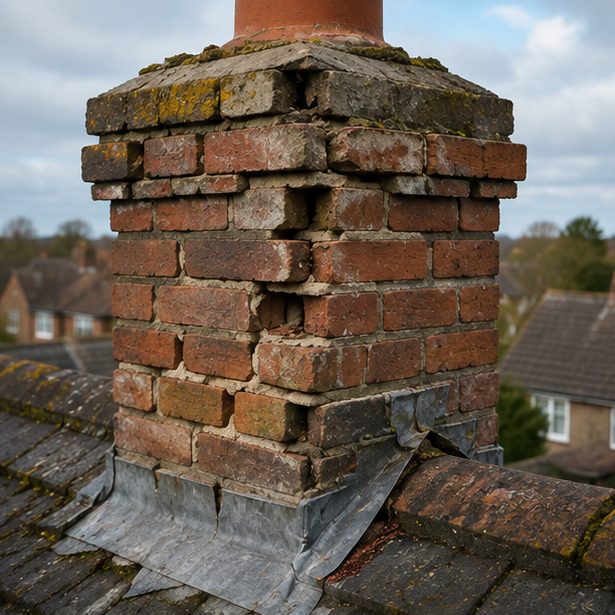
Images above are for illustration purposes only.
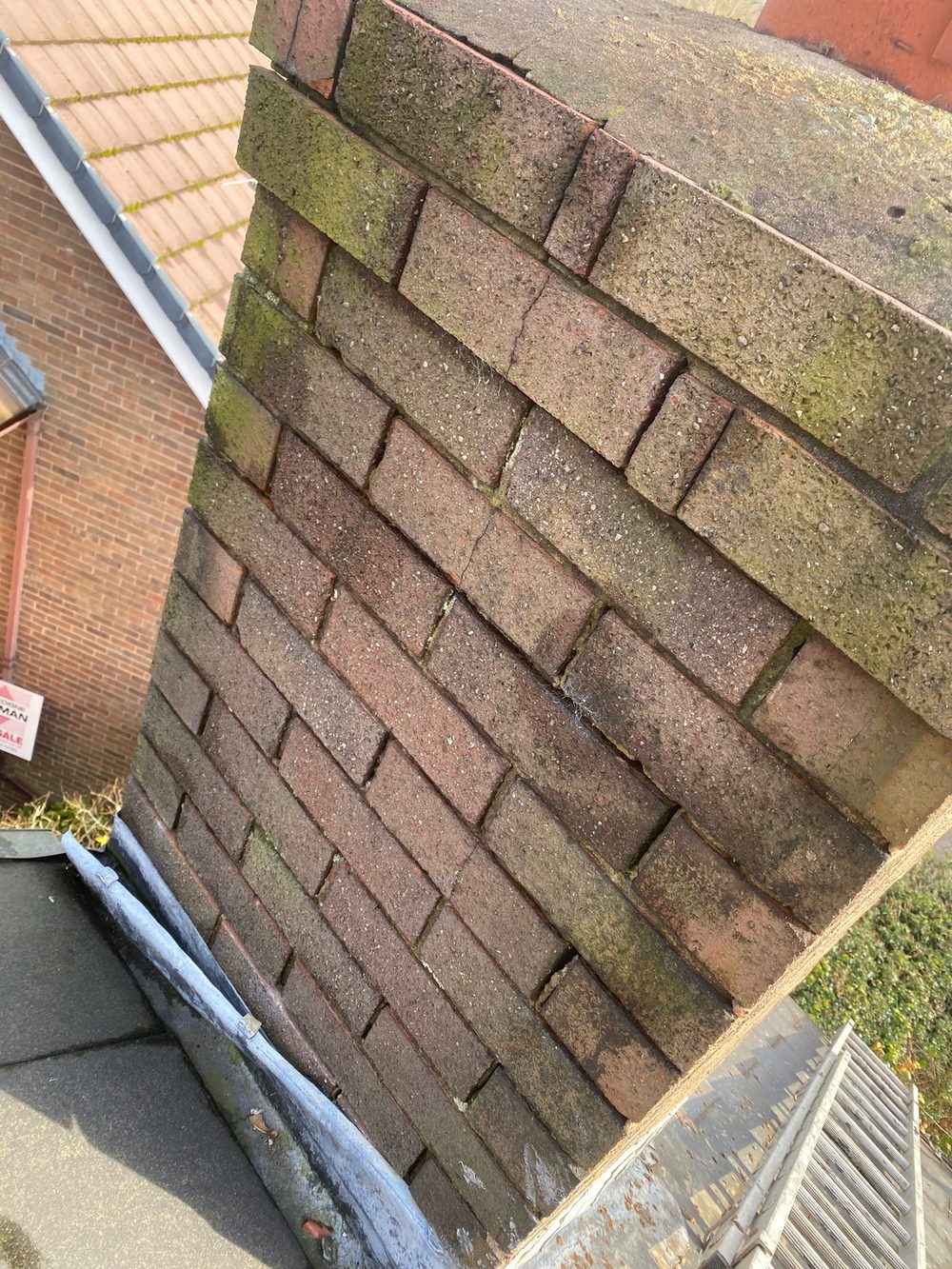
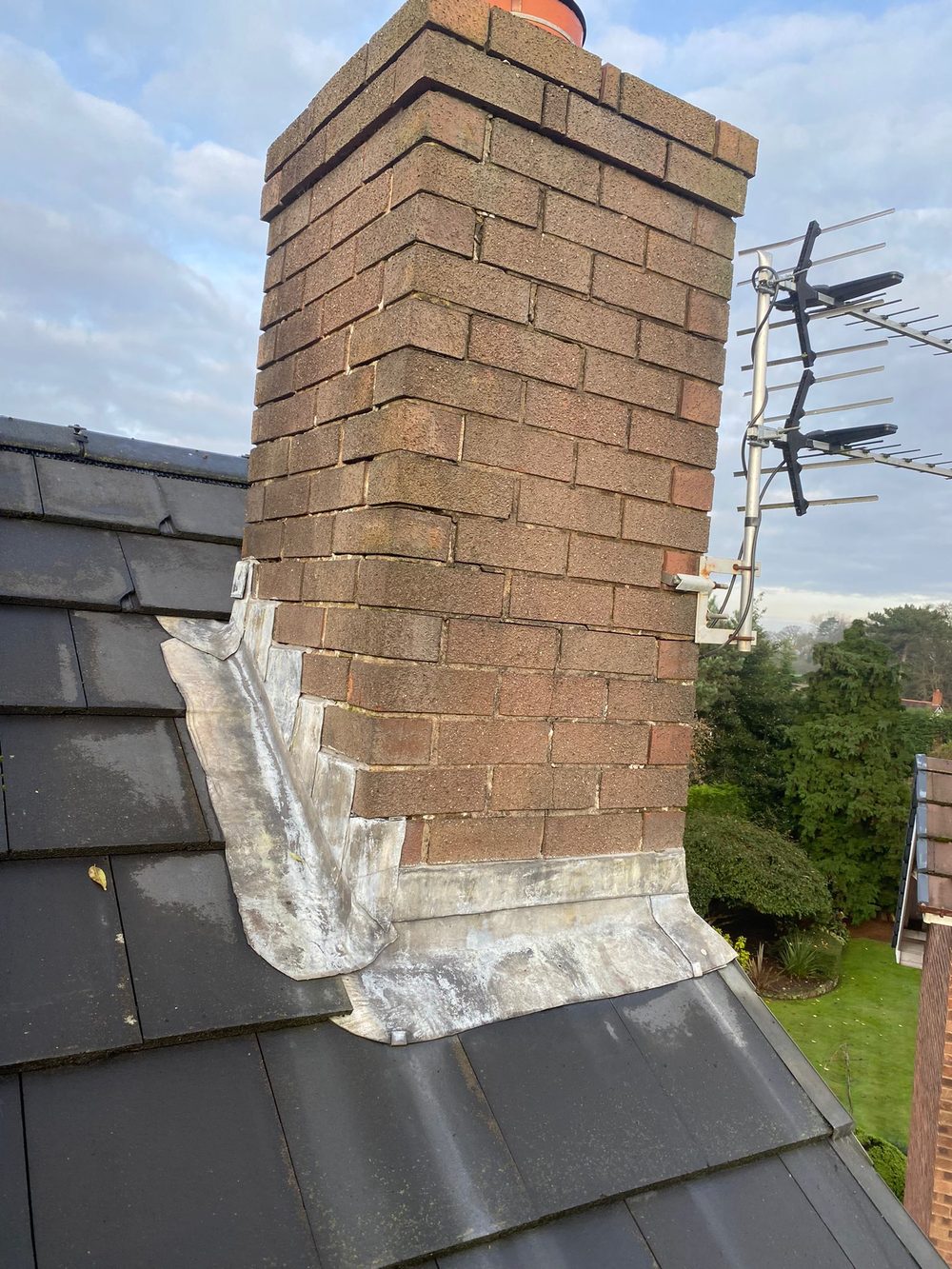
Photographs of our own chimney work. There are more on the main chimney repairs page and in the gallery.
Think about what a chimney is, structurally. Below the roof it is a breast: a narrow pier of brickwork on its own line of foundation, running up through the house with little connecting it sideways to anything. Above the roof it stands free on all four sides. The rest of the house is a set of long walls, tied at floors and roof, with hundreds of joints over which any movement can be shared out. That is the difference: a wall distributes movement, and a chimney concentrates it.
Height then does the rest. A rotation of a fraction of a degree where a stack leaves the roof is magnified all the way up its length, so the same ground movement that has opened a crack too fine to notice in a rendered gable shows at pot height as something you can get a finger into. There is also a straightedge to read it against: the line of the pots and the ridge behind them, both dead level and dead plumb the day they went up. A house can move a long way before the walls admit it. The chimney tells on it almost immediately.
The leadwork is the next thing to give, and it is the part that usually brings us out. Lead is the only soft, ductile connection between a heavy stack and a flexible roof, so when the two move relative to one another it is the lead that gets dragged: the upstand is levered out of its chase, the wedges drop out, the apron tears along its fold and the back gutter opens up at the ends. It will then leak in exactly the same place however many times somebody dresses it back in. Which sets the order for the work. If the movement is still live, pointing and re-leading is a holding repair, so the sensible first step is to establish whether the stack is still going anywhere before deciding whether to point it, rebuild the head or take it down. That assessment belongs to a structural engineer, and anything below roof level is Building Control territory rather than a decision taken on a roof.
A crack that is still opening looks different from one that stopped thirty years ago, and the differences are easy to learn. A live crack has clean, sharp edges, brick-coloured dust in it and no dirt, cobwebs or paint bridging it, and it usually tapers — wider at one end than the other — because it is a hinge rather than a gap. It will also step through the bricks as well as along the beds, because it is following the shortest line rather than the weakest mortar. A dormant one is rounded off, grubby, often filled at some point with the filling still intact. Photograph it with a coin for scale, mark two pencil ticks either side and measure between them every few weeks — a crack that widens every winter and closes every summer is temperature rather than ground.
The single most useful thing to look for, though, is continuity. Weathering stops where the weather stops. Ground movement does not, so a crack that runs down out of the stack, across the roof line and on into the gable below it is telling you something that no amount of frost and rain could. In the same family: a gap opening between the stack and the ridge tiles on one side only, a crack in the plaster of the chimney breast upstairs on the same line, and doors or sash windows near the breast that have started to bind. Any of those turns a chimney question into a house question.
Ground conditions decide the scaffold base here more often than elsewhere. Down on the low ground by the Weaver and around the flashes there is a good deal of soft and made ground, and standards stood straight onto it will find their own level over a fortnight and take the platform out of true with them. So the base gets spread properly on sole boards, and on the worst of it on a laid-out run of boards rather than a plate per leg. In the older streets around Witton and the town centre the frontages stand on the footway and a pavement platform needs a licence from Cheshire West and Chester Council with the bay beneath it suspended.
There is a second thing that catches nobody out anywhere else. If the house is already being monitored, or there is a claim running on it, then anybody drilling ties into the walls, loading a platform against them or taking weight off the roof needs to be doing it with the knowledge of whoever is doing the monitoring. Tell-tales get disturbed, and a scaffold is itself a load. So we ask at the survey whether anything of that sort is in progress.
On a stack that has moved, putting the lead back where it came from is the one thing not to do. The old chase sits in a joint that has opened or sheared, so wedging fresh lead into it is fixing new material to a failure, and it will be out again inside a couple of seasons. The joint is raked out and made good first, and where the course itself is no longer sound the flashing is stepped up to a chase in a bed joint that is. The other rule is that lead has to stay free to move: fixed along its top edge and dressed loose below, in short lapped lengths, never nailed flat down its whole length and never bonded with mastic, both of which turn the next small movement into a tear.
The head needs the same honesty. A stack that has rotated almost always has its flaunching cracked radially out from the pots, which are no longer sitting square in a bed that holds them, so patching the top is wasted effort. It is cut off and re-formed, with sound pots lifted, set aside and bedded back while the new mortar is green. There is also no sense in buying a cowl for a stack whose head is about to be rebuilt: settle the structure first and finish the top of it afterwards.
Repointing, flaunching, stack rebuilds and removals, lead aprons, soakers, stepped flashings and back gutters, pots, cowls and bird guards — and the roof around the stack when it needs attention at the same time.
“I had a leak in my vally had a number of roofers to come and take a look couldn’t find the problem Roofline’s solutions fixed the problem first time. Very happy with these guys thank you for the brilliant service”
Michael Price“Excellent work from the lads at roofline solutions. I had a leak in my valley, they came out and sorted it within a day.”
Chris Hollewell“I needed help removing a chimney.
Buddy discussed the options available to me, taking into account my budget, timeline and DIY ability.
We settled that his team would remove the chimney to the roofline, using scaffolding and ladders.
He gave a detailed description of the steps his team were going to take, how long it would take them, and provided a fair quote.
His team were pleasant and worked efficiently. They got the job done in the estimated time and I was happy with the end result.”
Written for homeowners working out which part of a chimney has failed, before anyone comes out.
Every town below has its own page, written around the stacks that are actually on the roofs there.
Describe what you can see and roughly where you are, and we will come back to you — usually the same day. If water is coming in now, please call instead.
Prefer to talk? Call 07464 259566 · WhatsApp 0044 7464 259566 · Email Evensbuddy@yahoo.com
We cover Northwich from our base at Elton, just north of Chester.
2 Manley View
Elton
Chester
CH2 4QF
Almost all of our work happens at your property rather than here, so please call before travelling.
Monday – Friday — 24hrs — Emergency Call-Outs
Saturday — 8:00 – 19:00
Sunday — 8:00 – 19:00
Weekday emergency call-outs are answered around the clock. Weekend cover is 8:00 to 19:00.