★★★★★
“Very professional efficient team great communication
Would definitely recommend made the process quick and easy will definitely look to keep for any future need
Thankyou”

Under a canopy a stack head never really dries, and what grows on it holds the water there. Clearing and re-forming the head, repointing, lead, pots and bird guards, worked from a scaffold.
Frodsham sits at the foot of its own hill. The sandstone escarpment runs up behind the town and carries woodland the whole way along it, and that woodland does not stop at the edge of the built-up part. Oak, beech, sycamore, holly and a great deal of self-seeded ash stand in the gardens along Howey Lane and Bellemonte Road, through Overton, out towards Netherton and Kingsley, and in the long plots behind Main Street.
Trees are most of what makes the place worth living in, and they are also the reason chimneys here behave differently. A stack standing under or beside a canopy spends the year in shade and in still air. It is wetted by the same rain as everybody else’s and it is dried by very much less sun and wind, and on top of that it receives a steady fall of leaf, twig, seed and dust from directly above.
Roofline Solutions works on the outside of those stacks: clearing and re-forming the head, raking out and repointing, lead aprons, soakers, stepped flashings and back gutters, pots, cowls and bird guards, part rebuilds and removals down to roof level. The inside of a live flue is not ours — lining, sweeping and appliance testing go to a HETAS or Gas Safe registered installer and a chimney sweep. The rest is set out on the main chimney repairs page.
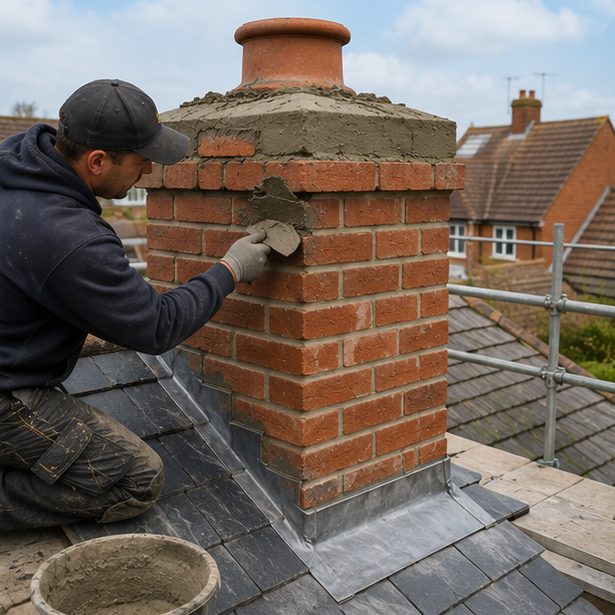
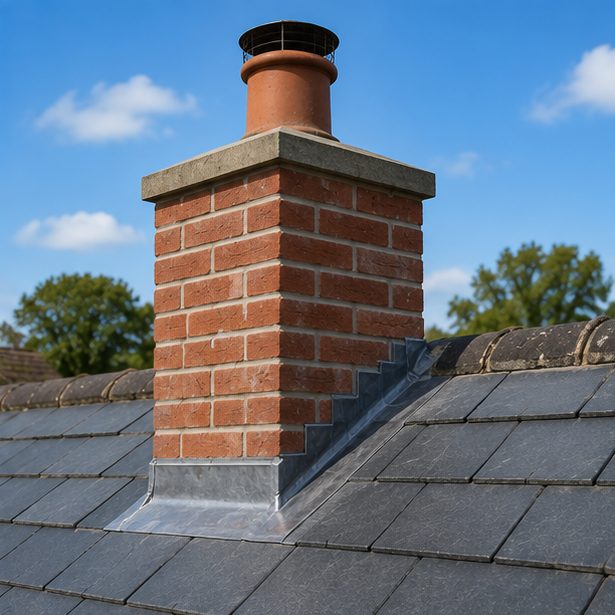
Images above are for illustration purposes only.
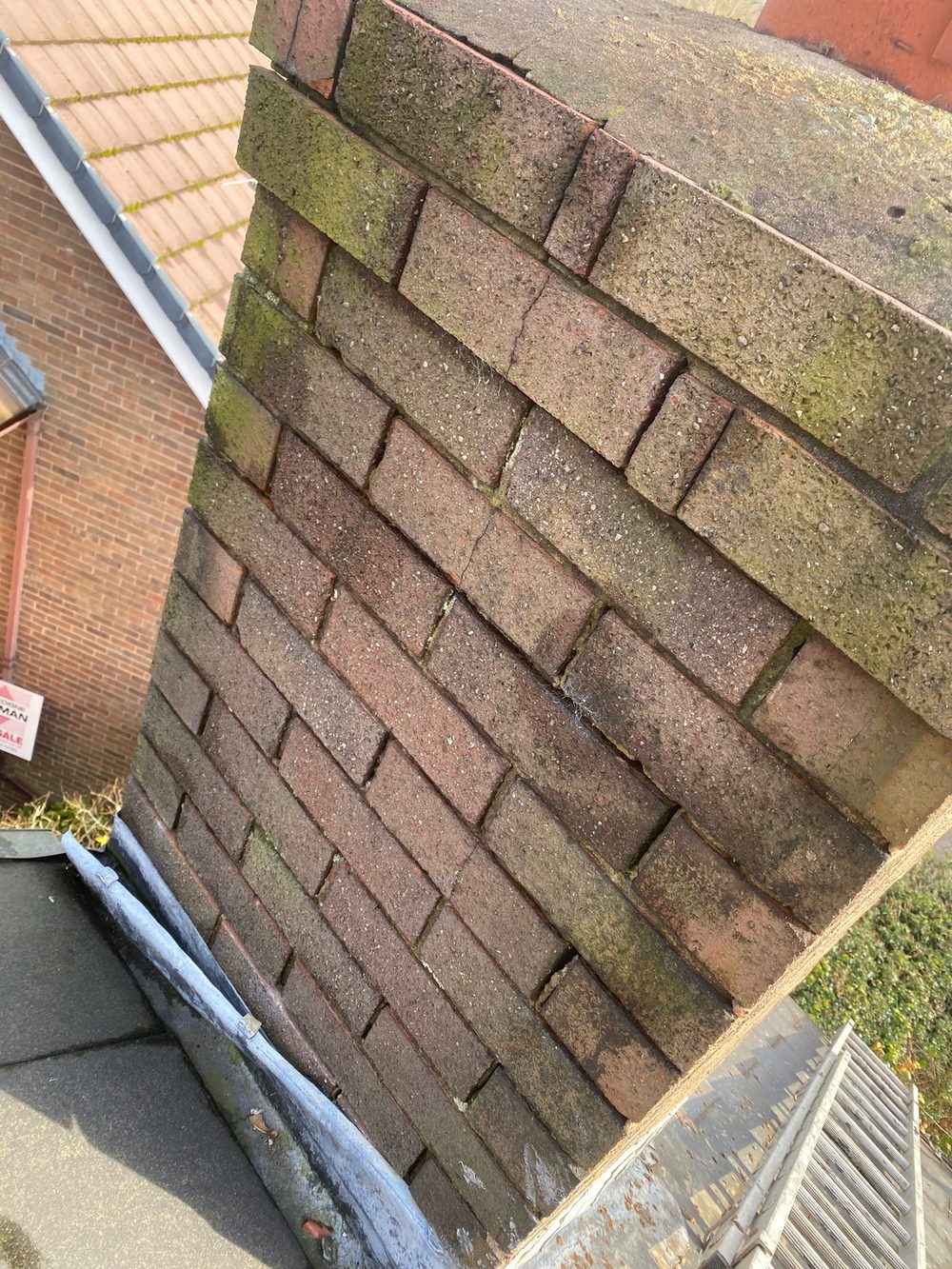
Photographs of our own chimney work. There are more on the main chimney repairs page and in the gallery.
The flaunching is where it all settles. It is the only roughly horizontal surface on the whole chimney, it is made of mortar with an open, sandy texture, and under a canopy it collects whatever comes down. Leaf litter, needle drop and wind-blown dust break down into a thin skin of organic matter across the top of the stack, and that skin is a seed bed. Moss roots into it first, then spreads outwards across the head; lichen colonises the bare mortar directly and needs no soil at all.
The harm is done by water rather than by the plant. A cushion of moss holds many times its own weight in rain and releases it slowly, so the mortar underneath is kept soaked for days after the weather has passed instead of drying out in an afternoon. A bed that is permanently saturated is a bed that breaks up at the first hard frost, and the rhizoids that anchor the moss work their way into every hairline crack and open it a little wider each season. Worse, a mat of growth flattens the fall the head was built with. Water that should run off the edge now ponds, finds the joint around the pot and goes down inside the stack.
The repair is not a bottle of something. Growth comes off by hand and with a stiff brush so that what is underneath can actually be seen, and a pressure washer is the one tool that should never come near a stack head — it strips soft mortar out of the joints in seconds and drives water deep into the brick and the flue. A chemical wash kills what is there and changes nothing about a flaunching that has already broken up, and in permanent shade the green is back within a couple of seasons. What lasts is a head re-formed to a proper fall with a drip at the edge, so the water leaves quickly enough that nothing has time to take hold, and where it can be done, an overhanging limb taken back to let some light onto the roof.
Start at the top and look for colour rather than damage. A head that reads green or black rather than grey, a cushion of moss banked up against the base of a pot, or a dark sodden patch that is still dark two days after rain all say the same thing. Compare the faces as well: the shaded side of a stack under trees carries a dark algal bloom while the open side stays clean, and lichen shows as flat grey-green crusts sitting on the mortar lines. Ivy reaching the stack is the one to act on straight away, because it goes into the joints rather than sitting on them.
Then look at what is arriving below. Crumbs of sandy mortar and lumps of moss in the gutter, in a valley, on the flat roof over a bay or on the path under the stack mean the head is coming apart now. A gutter on a wooded plot that has to be cleared twice a year is telling you how much organic matter is landing on the roof in the first place. Indoors, the pattern to watch for is damp on the breast that creeps in through a mild, wet winter rather than appearing overnight in a gale, which is what a head holding water looks like from the inside.
The trees decide the scaffold before anything else does. Branches have to be lifted, tied back or taken off before tube can go up against a gable, and the platform often has to be built round a limb rather than through it. Two things are worth knowing in advance. A tree in a conservation area, or one carrying a preservation order — and there are plenty of both on this hillside — cannot simply be cut, and permission from Cheshire West and Chester Council comes first. And a branch belonging to a neighbour is theirs, not yours, whichever garden it hangs over.
Getting there is the other half of it. The lanes climbing towards Overton and the hill are narrow with no turning room, some drives are long and steep, and a scaffold wagon cannot always reach the house, so the last stretch is carried by hand. Along Main Street the older frontages stand on the footway and need a pavement licence. Once the scaffold is up, the timing matters more here than in an open street: fresh mortar under a dripping canopy stays wet for a long time, so the clearing and the re-forming are booked into the same settled spell rather than split across a wet fortnight.
The back gutter is the piece that suffers on a wooded plot, and it is the one nobody can see. It is a lead trough behind the stack, and under a canopy it fills with leaf, needle and moss until it is effectively a planted bed. Once it is full, rain no longer runs out of it onto the slope; it stands, backs up over the upstand and goes behind the lead instead of over it. Clearing the back gutter is the single most useful thing that can be done on a roof like this, and it is worth doing while any scaffold is already standing. Organic matter left sitting against a chase also keeps the pointing over the lead permanently damp, which is where that pointing usually lets go first.
At the top, the woodland edge brings jackdaws, which will pack a flue with sticks in a single spring, so a bird guard earns its place on most stacks here. There is a choice in it that people are rarely offered: a fine mesh guard on a shaded plot blinds itself with leaf fragments and needles within a season and then throttles the flue it was meant to protect, so a coarser pattern sized to the actual rim is usually the better answer. Clay pots under trees grow lichen around the rim and fret there first, and a sound one is worth lifting, cleaning and bedding back into the new head rather than replacing with something that does not match its neighbours.
Repointing, flaunching, stack rebuilds and removals, lead aprons, soakers, stepped flashings and back gutters, pots, cowls and bird guards — and the roof around the stack when it needs attention at the same time.
“Very professional efficient team great communication
Would definitely recommend made the process quick and easy will definitely look to keep for any future need
Thankyou”
“Had Roofline Solutions come and do our guttering today and done a great job. Our guttering was dangerous, after messaging over the weekend, they came Tuesday and sorted it out by Wednesday. Tidy and communicated everything to me. Thanks”
Emma Pickett“Brilliant company. Did a really good job worked hard, looks really good up to my expected standards which are high. Can highly recommend them.”
CHESHIRE PORCELAINWritten for homeowners working out which part of a chimney has failed, before anyone comes out.
Every town below has its own page, written around the stacks that are actually on the roofs there.
Describe what you can see and roughly where you are, and we will come back to you — usually the same day. If water is coming in now, please call instead.
Prefer to talk? Call 07464 259566 · WhatsApp 0044 7464 259566 · Email Evensbuddy@yahoo.com
We cover Frodsham from our base at Elton, just north of Chester.
2 Manley View
Elton
Chester
CH2 4QF
Almost all of our work happens at your property rather than here, so please call before travelling.
Monday – Friday — 24hrs — Emergency Call-Outs
Saturday — 8:00 – 19:00
Sunday — 8:00 – 19:00
Weekday emergency call-outs are answered around the clock. Weekend cover is 8:00 to 19:00.