★★★★★
“Rapid response and fair pricing. Good workmanship. Pleasant staff.”
Ben Green
Render that has lost its grip stops shedding water and starts storing it. Tapping a stack out, stripping or patching, repointing the brickwork behind it, new heads, lead and pots, all from a scaffold.
Flint sits on the flat ground at the edge of the Dee with the castle and the marsh below it and the ground rising behind towards Flint Mountain. Between here and Bagillt and Oakenholt there is almost nothing in the way of shelter. Wind comes up the estuary with a long run at it, it arrives wet, and the first thing it meets on any house is the chimney.
A great many stacks in the town are rendered or roughcast, and in that position render earns its keep — while it is stuck to the brickwork. The trouble starts the day part of it stops being stuck. A coat that has lost its bond is no longer a surface that sheds water; it becomes a lid with a gap behind it, and the gap fills.
Roofline Solutions works on the outside of chimneys across Flint, Bagillt, Oakenholt, Coleshill and the rest of the Deeside coast: testing render for bond, patching or stripping it, repointing and rebuilding the brickwork underneath, re-forming heads, lead aprons, soakers, stepped flashings and back gutters, pots, cowls and guards. Flue lining, sweeping and appliance testing are not roofing and belong to a HETAS or Gas Safe registered installer and a sweep. There is more about rendered stacks on the Deeside page.
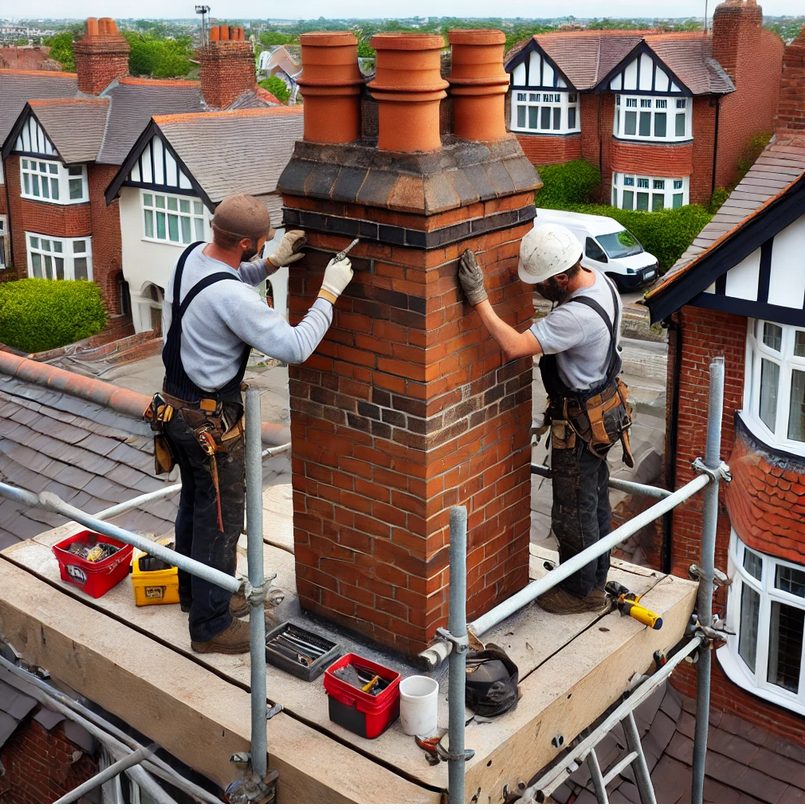
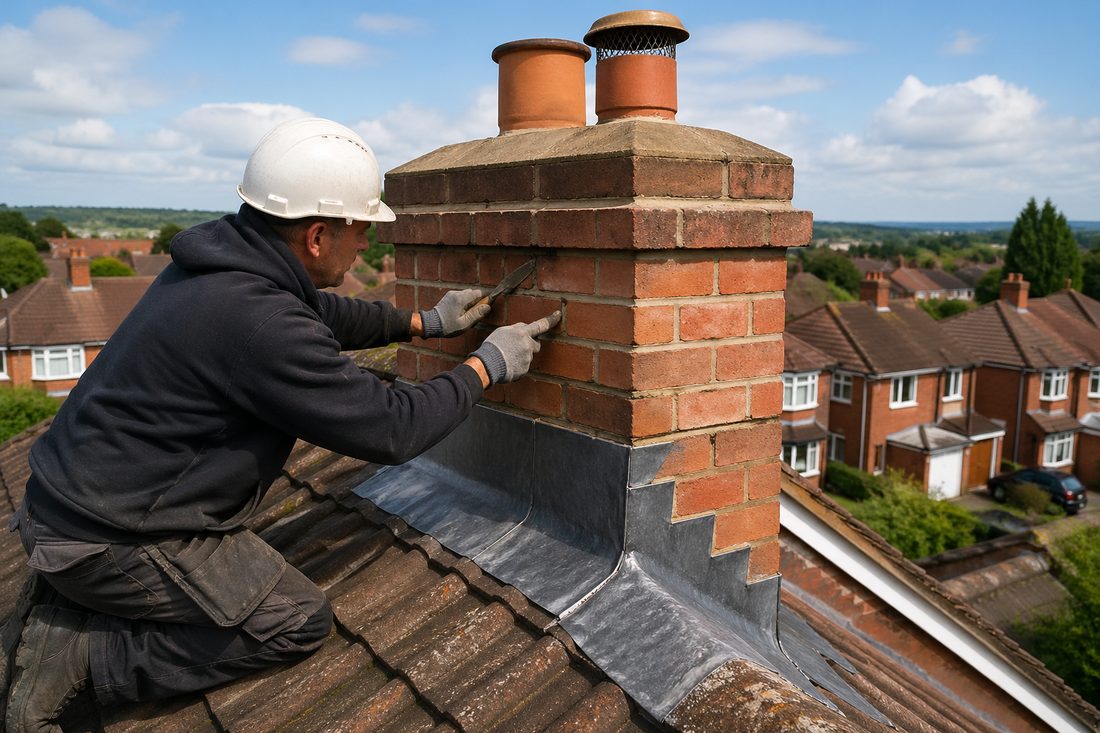
Images above are for illustration purposes only.
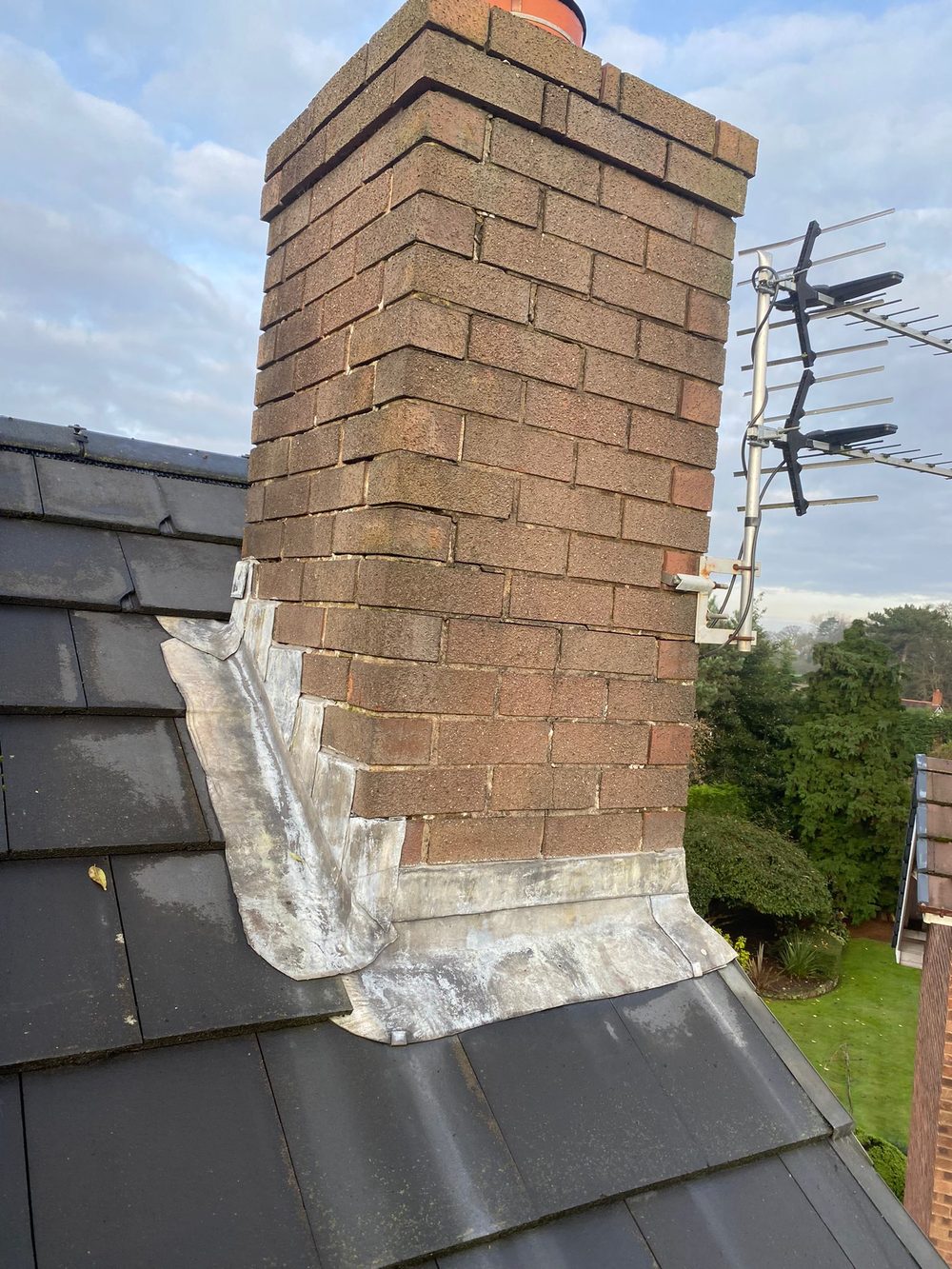
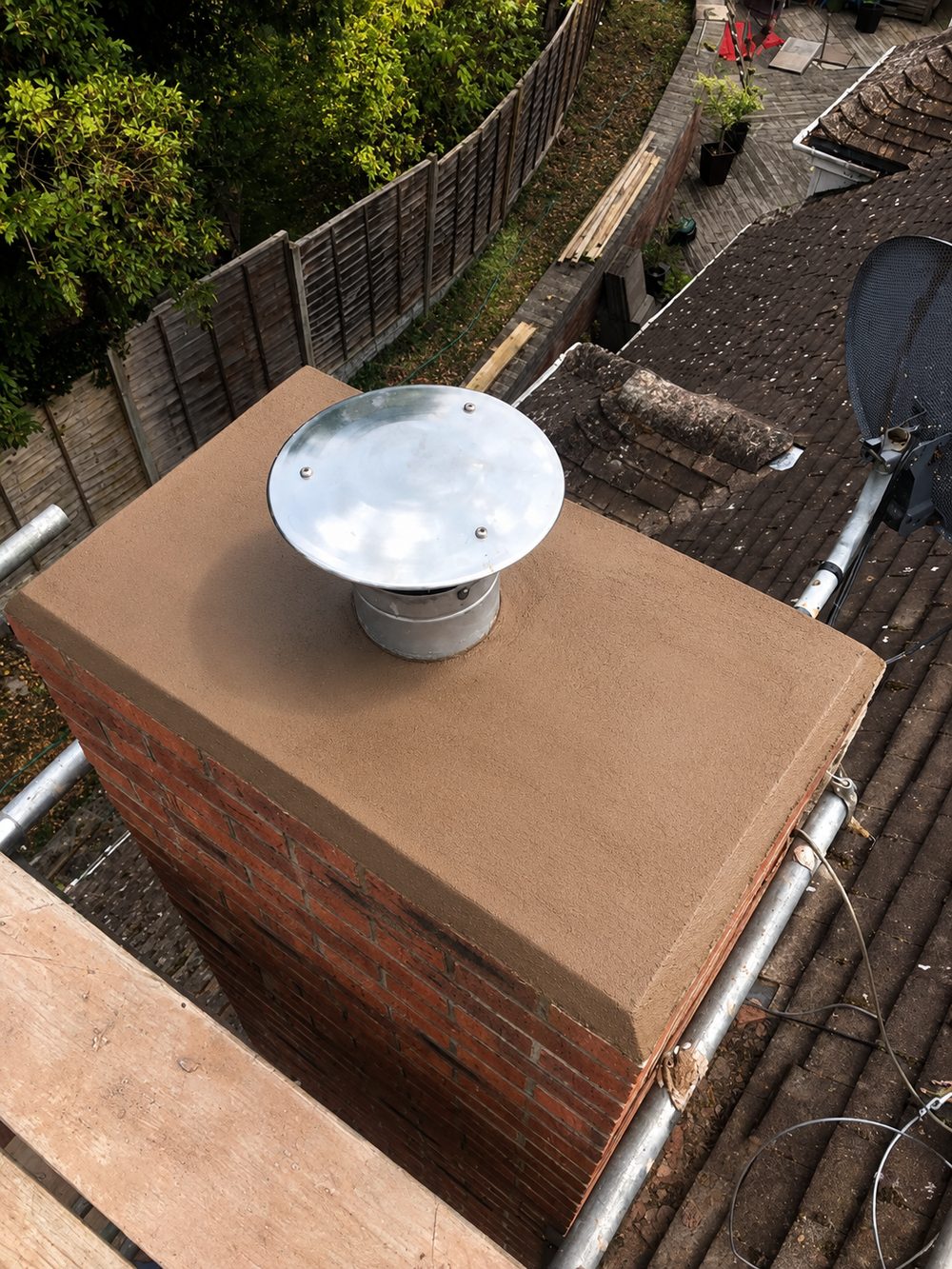
Photographs of our own chimney work. There are more on the main chimney repairs page and in the gallery.
A chimney is the hardest place on a house to keep render stuck down, and the reasons stack up. It is the only element rendered on all four sides at once, with nothing above it and weather able to reach it from every direction. It heats and cools faster than a wall because it has air on both faces. And the bond fails for ordinary, avoidable reasons: a strong render put onto softer brick and pulling away as the two move differently, a coat applied onto dusty or already-wet brickwork, movement at the head letting water behind the top edge, or an iron bead corroding and jacking the render off from the inside.
What happens next is the part people do not expect. Once there is a void behind the coat, water entering at the head, at the pot collar, through a crack or over the top of the lead runs down inside that void and cannot get out again. There is no wind and no sun on the brick any more, and the render is more closed than the brick it covers, so nothing dries. The masonry sits saturated right through the winter: faces spall off in the frost, joints wash back in the dark, and the water leaves at the lowest opening it can find, which is the roof junction. The stack is wetter with that render on it than it would be with the render off — and a debonded plate comes down eventually, usually onto a roof or a path.
There are two honest routes from there, and which applies is decided with hands on the stack. Cutting the hollow areas out back to a firm edge and re-rendering those patches keeps cost and mess down, and it is reasonable where the loose areas are limited — understanding that a patch shows, and that the render being kept is the same age as the bit that failed. Stripping the whole stack back to brick tells you the truth instead: with the brickwork bare the joints and the faces can be seen, and the choice is then to repoint and leave it as honest brickwork, or to re-render in a mix weaker than the brick with a bell at the bottom and proper stops. If what appears is broken down through its depth it becomes a head rebuild. Either way the water path has to be closed and the brickwork allowed to dry first, or the problem is sealed in.
Bond is tested by sound, and it is the quickest useful thing anybody does on a rendered stack. Knuckles or the handle of a trowel are worked over the whole of each face in a grid. Render that is still gripping the brick gives a dead, solid knock. Render with a void behind it drums. From a scaffold a full stack is mapped this way in a few minutes and the loose areas get chalked round, and the result is regularly a surprise to the householder: the face that looks worst is often still firmly attached, while a panel with not a mark on it is floating clear of the brickwork.
From the ground there are four things worth looking for. Crazed, map-like cracking across a panel, which is different from a single crack and usually means the coat itself is breaking down. A bulge, best seen by sighting along the face with the light raking across it rather than looking straight at it. A white bloom or salting at the edge of a crack, which means water has been coming back out there. And debris — flat plates of render or lumps of roughcast on the path, in the gutter or on a flat roof after a gale, which is the coat telling you it has already gone. The cracked collar of render around the base of a pot belongs on the same list.
Weather governs this work more than most. Render will not go on in driving rain, it will not set in a frost, and in a hard drying wind it skins over and crazes before it has any strength — and on this side of the estuary all three turn up in the same month. So it is planned as a sequence of visits rather than a day’s work: strip or cut out, let the brickwork dry, close the water path at the head and the lead, render, then leave it protected while it cures. The scaffold stands through all of that, and we say so at the quotation rather than afterwards.
Then there is the material coming off. Stripping a full stack produces a genuinely surprising weight of debris and every bit of it comes down the scaffold rather than off the roof, so the platform is boarded and netted, anything underneath is sheeted, and where it is going is agreed before a start date. Access to the houses themselves is usually straightforward on the estates, with side gates and drives; the older streets near the centre have the front wall on the footway and want a pavement licence from Flintshire County Council. Where a stack straddles a boundary the render is continuous across it exactly as the brickwork is, so the neighbour needs to know before tube arrives.
Taking render off a stack exposes its whole leadwork history, and it is seldom a happy one. The usual finds are an apron with its top edge buried in render rather than chased into a joint, a mortar fillet hidden under the coat, lead nailed flat to the face with mastic smeared along it, or no lead at all. The upside is that a bare stack is the one moment when the whole set can be made properly for the first time — apron across the downhill face, soakers or a stepped cover flashing up the sides, back gutter behind, every piece cut into sound bed joints and wedged. The order is not optional either: lead first, render stopped above it, so the coat throws its water out onto the lead instead of behind it.
One detail is worth insisting on when the render goes back. It must not be finished hard down onto the lead upstand. Lead moves a long way with temperature and render does not, so a coat bonded to it will crack along that line within a year or two and let water straight back into the gap that was just dealt with. At the very top, a rendered head is normally nothing more than render tapered up to the pot; that comes off and a mortar bed is formed to a fall with the pot bedded into it, which is the one place on a rendered stack where mortar and not render is the right material.
Repointing, flaunching, stack rebuilds and removals, lead aprons, soakers, stepped flashings and back gutters, pots, cowls and bird guards — and the roof around the stack when it needs attention at the same time.
“Rapid response and fair pricing. Good workmanship. Pleasant staff.”
Ben Green“The men were genuine and trustworthy. Turned up every time when they said they would, and phoned ahead. Very respectful and did an amazing job.,thank you x”
freda markham“Excellent service from Buddy and the team in installing a new garage roof in a really professional manner. Was kept updated at all stages and given good advice as to our options. Would highly recommend”
Peter AspinallWritten for homeowners working out which part of a chimney has failed, before anyone comes out.
Every town below has its own page, written around the stacks that are actually on the roofs there.
Describe what you can see and roughly where you are, and we will come back to you — usually the same day. If water is coming in now, please call instead.
Prefer to talk? Call 07464 259566 · WhatsApp 0044 7464 259566 · Email Evensbuddy@yahoo.com
We cover Flint from our base at Elton, just north of Chester.
2 Manley View
Elton
Chester
CH2 4QF
Almost all of our work happens at your property rather than here, so please call before travelling.
Monday – Friday — 24hrs — Emergency Call-Outs
Saturday — 8:00 – 19:00
Sunday — 8:00 – 19:00
Weekday emergency call-outs are answered around the clock. Weekend cover is 8:00 to 19:00.