★★★★★
“Excellent work from the lads at roofline solutions. I had a leak in my valley, they came out and sorted it within a day.”
Chris Hollewell
Wind off the Dee carries salt as well as rain, and on a Hoylake stack one face is always years ahead of the other three. Repointing, flaunching, leadwork, pots and head rebuilds, worked from a scaffold.
Hoylake stands on the corner of the peninsula where the Dee opens out into the Irish Sea, and there is nothing at all between the front of the town and the water. The housing behind that frontage is mostly late Victorian and Edwardian, put up when the railway arrived: bay-fronted villas and terraces in warm pressed red brick, with a scatter of interwar semis through Meols and out towards Carr Lane and the links.
Almost all of those roofs still carry their original stacks, and almost all of those stacks are being worked on by something that does not reach chimneys further inland. The prevailing wind here comes in off open water, and it arrives loaded with salt spray picked up a few hundred metres out. The rain that drives against the brickwork is not clean rain, and the brickwork knows it.
Roofline Solutions handles the outside of the stack: raking out and repointing, cutting off and re-forming the flaunching, aprons, soakers, stepped flashings and back gutters in lead, pots, cowls and bird guards, taking a failed head down and rebuilding it, and removing a stack to roof level where nothing is served by keeping it. Anything inside a live flue — lining, sweeping, commissioning an appliance — goes to a HETAS or Gas Safe registered installer and a sweep. The full range is set out on the chimney repairs page.
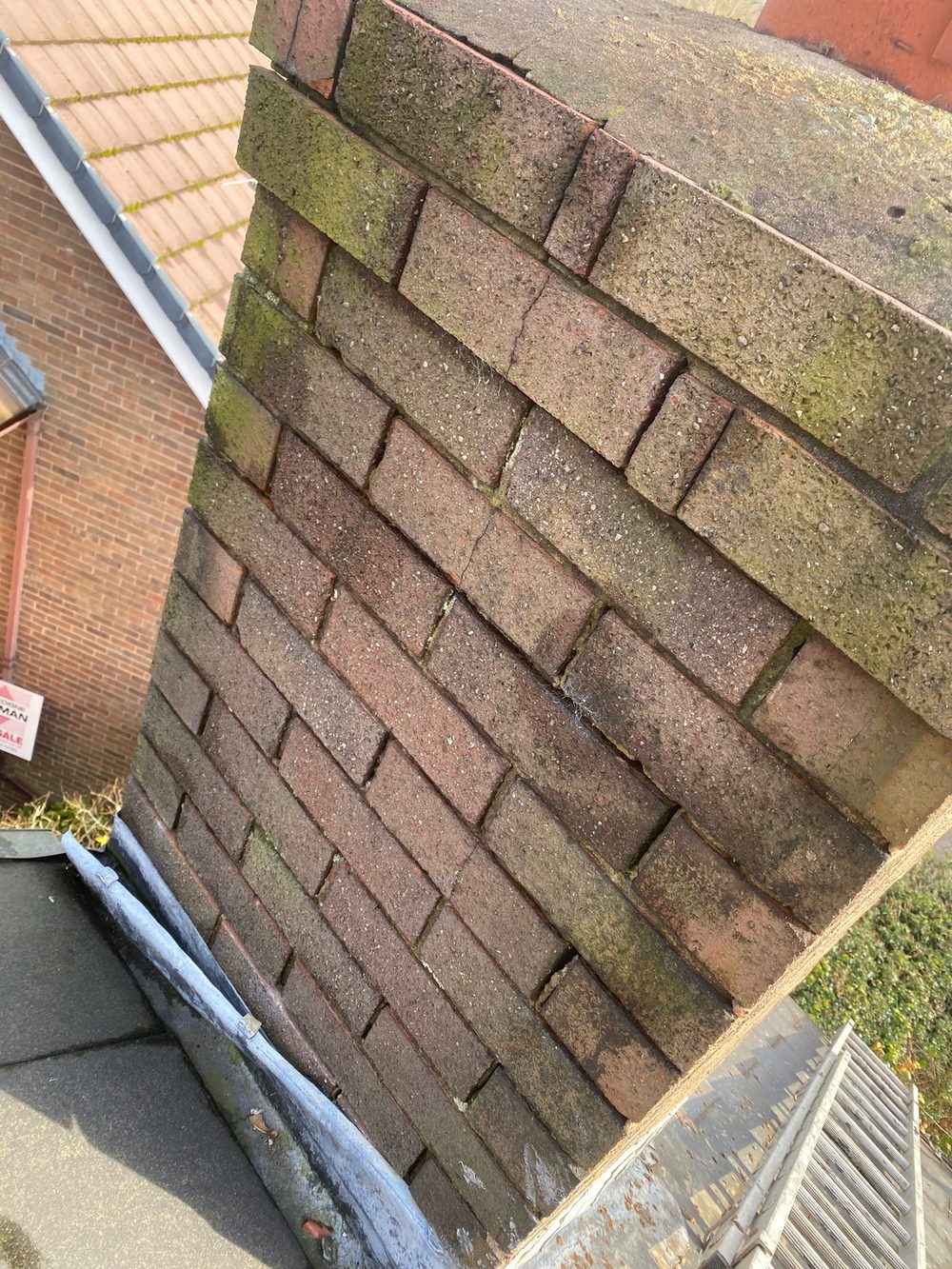
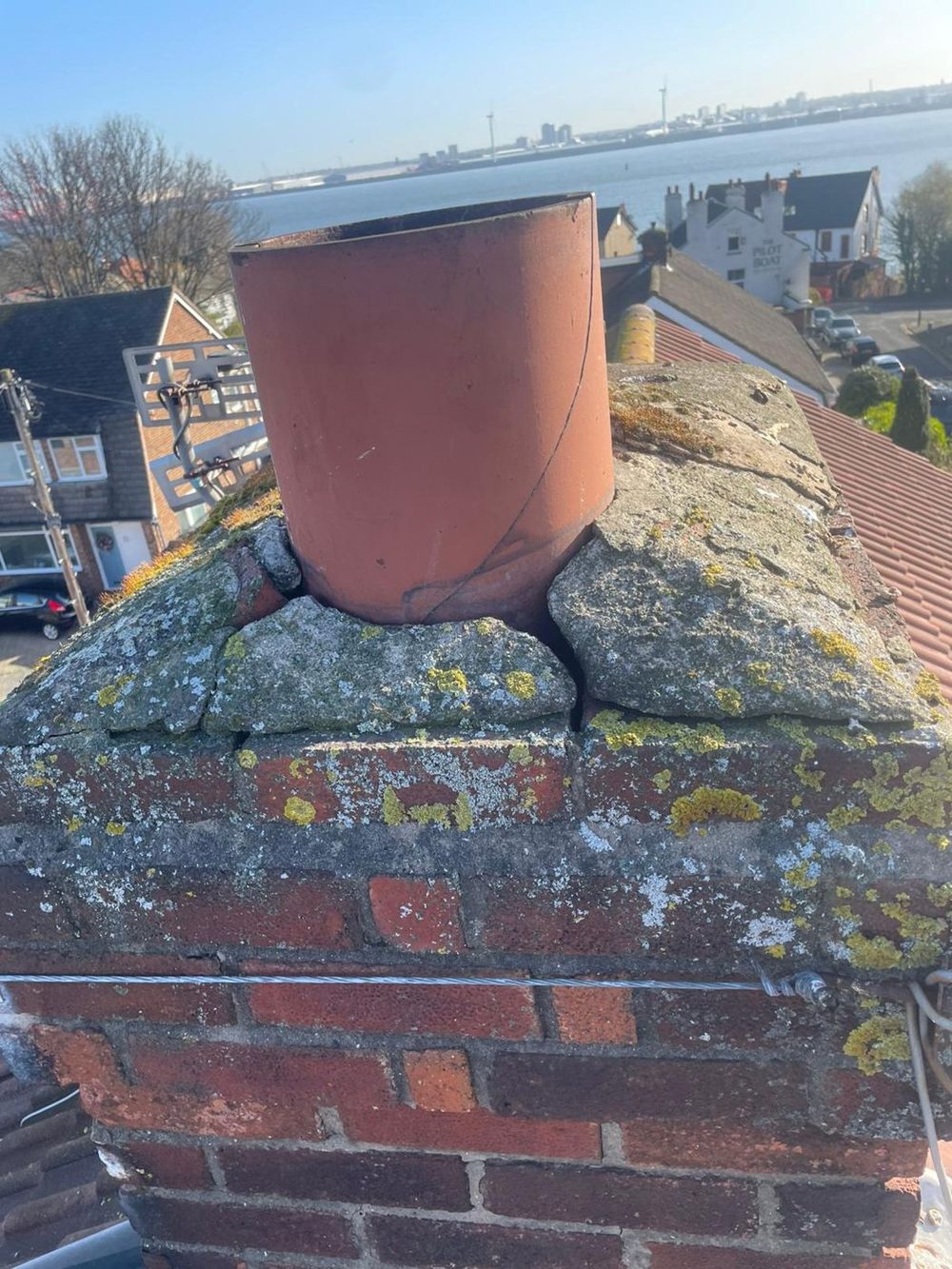
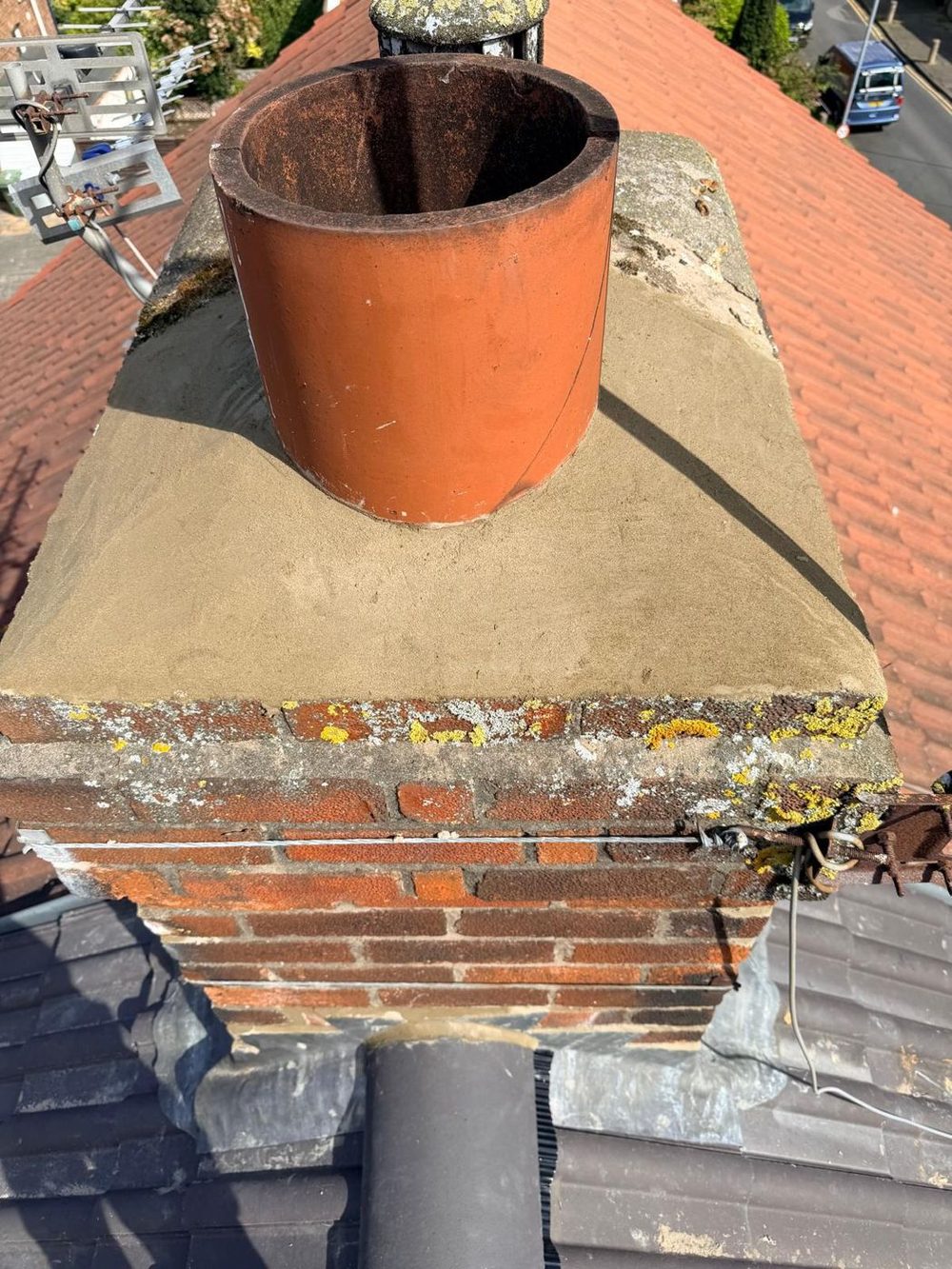
Photographs of our own chimney work. There are more on the main chimney repairs page and in the gallery.
Salt does not need a storm to get onto a chimney. On a breezy day the air along this coast carries a fine aerosol of sea water, and every wetting leaves a trace of it behind when the moisture evaporates. Brick and mortar are both porous, so the salt does not sit on the surface. It dissolves in the next shower, soaks a few millimetres in, and travels with the water into the body of the material.
The damage happens on the way back out. As the face dries, the solution is drawn towards the surface and the salt comes out of it as crystals. When that happens on the outside you get a harmless white bloom. When it happens a whisker behind the face — which is what a windy drying day on an exposed stack encourages — the crystals grow inside the pores and push outwards with real force. Wet, dry, wet, dry, a few thousand times, and the face of the brick lets go in a thin plate, leaving a soft sandy patch that then takes up water faster than the brick ever did. Add a frost on top of that and it accelerates.
This is why a Hoylake stack so rarely fails evenly. The seaward face — broadly west to north-west here — is wetted hardest and dried hardest, so it can be two decades further on than the face looking back inland. A stack that looks perfectly respectable from the road can be crumbling on the side you never see. The two things that follow from that are worth saying plainly: a stack in this town is pointed on all four faces or it is not really pointed, and sealing the brickwork with a waterproofer is the worst thing anybody can do to it, because it traps the salt and the moisture behind the face and hurries along exactly the failure you were trying to stop.
Ordinary weathering eats the mortar and leaves the brick more or less alone; the joints recede, the faces stay flat. Salt damage does the opposite — it attacks the brick itself. What you are looking for from the garden is faces that have gone hollow and pitted rather than joints that have gone deep, thin flakes lifting off like old paint, and patches that look lighter and softer than the brick around them. A white or greyish powder that brushes off is salt arriving at the surface, and it is a warning rather than the damage itself.
Then check what is landing below. Red dust and small curved flakes collecting on a bay roof, in the gutter or on the path under the stack mean the face is coming away now. Look too at the pots, because unglazed clay picks up salt in exactly the same way and tends to fret around the rim first. And if you can only see one or two faces of your own stack, the neighbour opposite usually has a clear view of the side that matters most, which is the one pointing at the water.
The plots themselves are generally kind. Most of the Edwardian houses here have a side passage or a drive, gardens with room to stand a full scaffold, and a roof at an ordinary pitch, so getting tube and boards to the back of a house is rarely the problem. Along the front and on the older terraces towards the station the buildings sit close to the pavement, and a platform on the footway needs a licence from Wirral Council booked in before anything is delivered.
The weather is the real constraint, and it changes how a job is planned rather than whether it can be done. A sheeted scaffold on an exposed frontage behaves like a sail, so sheeting is used sparingly and the tie pattern is set for the site rather than out of habit. Mortar will not be worked in a gale, fresh flaunching will not cure with salt spray blowing across it, and a bad week here is genuinely unworkable. We would rather move a start date and say why than rush green mortar onto a stack that has the whole winter in front of it.
Lead is the one material on the roof that is entirely unbothered by all this. It weathers to a stable grey carbonate film and then stops, which is precisely why it has been used on exposed coastal buildings for centuries. What does suffer is everything used alongside it. Ordinary steel or galvanised nails, clips and fixings corrode fast in salt air and then stain the lead and the slate below, so fixings on a stack in this town want to be lead wedges and stainless or copper where anything else is needed. The pointing over the chase is the other weak point, and it gets the same care as the rest of the stack.
The same logic runs to the top of the chimney. A stainless cowl or bird guard is only as good as the grade of stainless it is made from; the cheaper grades rust in a couple of winters within sight of the sea, and the streaks run down the pot and the brickwork. Terracotta patterns avoid the problem altogether and often suit an old pot better. Where a pot has fretted badly around the rim it can sometimes be turned or reduced rather than replaced, and where it is cracked through it comes off, because once the old flaunching is cut away nothing is holding it.
Repointing, flaunching, stack rebuilds and removals, lead aprons, soakers, stepped flashings and back gutters, pots, cowls and bird guards — and the roof around the stack when it needs attention at the same time.
“Excellent work from the lads at roofline solutions. I had a leak in my valley, they came out and sorted it within a day.”
Chris Hollewell“Had Roofline Solutions come and do our guttering today and done a great job. Our guttering was dangerous, after messaging over the weekend, they came Tuesday and sorted it out by Wednesday. Tidy and communicated everything to me. Thanks”
Emma Pickett“Rapid response and fair pricing. Good workmanship. Pleasant staff.”
Ben GreenWritten for homeowners working out which part of a chimney has failed, before anyone comes out.
Every town below has its own page, written around the stacks that are actually on the roofs there.
Describe what you can see and roughly where you are, and we will come back to you — usually the same day. If water is coming in now, please call instead.
Prefer to talk? Call 07464 259566 · WhatsApp 0044 7464 259566 · Email Evensbuddy@yahoo.com
We cover Hoylake from our base at Elton, just north of Chester.
2 Manley View
Elton
Chester
CH2 4QF
Almost all of our work happens at your property rather than here, so please call before travelling.
Monday – Friday — 24hrs — Emergency Call-Outs
Saturday — 8:00 – 19:00
Sunday — 8:00 – 19:00
Weekday emergency call-outs are answered around the clock. Weekend cover is 8:00 to 19:00.