★★★★★
“The guys did a great job in repairing our chimney. They were reliable, friendly and efficient. Buddy kept me in the loop throughout the whole process and I would not hesitate to use Roofline again!”
Hollie Furnival
Stacks near the works take sulphate as well as weather, and it shows in the bed joints long before it shows in the house. Repointing, rebuilds, flaunching, lead and pots, all from a scaffold.
Ellesmere Port grew around the canal basin and then around the works, and the housing arrived in waves to match. There are canal-side and dock cottages in the older part of town, interwar semis through Whitby and Overpool, and long post-war estates at Great Sutton, Little Sutton, Wolverham and Westminster. Nearly all of it is brick, nearly all of it has a stack, and every one of those stacks has spent its life in the air that comes off the estuary and the refinery.
That air is the reason chimneys here do not behave like chimneys a dozen miles inland. Sulphur, whether from flue gases or from the atmosphere, ends up as sulphate dissolved in wet brickwork, and sulphate is not kind to ordinary cement mortar. A chimney is the one part of a house that is wet on the outside and sooty on the inside at the same time, which means it is being worked on from both faces at once.
Roofline Solutions repoints, re-flaunches, re-leads, rebuilds and removes stacks across the town and the rest of west Cheshire, including Deeside over the water. We are roofers, and everything described here happens on the outside of the masonry from a scaffold. Lining a flue for a working appliance, sweeping it or testing it is the province of a HETAS or Gas Safe registered installer and a chimney sweep, and it is not work this firm takes on.
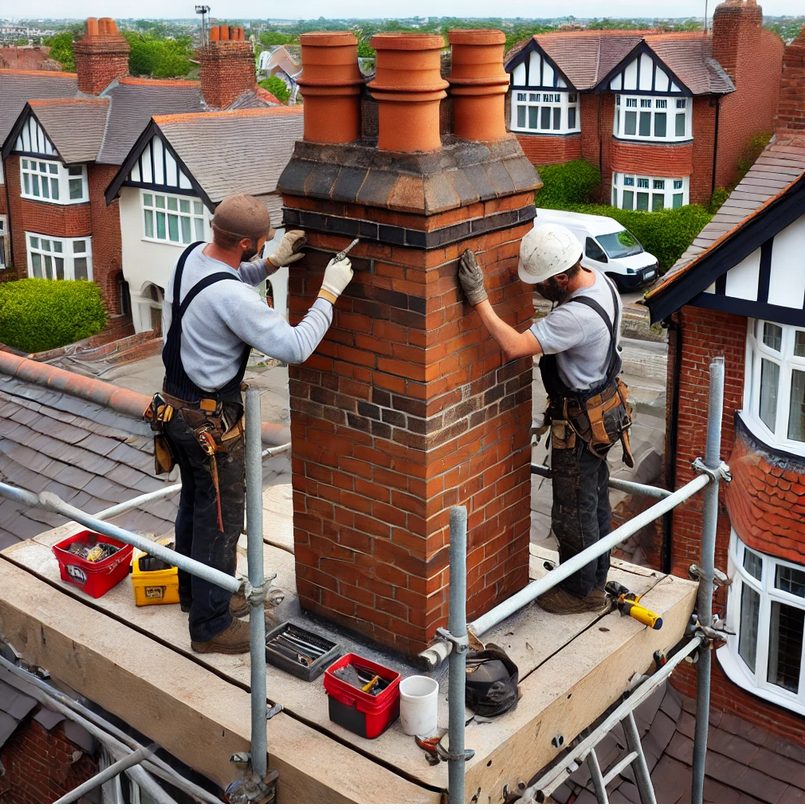
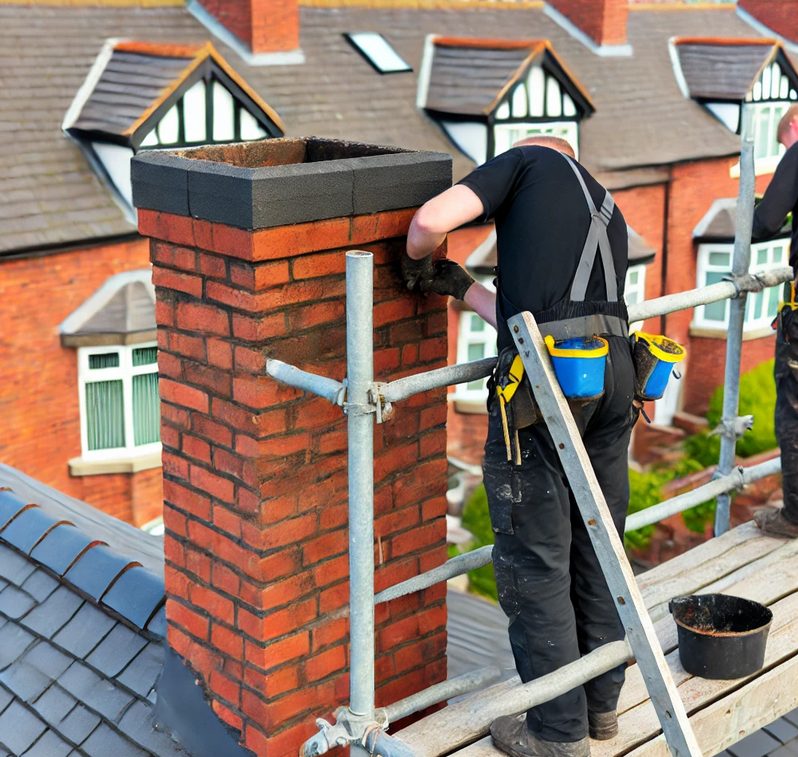
Images above are for illustration purposes only.
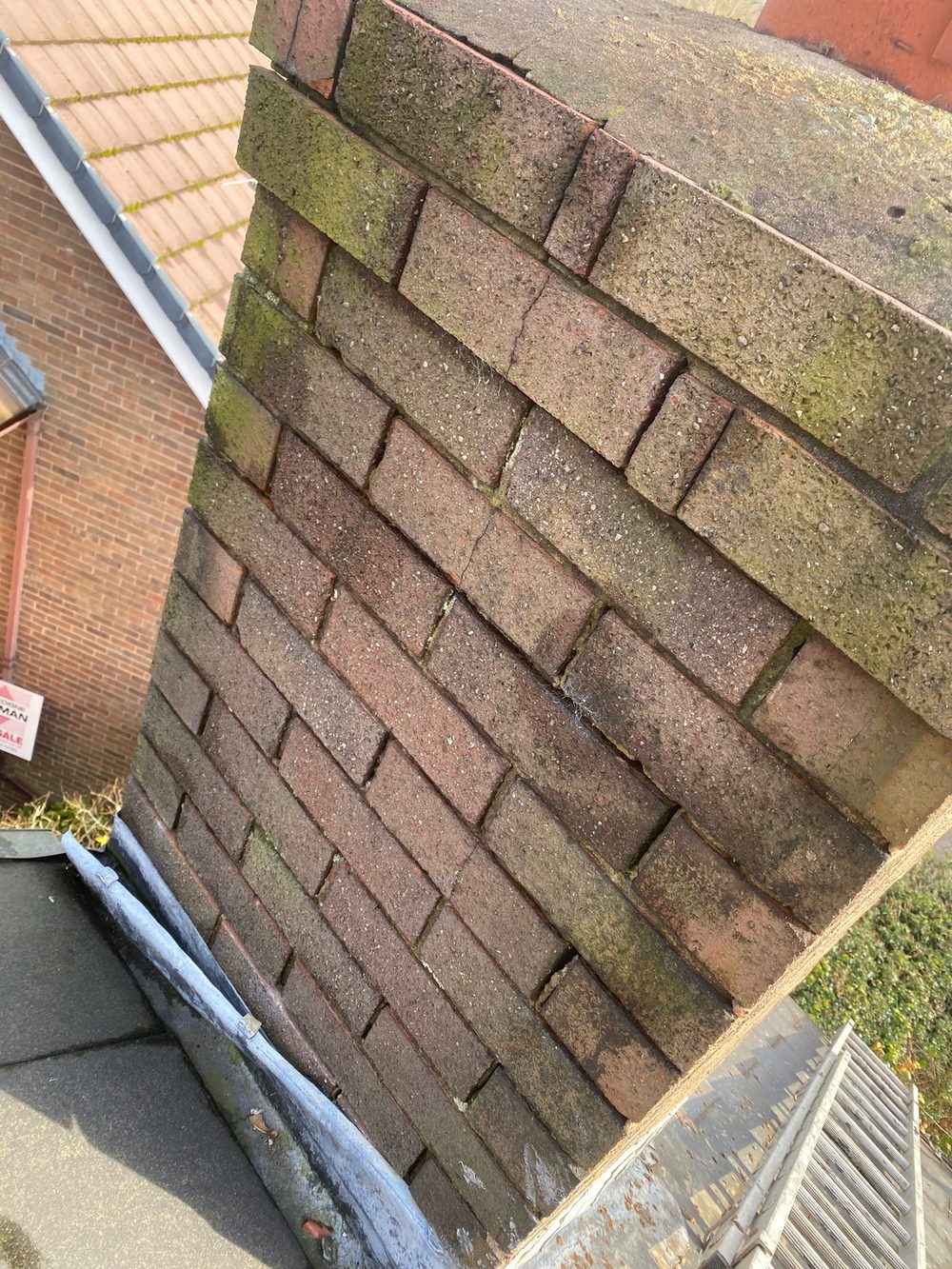
Photographs of our own chimney work. There are more on the main chimney repairs page and in the gallery.
Sulphate attack is a slow chemical reaction rather than ordinary weathering, and that is what makes it deceptive. Soluble sulphates — some carried in on the weather, rather more of them left inside the flue by generations of burning — reach the cement in the bed joints while the mortar is wet, and form a new compound that takes up more room than the material it replaced. The joint does not crumble first. It swells.
Swelling joints do something you can see from the pavement. Each bed joint grows by a fraction of a millimetre, there are twenty or thirty of them in a stack, and the growth is greatest where the mortar stays wet the longest. One face of the stack therefore ends up marginally taller than the face opposite, and the top tips away from it. That is why a leaning stack so often leans towards the sunny side of the house: the shaded face is the one that never properly dried out.
The other signature is horizontal. Cracks follow the beds rather than running up through the bricks, the exposed mortar has a pale and almost chalky look, and the joints sit slightly proud instead of weathering back. Once a stack has reached that stage, repointing the face is cosmetic, because the damage runs through the full thickness of the joint. The honest answer is to take the affected courses down and rebuild them in a sulphate-resisting mix, over a damp-proof tray, with a new set of lead at the junction.
You do not need a spirit level on the roof to do this. Stand back far enough to see the whole stack against the sky, hold a phone or a pencil up at arm’s length and line its edge against the corner of the brickwork, then compare that corner with the vertical line of the house below it. A stack that has gone over shows itself in seconds. Do it from two directions, because a lean is rarely square on to the road.
Then look for the other three symptoms. Cracking that runs along the beds rather than diagonally across the bricks. Mortar that has gone light in colour and soft enough to mark with a door key. And lead that has pulled out of its chase down one side, because a stack that has moved drags its flashings with it, and the side that has opened up is usually the side the top has leaned away from. Three out of four is enough to want somebody up there.
Most of the town is straightforward to get a scaffold to. The interwar and post-war estates have side entries, driveways and back gardens with gates wide enough for tube and boards, and the roofs are two storeys at an ordinary pitch. The older terraces near the basin are tighter, with the front wall standing on the footway and no side access at all, so those need a pavement licence from Cheshire West and Chester Council and a carry-in over the back rather than a delivery to the door.
Where a survey finds a lean, the access is planned differently from the start. A stack that is out of plumb is treated as unstable until somebody has hands on it, so the scaffold goes high enough to work above the head rather than reaching over it, it is boarded out on all four sides, and a fan or debris net goes on where there is a path, a conservatory or a neighbour’s roof underneath. Taking courses down produces a surprising volume of rubble, and the rubble has to land somewhere chosen in advance.
A stack that has moved almost always wants its lead renewed rather than re-dressed. The chases were cut into bed joints that have since grown and split, so the lead has effectively been levered part of the way out of the wall; wedging it back into a failed joint simply puts it in the same position again next winter. On a rebuild the whole set is made new — apron on the downhill face, soakers with a stepped cover flashing up the sides, back gutter behind — and every piece is chased into sound mortar.
Pots on the older stacks here are often the originals and generally worth keeping. A sound pot is lifted, set aside while the head is rebuilt and then bedded back into the new flaunching. A pot that has cracked through its wall is a different matter, because once the old flaunching comes away nothing is restraining it, and in a gale that is a safety question rather than a maintenance one. Where a flue has been out of use for years, a vented cap in place of the pot is usually the sensible way to finish, with a bird guard if jackdaws have been getting in.
Repointing, flaunching, stack rebuilds and removals, lead aprons, soakers, stepped flashings and back gutters, pots, cowls and bird guards — and the roof around the stack when it needs attention at the same time.
“The guys did a great job in repairing our chimney. They were reliable, friendly and efficient. Buddy kept me in the loop throughout the whole process and I would not hesitate to use Roofline again!”
Hollie Furnival“Excellent service from Buddy and the team in installing a new garage roof in a really professional manner. Was kept updated at all stages and given good advice as to our options. Would highly recommend”
Peter Aspinall“A great team that really looked after us and have continued to support us. I wouldn’t hesitate to use roofline again or recommend them to family and friends. Buddy takes pride in his work and customer service.”
Samantha MerrickWritten for homeowners working out which part of a chimney has failed, before anyone comes out.
Every town below has its own page, written around the stacks that are actually on the roofs there.
Describe what you can see and roughly where you are, and we will come back to you — usually the same day. If water is coming in now, please call instead.
Prefer to talk? Call 07464 259566 · WhatsApp 0044 7464 259566 · Email Evensbuddy@yahoo.com
We cover Ellesmere Port from our base at Elton, just north of Chester.
2 Manley View
Elton
Chester
CH2 4QF
Almost all of our work happens at your property rather than here, so please call before travelling.
Monday – Friday — 24hrs — Emergency Call-Outs
Saturday — 8:00 – 19:00
Sunday — 8:00 – 19:00
Weekday emergency call-outs are answered around the clock. Weekend cover is 8:00 to 19:00.