★★★★★
“Excellent work replacing ridge tiles, repointing chimney and repairing flashing. Also fixed other broken tiles. Clean and tidy job. Would definitely recommend.”
NeilA rain cap, a bird guard, an anti-downdraught cowl and a vented cap look much the same from the road and cure four different faults. This is how to work out which fault you have before you buy a fitting for it.
Almost everybody uses the word cowl for anything sitting on top of a chimney, which is why so many turn out to be the wrong one. Behind the loose term are four different pieces of kit answering four unrelated complaints.
The pot comes first and is not a fitting at all. It is the fired clay cylinder bedded into the mortar on top of the stack, part of the chimney in the way a ridge tile is part of a roof. Its job is to carry the mouth of the flue a little above the brickwork and to narrow the outlet slightly, which speeds the gases on their way out. Plenty of estate stacks never had one at all and were finished with a concrete or clay terminal set straight into the mortar instead.
Everything else is an addition. A rain cap is a lid carried on legs a few inches above the mouth, keeping weather off the opening while air still passes underneath. A bird guard is a mesh cage over or in the same opening, sized to keep a jackdaw out and let smoke through. An anti-downdraught cowl is a shaped or rotating fitting that manages what the wind does across the top of the flue. A vented cap closes a flue that is no longer used while leaving a deliberate air path through it. Some patterns combine two of those in one unit, which is sensible when you have two of the faults and wasteful when you have one.
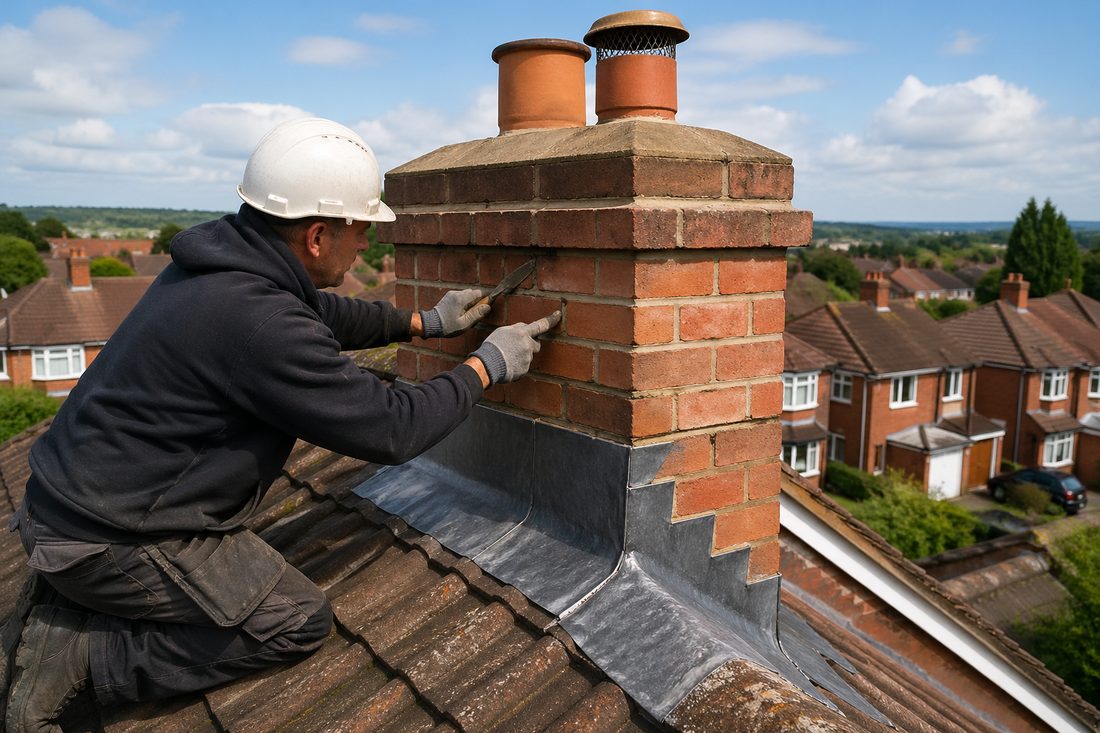
Image above is for illustration purposes only.
An unused or lightly used flue with a plain open pot on it is a vertical pipe with its mouth pointing at the sky, and in a wet winter a surprising amount of water goes down it. Indoors that shows as a smell of soot that strengthens after rain, a dark tarry mark creeping out of the old fireplace opening, and sometimes water lying in the grate. Working out whether a patch on a breast is this or something else is a subject of its own, taken up in damp on a chimney breast.
The fitting for that fault is a rain cap, and the important thing about it is what it does not do: it does not close the flue. The lid stands clear of the pot rim on legs, so rain is shed away from the mouth while air carries on moving through, which is exactly what a flue still serving something needs.
What a cap cannot do is worth saying in the same breath. Water getting into a stack through open joints, a cracked bed of mortar or a failed junction with the roof is not travelling down the flue, and no fitting on the top will make any difference to it. That is mortar and lead work — see repointing a chimney.
Jackdaws are the reason most bird guards get bought. They drop sticks down a flue until enough of them wedge to make a platform, fast enough that a chimney which drew perfectly in March is blocked solid by May. The signs are a fire that suddenly smokes back into the room, scratching inside the breast, twigs in the grate, and calling that plainly comes from inside the wall rather than off the roof.
The order the work happens in matters more than the fitting does. A flue that is already blocked has to be cleared and swept before anything goes over the top of it, and that is a chimney sweep’s job, not a roofer’s. Put a guard on first and all you have done is seal the blockage in. There is also a legal point that catches people out in spring: nesting birds and their nests are protected while the nest is in use under the Wildlife and Countryside Act 1981, so an active nest is left alone until the young have gone, and the guard goes on afterwards to stop it happening again next year.
The guard itself is usually a stainless mesh cage, clamped over the pot rim or strapped down inside the bore, and where there is no pot it can be bedded into fresh mortar as the head is re-formed. Two things are worth insisting on: the mesh has to be open enough not to choke a flue that is still in use, and the whole fitting has to come off again without breaking anything, because a sweep who cannot get a guard off will simply leave it where it is.
Smoke that comes back into the room only in certain winds is a different complaint altogether, and the one where a fitting is least likely to be the whole answer. The cause is very often not the chimney but what has grown or been built around it: trees that were saplings when the house went up, a neighbouring extension, a taller roof next door, or a house sitting below a bank so that wind rolls down onto it. Any of those can put the mouth of the flue into an area of pressure that pushes down it rather than drawing across it.
Anti-downdraught fittings work on that pressure. Some are fixed, with vanes or a skirt that deflects a crosswind out of the mouth. Others rotate, turning their back to the wind so the opening always faces away from it. They are effective against a wind problem and useless against anything else. Where the real difficulty is that the flue finishes too low for its surroundings, the honest fix is height — a taller pot, or rebuilding the head a course or two up.
The other half of the picture is indoors and belongs to other trades. A room that has been draught-proofed, double glazed and fitted with a cooker hood can leave a fire with nothing to breathe, and a starved fire smokes back in any wind. If a cowl has already been tried and the chimney still smokes, that is useful information: it says the trouble was never at the top.
Anything serving a live appliance changes who decides. The terminal on a gas flue is part of the appliance installation and has to suit that appliance, which is why a mesh cage bought to keep birds out is not something to put over a gas flue on your own initiative. That choice belongs to a Gas Safe registered installer, and it is one of the few places in chimney work where getting it wrong is dangerous rather than merely wasteful.
Solid fuel and wood follow the same logic for different reasons. A stove is designed around a particular draught, so a fitting that restricts the outlet can stop it performing, and anything over a solid-fuel flue has to put up with heat and tar and come off again for sweeping. The person who installed or commissioned the appliance is the one to specify it.
Roofline Solutions are roofers. We fit, re-bed and remove pots and their fittings, and we put right the mortar they stand in. We do not line flues, sweep them or test appliances, and where the flue is live we would rather fit a terminal somebody qualified has chosen than pick one ourselves.
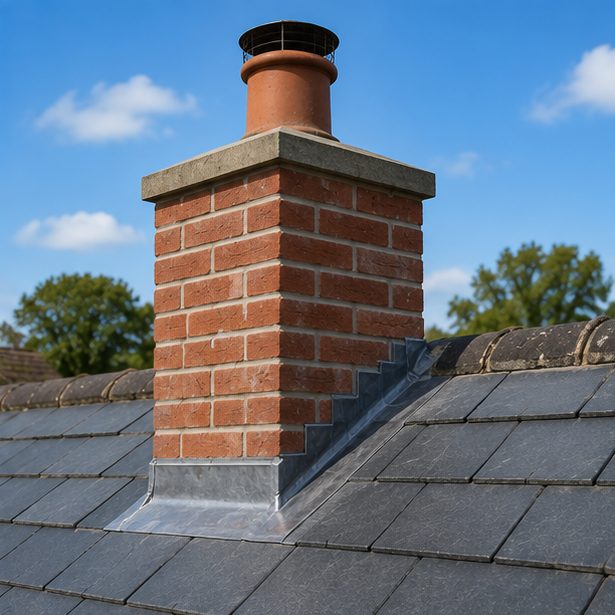
Image above is for illustration purposes only.
The decision is short once the faults are separated. If the flue is finished with, it wants a vented cap and a vent at the bottom — a subject in itself, taken up in capping a flue you no longer use. If the flue is live, rain going down it points at a cap, birds point at a guard after a sweep, and smoke in certain winds points at an anti-downdraught pattern. If none of them applies, fitting nothing is a perfectly good answer: every fitting is one more thing to work loose, rust or need taking off again.
How it is held on matters as much as what it is. A fitting is clamped over the rim of the pot, strapped inside the bore, or bedded into the mortar where no pot exists, and in every case it is only as secure as the thing it grips. A pot cracked through, or a bed of mortar broken into loose pieces, has to be dealt with first, which is why so many cowl jobs turn into head jobs once somebody is up there looking. Stainless is worth having over plated steel anywhere, and particularly near an estuary, where cheap fixings rust and bleed a brown streak down the brickwork within a couple of winters.
Four questions cover the rest. Which fault is this pattern for, and why is it the one for my chimney? How is it being fixed, and in what material? Can a sweep take it off and put it back? And is the mortar around the pots being re-formed at the same time, given that the access is the same either way? Work the first of those out from the ground with binoculars or from an upstairs window at the back. There is nothing about a pot worth climbing to see.
The rest of the series, on the questions people ask most.
Every town has its own page, written around the stacks that are actually on the roofs there. Start with the main chimney repairs page.
“Excellent work replacing ridge tiles, repointing chimney and repairing flashing. Also fixed other broken tiles. Clean and tidy job. Would definitely recommend.”
Neil“The guys did a great job in repairing our chimney. They were reliable, friendly and efficient. Buddy kept me in the loop throughout the whole process and I would not hesitate to use Roofline again!”
Hollie Furnival“Highly recommend. Very quick and efficient. Great communication. Went above and beyond to work the weekend to complete the work that needed to be done. Very happy with the results.”
Karen JonesDescribe what you can see and roughly where you are, and we will come back to you — usually the same day. If water is coming in now, please call instead.
Prefer to talk? Call 07464 259566 · WhatsApp 0044 7464 259566 · Email Evensbuddy@yahoo.com
We cover Chester, Cheshire, the Wirral and Flintshire from Elton, just north of Chester.
2 Manley View
Elton
Chester
CH2 4QF
Almost all of our work happens at your property rather than here, so please call before travelling.
Monday – Friday — 24hrs — Emergency Call-Outs
Saturday — 8:00 – 19:00
Sunday — 8:00 – 19:00
Weekday emergency call-outs are answered around the clock. Weekend cover is 8:00 to 19:00.