★★★★★
“Excellent work replacing ridge tiles, repointing chimney and repairing flashing. Also fixed other broken tiles. Clean and tidy job. Would definitely recommend.”
NeilThree different answers to the same stack, and the condition that separates them. What makes brickwork worth pointing, what pushes it past that, and the point at which the decision is not a roofer’s.
People usually ring up asking whether a chimney can be patched, and the honest answer is that the stack decides, not the budget. There are three destinations, and they are separated by the physical state of the material rather than by anybody’s preference.
Repointing renews the weathering layer of the joints and leaves everything else alone. It is a repair to the surface of a wall that is otherwise sound. A rebuild takes brickwork down and puts it back: usually only the part above the roof, sometimes only the top few courses and the head, occasionally the whole stack down to where it meets the roof structure. Removal takes the stack away to roof level and the covering is closed over where it stood.
Two things follow. These are not alternatives on a menu; a stack in a given condition has one right answer and the other two are either wasteful or inadequate. And the access is much the same for all three, since a scaffold goes up whichever route is taken — which is why it is worth establishing the condition properly before anything is booked, rather than doing the least you can and going back for the rest later.
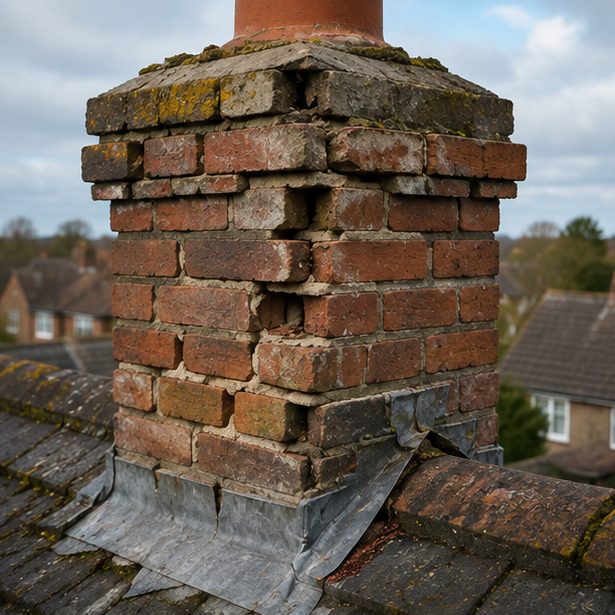
Image above is for illustration purposes only.
The test is whether the bricks are still bricks. A brick that has kept its face and its arris, that rings rather than crumbles, and that does not leave sand on your hand is doing its job, and if the only thing wrong with the wall is that the joints between such bricks have eroded or fallen out, that wall is a pointing job. Isolated spalled bricks do not change the answer: individual bricks can be cut out and replaced while the rest of the stack is pointed around them.
The joints have to be judged as well, and not just from the outside. Pointing replaces an outer layer and relies on the bedding mortar further in being intact. Raking one joint out properly and looking at what is behind it settles the question in a few minutes: sound, firm mortar a short distance in means a pointing job, while a joint that is empty or powdery all the way through means the courses are close to sitting on each other dry, and pointing the front of that is cosmetic.
Then there is the shape of the thing. A stack that stands plumb, with straight courses and no cracks running up through it, is a candidate. A head that is broken but sitting on sound brickwork is not an objection, because the mortar on top of a stack is renewed as a matter of routine and often on its own. In short: sound brick, sound bedding, straight and uncracked, means the answer is mortar and lead, and the mix used for it matters more than most people expect — see repointing a chimney.
Four findings move a stack into rebuild territory, and any one of them is usually enough. The first is spalling across whole courses rather than in isolated bricks — faces blown off, bricks hollowed out, a face you can rub sand from. There is nothing to point against there, because a joint needs two sound arrises to be finished between.
The second is bedding mortar that has gone right through, so that the bricks are effectively dry-stacked and holding position by weight alone. The third is loss of plumb. A stack that leans, bows or has courses that no longer line up has moved, and the usual cause on a chimney is sulphate attack: the sulphates in old flue gases combine with the cement in the bed joints, the joints expand, and because the weather face stays wettest the expansion is uneven and the stack pulls over. Pointing a leaning stack does nothing at all about why it is leaning.
The fourth is cracking that runs through rather than along — a vertical crack up a face, a corner separating, a head split into pieces that move independently. A stack showing any of those is taken down to where the brickwork is sound, which is commonly a course or two below the roof line, and rebuilt from there. Done properly a rebuild is an improvement on what was there rather than a replica: it is the opportunity to build in a damp-proof tray just above the roof, to put a full set of lead in at the junction, and to finish the head in a way that sheds water instead of holding it. Reclaimed or matched brick keeps it looking like the house, and sound pots usually go back on.
Removal earns its place when three things are true together: no flue in the stack is in use, nobody in the household wants a fire or a stove in the future, and the brickwork is in poor enough condition that keeping it means real work. A stack that has reached that point is a maintenance liability standing in the most exposed position on the building, and taking it down to roof level, closing the opening in the roof structure and making the covering good is straightforward work by comparison with a rebuild.
Three cautions come with it. It is not reversible, and a future owner who wants a wood burner will find the flue has gone. It changes the appearance of the house, which matters more than people expect on a terrace or a row of matched semis where every roof has the same silhouette, and in a conservation area or on a listed building it may need consent from the local planning authority before anybody starts — that is a question to ask them, not us. And if the stack is shared with a neighbour it cannot be taken down one-sidedly at all, which is set out in shared and party chimney stacks.
There is also a detail that gets forgotten on the day. Taking the stack off at roof level leaves the flues and the chimney breast still standing inside the house, and those flues are now closed at the top. They need venting at the bottom exactly as a capped flue does, or the damp that capping is supposed to prevent arrives anyway. The reasoning is in capping a flue you no longer use.
Everything above is work on and above the roof line. Below that line the questions change completely, because the stack and the breast under it are carrying load and, on many houses, helping to restrain the wall they sit in.
Taking a stack down below roof level, leaving an upper section supported on gallows brackets fixed to a wall, propping a breast, or removing a chimney breast on one or more floors are all structural alterations. They are Building Control matters and they want a structural engineer’s calculations, because something has to carry what the brickwork was carrying and the remaining masonry has to be shown to be stable without it. On a party wall they engage the neighbour as well. None of that is decided by looking at the roof, and anybody who offers to take a breast out on the strength of a quick look at the chimney is not the person to have doing it.
The practical line is easy to state. If the work finishes at or above the roof covering, it is roofing. If it goes below, bring in Building Control and an engineer before anything is agreed, and get their answer in writing before a scaffold is ordered.
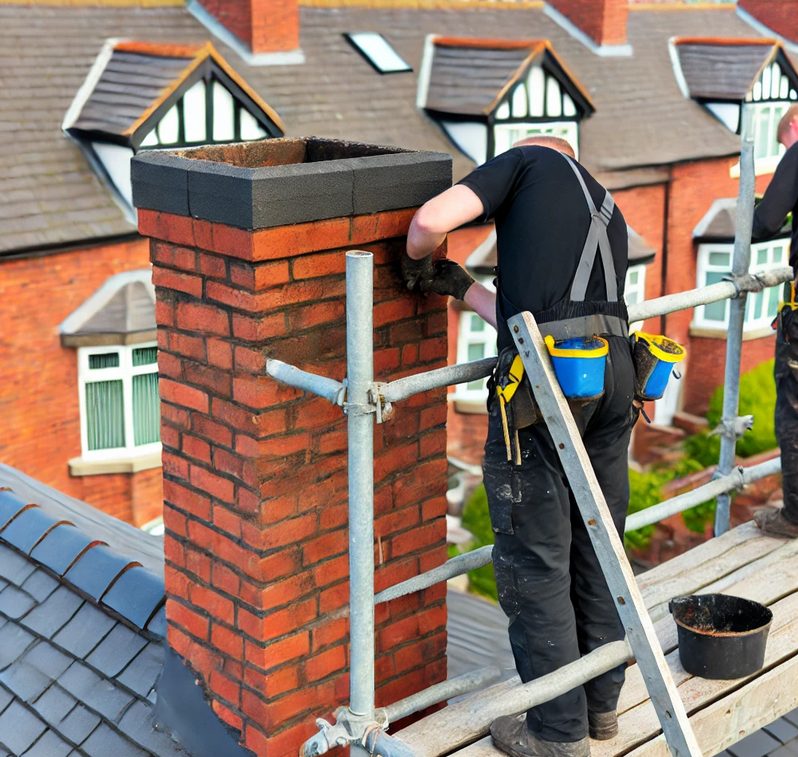
Image above is for illustration purposes only.
The useful thing to ask for is the reasoning rather than the verdict. Has a joint been cut out to see what is behind it, and what was found? Is the stack plumb, and how was that checked? If it is a rebuild, how far down does it go and what decides that course? Is a tray going in? What happens to the pots? Is the lead being renewed while the access is there? Those questions are answerable in plain words, and the quality of the answers tells you a good deal.
Ask one more thing as well: what happens if it turns out worse once the head comes off. Brickwork that has been wet for years is often in poorer condition a few courses down than it looks from outside, and a job described as a head rebuild sometimes has to go further. Far better to agree in advance how that is handled than to hear about it on the second morning. What else a written quotation should set out is covered in what should be on a chimney repair quotation.
Form your own impression from the ground first. A stack that is visibly leaning, or whose outline against the sky bows, tells you something before anyone arrives. Look from two directions and from an upstairs window rather than going up: this is exactly the judgement people climb to make, and it is not worth the risk on a stack that may already be loose.
The rest of the series, on the questions people ask most.
Every town has its own page, written around the stacks that are actually on the roofs there. Start with the main chimney repairs page.
“Excellent work replacing ridge tiles, repointing chimney and repairing flashing. Also fixed other broken tiles. Clean and tidy job. Would definitely recommend.”
Neil“The guys did a great job in repairing our chimney. They were reliable, friendly and efficient. Buddy kept me in the loop throughout the whole process and I would not hesitate to use Roofline again!”
Hollie Furnival“Highly recommend. Very quick and efficient. Great communication. Went above and beyond to work the weekend to complete the work that needed to be done. Very happy with the results.”
Karen JonesDescribe what you can see and roughly where you are, and we will come back to you — usually the same day. If water is coming in now, please call instead.
Prefer to talk? Call 07464 259566 · WhatsApp 0044 7464 259566 · Email Evensbuddy@yahoo.com
We cover Chester, Cheshire, the Wirral and Flintshire from Elton, just north of Chester.
2 Manley View
Elton
Chester
CH2 4QF
Almost all of our work happens at your property rather than here, so please call before travelling.
Monday – Friday — 24hrs — Emergency Call-Outs
Saturday — 8:00 – 19:00
Sunday — 8:00 – 19:00
Weekday emergency call-outs are answered around the clock. Weekend cover is 8:00 to 19:00.