★★★★★
“Excellent work replacing ridge tiles, repointing chimney and repairing flashing. Also fixed other broken tiles. Clean and tidy job. Would definitely recommend.”
NeilOn a terrace or a semi the chimney often straddles the boundary and belongs to two households. What that means for repairs, for access, and for the things no single owner can decide on their own.
Terraces and semis were built with the dividing wall carried up through the roof, and in most of them that wall does not stop at the ridge: it carries on and becomes the chimney stack. The flues from both houses rise inside the same block of masonry, often crossing over one another as they climb so that the pot above your bedroom is not necessarily the one your bedroom fireplace feeds.
The way to tell is mostly position. A stack sitting on the ridge exactly where one house meets the next, with more pots on it than your own fireplaces can account for, is almost certainly shared. A stack standing on a gable end, or somewhere in the middle of your own roof slope, generally is not — though on a semi a gable stack can still sit on a boundary if the plot line runs through it. Counting fireplaces, including ones that have been blocked up, against the pots you can see from the street is a rough but useful start.
Flats change the picture again. In a converted house the structure, including the stack, is usually the freeholder’s responsibility rather than any individual leaseholder’s, and the work is organised and paid for through whatever management arrangement the building has. If you own a leasehold flat, the first call is the freeholder or the managing agent, not a roofer.
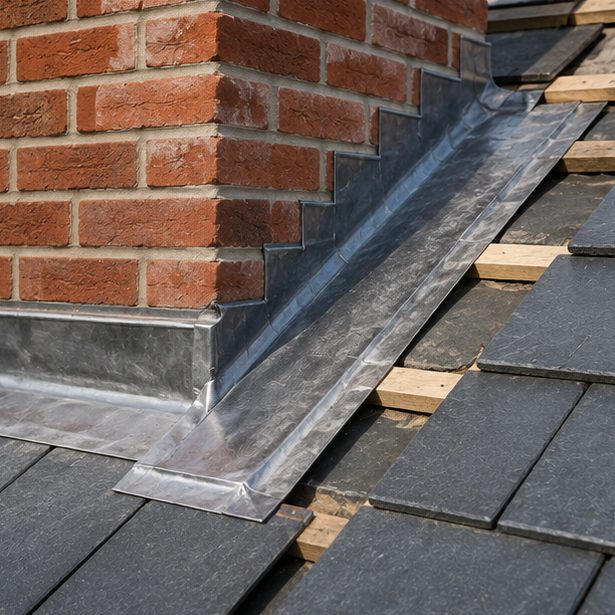
Image above is for illustration purposes only.
The common arrangement is that the boundary runs vertically up through the middle of the wall and on up through the stack, so each owner owns the half on their side and each has a right of support from the other. It is not the only arrangement. Some titles put the whole of a wall in one owner’s land with rights granted to the other, and some later conveyances say something different again.
Where it matters, the answer is in the paperwork rather than on the roof. The title register and plan from HM Land Registry, and the deeds if the property is unregistered, are what settle ownership and any express rights or obligations to repair. For anything contentious, the people to ask are a solicitor or a party wall surveyor. We are roofers: we will tell you what we can see about how the stack is built and where it sits, and we will not tell you who owns it.
For everyday repair, though, the legal nicety matters less than the physical fact. The stack is one object. Water entering on the face you have never seen travels through masonry that is common to both houses, and a head that is breaking up is breaking up over both sets of pots. That is the real argument for treating it as one job.
Routine repair and maintenance to your own half is normally uncontroversial: pointing the faces on your side, re-forming the mortar around your own pots, renewing the lead where the stack meets your roof slope, replacing or reseating your pots, fitting a cowl, capping and venting a flue that is yours. None of that changes the structure or takes anything away from the neighbour.
Being entitled to do it is not the same as being able to do it unaided, and this is the point that surprises people. A scaffold tall enough to reach a ridge stack will usually need to stand on, tie into or oversail the other property. Lead at the junction has to be dressed into the covering on both slopes, because the back gutter behind the stack spans its whole width and has to discharge somewhere. Mortar droppings land on the neighbour’s tiles and have to be cleared off them. Every one of those needs a conversation first, and a polite one well in advance is worth more than any amount of standing on rights afterwards.
Where a neighbour refuses access outright and the work is genuinely necessary to preserve the building, there is a route through the courts: the Access to Neighbouring Land Act 1992 allows an order granting temporary access for essential preservation work. It exists, it is slow, and it is a last resort rather than an opening move.
Anything that cuts into, rebuilds, underpins or takes down a shared stack is a different category of work, and in England and Wales it engages the Party Wall etc. Act 1996. A stack rising off a party wall is generally part of that party structure, so rebuilding it, taking it down, cutting into it for a beam or a tray, or raising it are the kinds of operation the Act is written for. Ordinary repair to your own face usually is not.
The mechanics are worth knowing before you need them. The person doing the work serves written notice on the neighbour, generally two months ahead for work to a party structure. The neighbour has fourteen days to consent or to dissent. Consent in writing and the work proceeds. Silence counts as dissent, and dissent means each side appoints a surveyor, or both agree on a single one, and the surveyors settle the matter in a formal written document that records the condition of both properties and sets out how the work is to be done. The Act does not apply in Scotland or Northern Ireland, where the title deeds and the general law govern instead.
Separately from all of that, there is a plain physical limit. A shared stack cannot be taken down while any flue in it is still serving anything, and your neighbour’s open fire, stove or gas appliance is exactly that. Whether your own flues are redundant makes no difference. If both households are finished with theirs and both want it gone, it can come down to roof level as one job with both slopes made good — the thresholds for that decision are in repoint, rebuild or remove. Going below roof level, on a party wall, brings in Building Control and a structural engineer as well as the neighbour.
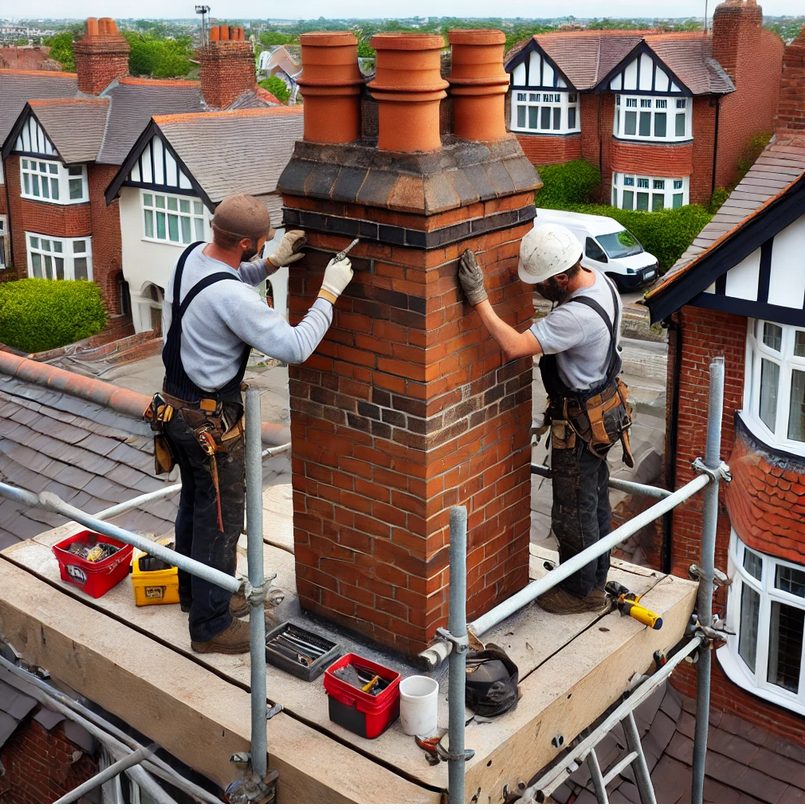
Image above is for illustration purposes only.
Where two households can agree, a shared stack is much better done as a single piece of work. One scaffold serves both sides, the mortar is mixed once and matches all round, the lead is formed as one continuous set instead of being cut and jointed at a boundary, and the outlay is split between two houses rather than duplicated two years apart. It is also the only way the whole stack actually gets dealt with, since half a stack pointed is half a stack still letting water into masonry both houses depend on.
The things to settle before anything is ordered are simple enough to write on one sheet: what work is being done, who is instructing the firm, how the outlay is divided, how access and scaffold are arranged, and what happens if the job turns out to need more than was expected. Putting that in writing between neighbours is not unfriendly; it is what stops an ordinary repair turning into a grievance.
If the neighbour will not engage, do what you can on your own side, keep a record of what was done and what was left, and have their half photographed from the scaffold while it is up. That is the way to see the faces you have no view of; climbing up to look at a shared stack from the roof is the one thing not to do, because it is the highest point on either house. Where their half is actively causing damage to your property, there are routes — a letter first, then advice on nuisance or disrepair, and for a rented house the landlord, the managing agent or the local authority’s housing team. Where the house appears empty, the title register will usually identify the owner. None of that is roofing, and we will say so, but it is the ground on which a lot of shared stacks eventually get repaired.
The rest of the series, on the questions people ask most.
Every town has its own page, written around the stacks that are actually on the roofs there. Start with the main chimney repairs page.
“Excellent work replacing ridge tiles, repointing chimney and repairing flashing. Also fixed other broken tiles. Clean and tidy job. Would definitely recommend.”
Neil“The guys did a great job in repairing our chimney. They were reliable, friendly and efficient. Buddy kept me in the loop throughout the whole process and I would not hesitate to use Roofline again!”
Hollie Furnival“Highly recommend. Very quick and efficient. Great communication. Went above and beyond to work the weekend to complete the work that needed to be done. Very happy with the results.”
Karen JonesDescribe what you can see and roughly where you are, and we will come back to you — usually the same day. If water is coming in now, please call instead.
Prefer to talk? Call 07464 259566 · WhatsApp 0044 7464 259566 · Email Evensbuddy@yahoo.com
We cover Chester, Cheshire, the Wirral and Flintshire from Elton, just north of Chester.
2 Manley View
Elton
Chester
CH2 4QF
Almost all of our work happens at your property rather than here, so please call before travelling.
Monday – Friday — 24hrs — Emergency Call-Outs
Saturday — 8:00 – 19:00
Sunday — 8:00 – 19:00
Weekday emergency call-outs are answered around the clock. Weekend cover is 8:00 to 19:00.