★★★★★
“Excellent work replacing ridge tiles, repointing chimney and repairing flashing. Also fixed other broken tiles. Clean and tidy job. Would definitely recommend.”
Neil
Short new-town stacks, redundant back-boiler flues and the brown stain that follows when one is sealed solid. Repointing, flaunching, leadwork, pots, vented caps and stack removals, worked from a scaffold.
Runcorn is two towns on one map, and the chimneys tell you which one you are standing in. Around the Old Town, the Bridgewater Canal and Weston Point there are Victorian and Edwardian roofs carrying tall brick stacks and clay pots. Out at Halton Brow, Castlefields, Palacefields, Murdishaw and Windmill Hill there is the new town, laid out from the mid-1960s onwards, and the stacks there are a different animal altogether.
The new-town stack was never built to do very much. A house going up in 1968 got a single back boiler in the living-room fireplace, and the stack above it carried one flue three or four courses clear of a shallow concrete tile roof. It is short, it is thin, and it went up quickly on a programme — and for the best part of fifty years nothing has been asked of it except to stand there and stay dry.
Roofline Solutions works on the outside of stacks like those, and on the older brick ones nearer the river: repointing, re-forming flaunching, lead aprons and flashings, pots, cowls, vented caps, part rebuilds and taking a redundant stack down to roof level. What we do not touch is the inside of a working flue. Lining, sweeping and testing belong to a HETAS or Gas Safe registered installer and a chimney sweep, and the rest of what we do is set out on the main chimney repairs page.
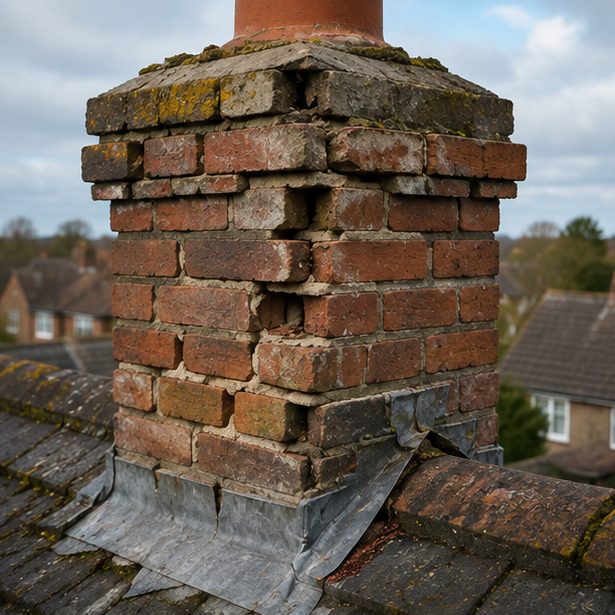
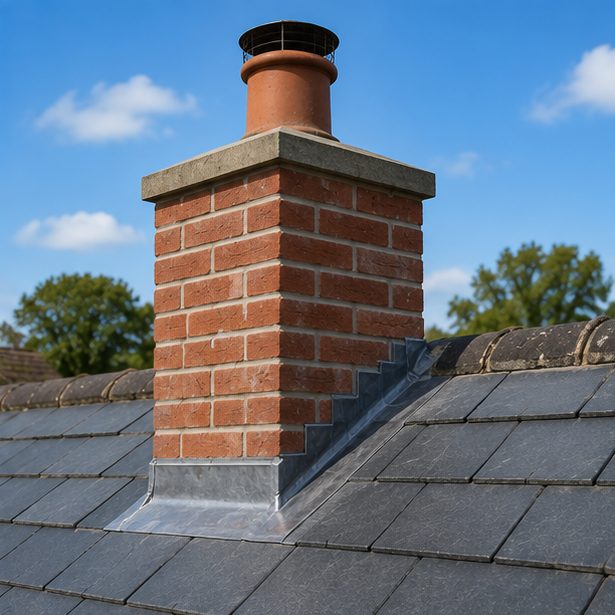
Images above are for illustration purposes only.
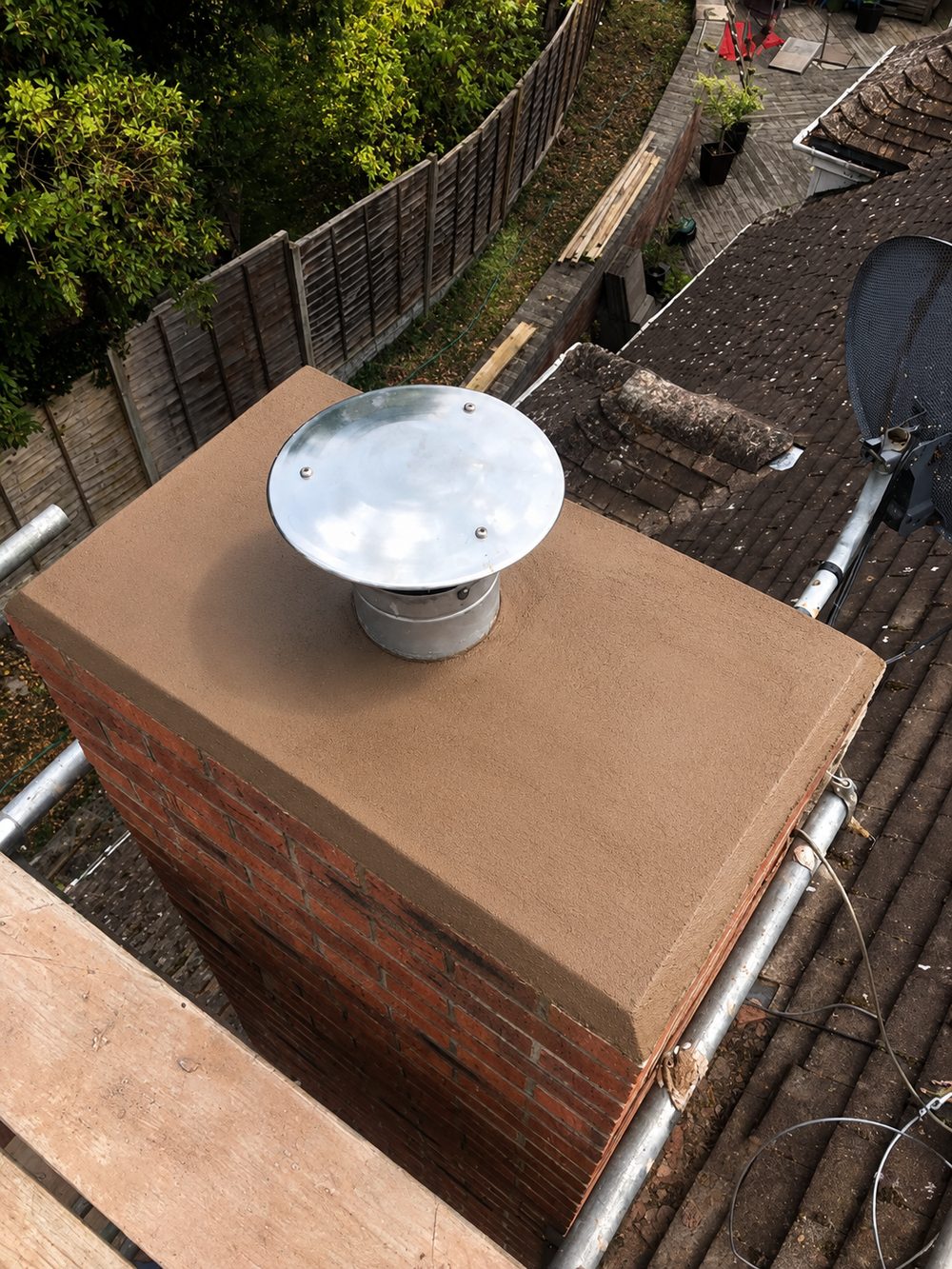
Photographs of our own chimney work. There are more on the main chimney repairs page and in the gallery.
When the back boiler came out and a combi went on the kitchen wall, almost nobody did anything about the flue. The fireplace was boarded, plastered or tiled over, the hearth was carpeted, and the stack carried on standing above the roof with a live opening at the top and a dead one at the bottom. On a great many estate roofs in Runcorn that is still the arrangement, four decades on.
The version that causes trouble is the one where somebody did act, and sealed it. A slab bedded flat across the head, or a plastic cap pushed into the pot and mortared round, closes the top; the plaster and the tiled-over hearth close the bottom. A flue shut at both ends does not stop being damp. Brickwork draws moisture up from the roof line, decades of soot left inside pull more out of the air, and none of it now has anywhere to go.
What comes next is a soft brown stain with a yellowed edge on the chimney breast, usually in the back bedroom, usually low on the breast or along the ceiling line. The answer to that is not more sealant. A flue that is finished with wants a vented cap at the top and an air brick or grille in the breast at the bottom, so a thread of air keeps moving through it all year. Where the stack itself is past saving and nothing is served by it, taking it down to roof level and making the roof good is the cleaner end to the story.
Two things separate a leaking stack from a breathing problem, and you can sort most of it out from indoors. A leak tracks the weather: the stain darkens within a day of driving rain from one particular quarter and dries back in between, and it often runs rather than spreads. Condensation in a sealed flue does close to the opposite. It is at its worst in a cold snap with the heating on, it spreads evenly, and it is frequently there in the middle of a dry fortnight.
From the garden, borrow a pair of binoculars and look at four things on a short estate stack. Whether the mortar on top is cracked or has pieces missing around the flue opening. Whether the bed joints have eroded back far enough to read as shadow. Whether there is a grey cement fillet where the stack meets the tiles instead of a proper lead apron. And whether the whole head has simply been slabbed over solid. Any one of those is worth a look; the last of them together with a stain indoors is most of a diagnosis.
Estate roofs here are usually a help rather than a hindrance. The houses are two storeys, the pitch is shallow, the stack is short, and there is often open ground at the front to stand a scaffold on. What catches people out is where the scaffold has to sit. A lot of these estates were planned around parking courts and footpaths rather than driveways, and a platform that lands on an adopted footway needs a licence from Halton Borough Council before it goes up. The same applies on the older roofs towards Frodsham where the frontage is tight.
The roof covering matters as much as the plot. Most of the new-town stock is finished in interlocking concrete tiles, which are heavy, brittle at the nibs and thoroughly unforgiving of being walked on; nearer the Old Town it is more often natural or fibre-cement slate. Either way the stack is reached from a scaffold rather than across the covering, and the top lift is set so the working platform sits a course or two below the head. Mortar has to be worked with two hands and a board, at a height where you can see what you are doing.
Interlocking tiles change how the lead at the base of a stack has to be made. A deep-profile tile has a roll and a trough, so a front apron cannot be dressed flat — it has to be bossed over each roll and turned down into the trough, or the wind gets underneath it and lifts it. Soakers, which work beautifully with a flat slate, are no use at all against a profiled tile, so the sides are normally run as a single stepped and dressed cover flashing chased into the bed joints instead.
At the top, what a stack needs depends entirely on what the flue is still for. A flue serving an appliance wants the cowl that matches the fault it actually has: a rain cap, a bird guard against jackdaws, or an anti-downdraught pattern if it smokes back in certain winds. A flue that is finished with wants a vented cap and not a sealed one. And plenty of estate stacks never carried a clay pot in the first place, just a terminal bedded into the flaunching; when that comes out, the opening still has to be closed properly and left able to breathe rather than simply filled with mortar.
Repointing, flaunching, stack rebuilds and removals, lead aprons, soakers, stepped flashings and back gutters, pots, cowls and bird guards — and the roof around the stack when it needs attention at the same time.
“Excellent work replacing ridge tiles, repointing chimney and repairing flashing. Also fixed other broken tiles. Clean and tidy job. Would definitely recommend.”
Neil“I had a leak in my vally had a number of roofers to come and take a look couldn’t find the problem Roofline’s solutions fixed the problem first time. Very happy with these guys thank you for the brilliant service”
Michael Price“Highly recommend. Very quick and efficient. Great communication. Went above and beyond to work the weekend to complete the work that needed to be done. Very happy with the results.”
Karen JonesWritten for homeowners working out which part of a chimney has failed, before anyone comes out.
Every town below has its own page, written around the stacks that are actually on the roofs there.
Describe what you can see and roughly where you are, and we will come back to you — usually the same day. If water is coming in now, please call instead.
Prefer to talk? Call 07464 259566 · WhatsApp 0044 7464 259566 · Email Evensbuddy@yahoo.com
We cover Runcorn from our base at Elton, just north of Chester.
2 Manley View
Elton
Chester
CH2 4QF
Almost all of our work happens at your property rather than here, so please call before travelling.
Monday – Friday — 24hrs — Emergency Call-Outs
Saturday — 8:00 – 19:00
Sunday — 8:00 – 19:00
Weekday emergency call-outs are answered around the clock. Weekend cover is 8:00 to 19:00.