★★★★★
“A great team that really looked after us and have continued to support us. I wouldn’t hesitate to use roofline again or recommend them to family and friends. Buddy takes pride in his work and customer service.”
Samantha Merrick
Render turns a chimney into a closed box: no courses, no joints, nothing to read from the ground. Inspection, head and lead repairs, pointing, pots and rebuilds on rendered stacks, worked from a scaffold.
Deeside is mostly a post-war place. Connah’s Quay, Shotton, Queensferry, Garden City, Sandycroft, Sealand and the estates out towards Mancot and Hawarden filled out through the 1950s and 60s and on into the 70s, built for people working the steelworks and the aircraft factory. Two storeys, concrete interlocking tiles, shallow pitches, and a great deal of render, roughcast and pebbledash on the walls.
On a lot of those houses the chimney is rendered whether or not the rest of the house is. Sometimes it was built that way, because a rendered stack was quick and it suited an exposed, flat, wind-blown site. Sometimes the render went on twenty years later, as somebody’s answer to a stack that was getting wet. Either way the result is the same: a chimney with its face covered over.
This page is about working on stacks like that. Roofline Solutions handles the outside of the chimney — opening up and inspecting, heads and flaunching, repointing where there is brickwork to point, lead at the roof junction, pots, cowls and guards, part rebuilds and removals to roof level. We are roofers, not flue installers or sweeps, so anything inside a working flue goes to a HETAS or Gas Safe registered installer and a chimney sweep. The next town along the estuary is Flint.
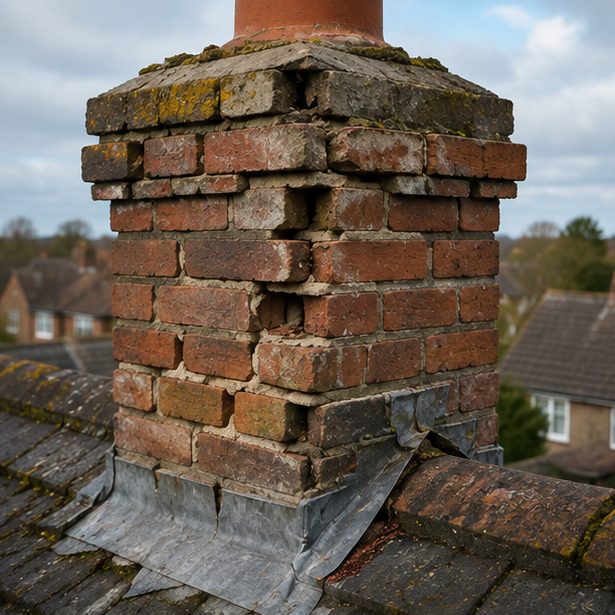
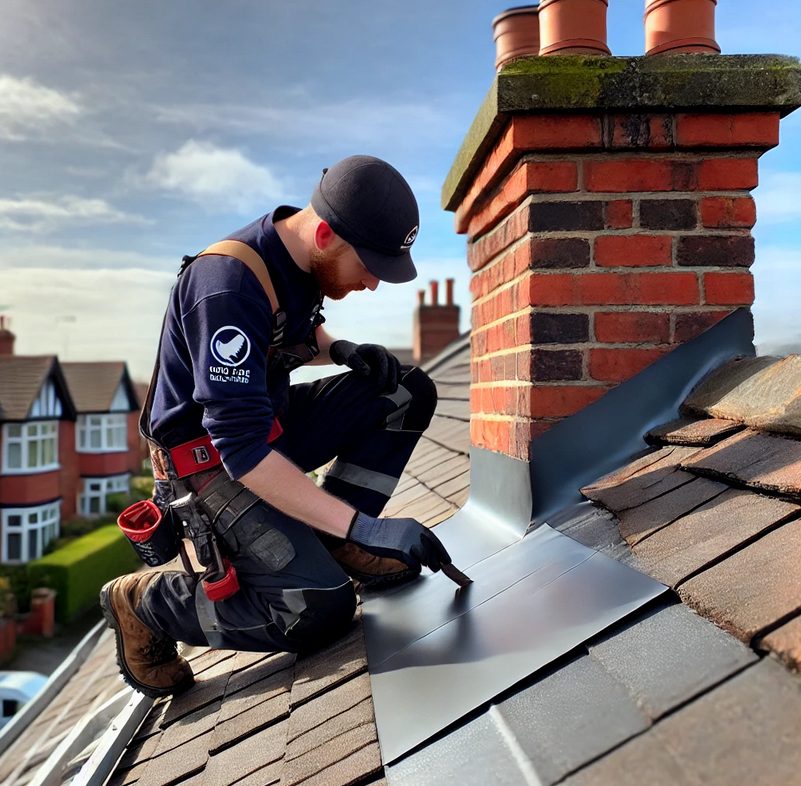
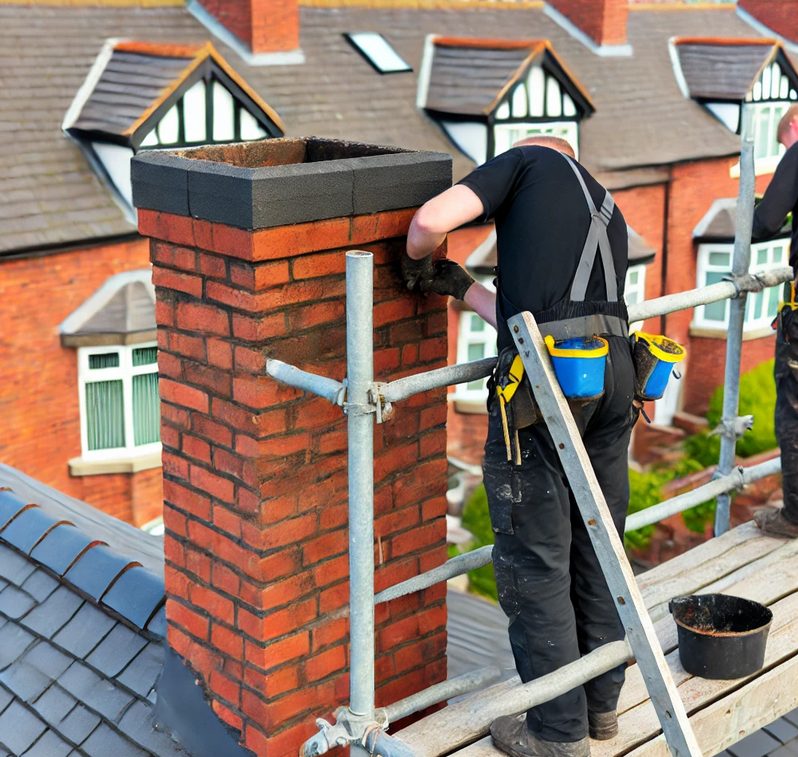
Images above are for illustration purposes only.
A bare brick chimney reports on itself. Stand in the garden with a pair of binoculars and the brickwork tells you how far the beds have weathered back, which faces have spalled and gone sandy, where a perp has opened up, and — because the mortar lines are dead level — whether the whole thing is still standing plumb. It is the most informative surface on the building. Render replaces all of it with a single flat plane. No courses, no joints, no colour change, nothing to measure anything against.
Meanwhile the chimney carries on doing what chimneys do. Render is not a waterproof skin; it is a sacrificial coat that sheds most of the water and lets some through, and on a stack it is asked to seal against the flaunching at the top, against the pot, and against the top edge of the lead at the bottom. Water gets in at those junctions and through hairline cracks, and once it is behind, it is in the dark with no sun and no wind on it. The joints go on eroding and the brick faces go on breaking down, quietly, for years, with nothing showing on the outside.
That is the whole of the difference, and it is worth being blunt about it. A brick stack gives you a decade of visible warning before it becomes serious. A rendered one often gives you none: the first symptom is water on a bedroom ceiling, or a piece of render on the lawn after a gale, and by then the masonry behind has been wet for a long time. It also means nobody can tell you what a rendered stack needs from a photograph or from the pavement. A real inspection is hands-on — the whole face tapped over, the head and the lead junction looked at closely, and where there is any doubt, a small area cut away in a corner so that a bed joint and a brick face can actually be seen. We would far rather say that we do not yet know, and explain how we find out, than price a guess.
Some things do get through the render, and they are worth learning. Look along each face at a shallow angle rather than straight at it, with the light across it, and a bulge or a dish in what should be a flat plane shows up immediately. A hairline crack running dead straight and level is following a bed joint underneath; one coming out of a corner of the head, or down from the pot, is following movement. A rust-coloured line or stain means there is a metal bead or stop under the render and it has started to corrode, which will push the render off from behind. And a patch that is still dark when the rest of the face has dried is holding water.
Then look for what has come away. Pebbledash gives itself away earlier than smooth render, because the stones drop out in patches and leave bald grey areas, and the chippings collect in the gutter, on the drive and in the borders under the stack. Where the render has been painted, blistering and flaking paint maps out the damp areas quite accurately. At the roof junction, check whether the render has simply been run down onto the tiles and stopped there, because that is a mortar fillet by another name and it will have cracked. Indoors, a stain on the breast or a wet mark in the loft beside the stack completes the picture.
The housing itself is easy to work on. Estate semis and short terraces with drives, side gates and back gardens take a scaffold without much argument, the roofs are two storeys at a modest pitch, and the stacks are short. Where the older frontages near the Quay stand on the footway, a pavement scaffold needs a licence from Flintshire County Council and a parking bay suspended, and on the newer cul-de-sacs the constraint is usually just getting a wagon past parked cars.
The sequence is what differs on a rendered stack. Because the condition cannot be established from the ground, there are jobs here where the scaffold has to go up before anybody can say what the work actually is, and we will set that out honestly rather than pretend to see through render. Opening render up is also dusty, dirty work: sheeting goes over the platform, debris netting round it, plants and cars covered and windows shut. Pebbledash chippings travel a long way from where they fall, and they end up in borders, gutters and next door’s lawn if nobody has planned for them.
Opening a rendered stack at the roof junction turns up the same two faults again and again. The first is render carried all the way down and stopped on the tiles, with no lead behind it at all, so the weathering at the base of the chimney is a rigid coat of mortar that cracked years ago. The second is worse because it looks right: the lead is there, but the render has been dressed down over the top edge of it, burying the upstand. Water that gets behind the render then runs down inside it and comes out underneath the lead, which is the one place the lead cannot protect. The correct detail is lead chased into a bed joint and wedged, with the render stopped above it on a bell or a drip so the water is thrown clear onto the lead.
The head has the same problem in miniature. A rendered stack very often has no mortar flaunching at all — the render is simply taken over the top and tapered up to the pot or terminal, and the collar around it is the first thing to crack. There is nothing to rake out of a crack like that, so the answer is to take the top off and form a proper bed to a fall, thick at the pot and thinner at the edge, with the pot bedded in while it is green. Pots on these houses are frequently a plain concrete or clay terminal rather than anything moulded, so a cowl or bird guard has to be sized to what is actually up there; and where a flue is finished with, the cap that goes on should still let air move through it.
Repointing, flaunching, stack rebuilds and removals, lead aprons, soakers, stepped flashings and back gutters, pots, cowls and bird guards — and the roof around the stack when it needs attention at the same time.
“A great team that really looked after us and have continued to support us. I wouldn’t hesitate to use roofline again or recommend them to family and friends. Buddy takes pride in his work and customer service.”
Samantha Merrick“Would highly recommend roofline solutions they arrived in time an explained to me what need to be done well spoken and polite”
Kyle Cummings“I had a leak in my vally had a number of roofers to come and take a look couldn’t find the problem Roofline’s solutions fixed the problem first time. Very happy with these guys thank you for the brilliant service”
Michael PriceWritten for homeowners working out which part of a chimney has failed, before anyone comes out.
Every town below has its own page, written around the stacks that are actually on the roofs there.
Describe what you can see and roughly where you are, and we will come back to you — usually the same day. If water is coming in now, please call instead.
Prefer to talk? Call 07464 259566 · WhatsApp 0044 7464 259566 · Email Evensbuddy@yahoo.com
We cover Deeside from our base at Elton, just north of Chester.
2 Manley View
Elton
Chester
CH2 4QF
Almost all of our work happens at your property rather than here, so please call before travelling.
Monday – Friday — 24hrs — Emergency Call-Outs
Saturday — 8:00 – 19:00
Sunday — 8:00 – 19:00
Weekday emergency call-outs are answered around the clock. Weekend cover is 8:00 to 19:00.