Chimney repairs, repointing, leadwork and pot replacement across Chester, Cheshire and the Wirral by Roofline Solutions

Chimney Repairs Heswall

On the Heswall ridge a stack stands a long way above the roof and takes the wind with nothing to hold it but its own joints. Pointing, flaunching, lead, pots and head rebuilds, all from a scaffold.

★ 5.0 from 63 Google reviews
Repointing, flaunching, leadwork & pots
Fully insured
Free written quotations
Chester, Cheshire & Wirral
HomeChimney RepairsChimney Repairs Heswall
Heswall & Surrounding Areas

Chimney Work in Heswall

Heswall is built up the side of a hill and then along the top of it. Between the Lower Village and the ridge at Telegraph Road the ground climbs hard, and the houses climb with it — Victorian and Edwardian villas built deliberately high for the view over the Dee, big interwar detached houses on long sloping plots, and later development running out through Gayton, Pensby, Barnston and Thurstaston.

Two things follow from that, and they both land on the chimney. The first is exposure: there is very little shelter on a west-facing slope above an estuary, and the wind arrives with a clear run at whatever is standing highest on the roof. The second is height. These are tall houses with steep roofs, and a flue has to finish well clear of the ridge to draw at all, so the stacks were built long — often a couple of metres of brickwork above the tiles before you even count the pots.

The work on this page is roofing work: repointing, re-forming flaunching, renewing lead aprons, soakers, stepped flashings and back gutters, pots, cowls and bird guards, part rebuilds, and taking a stack down to roof level. What we do not do is line or sweep a flue or sign off an appliance; that belongs to a HETAS or Gas Safe registered installer and a chimney sweep, and we will say so rather than take on work that is not ours. Roofs and ridges around the stack come under roof repairs.

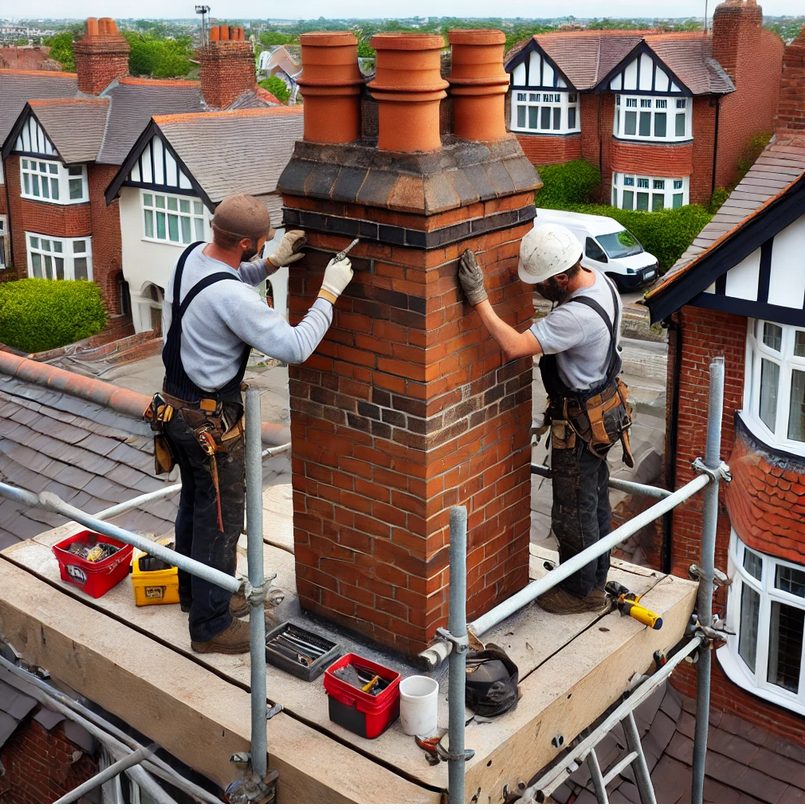
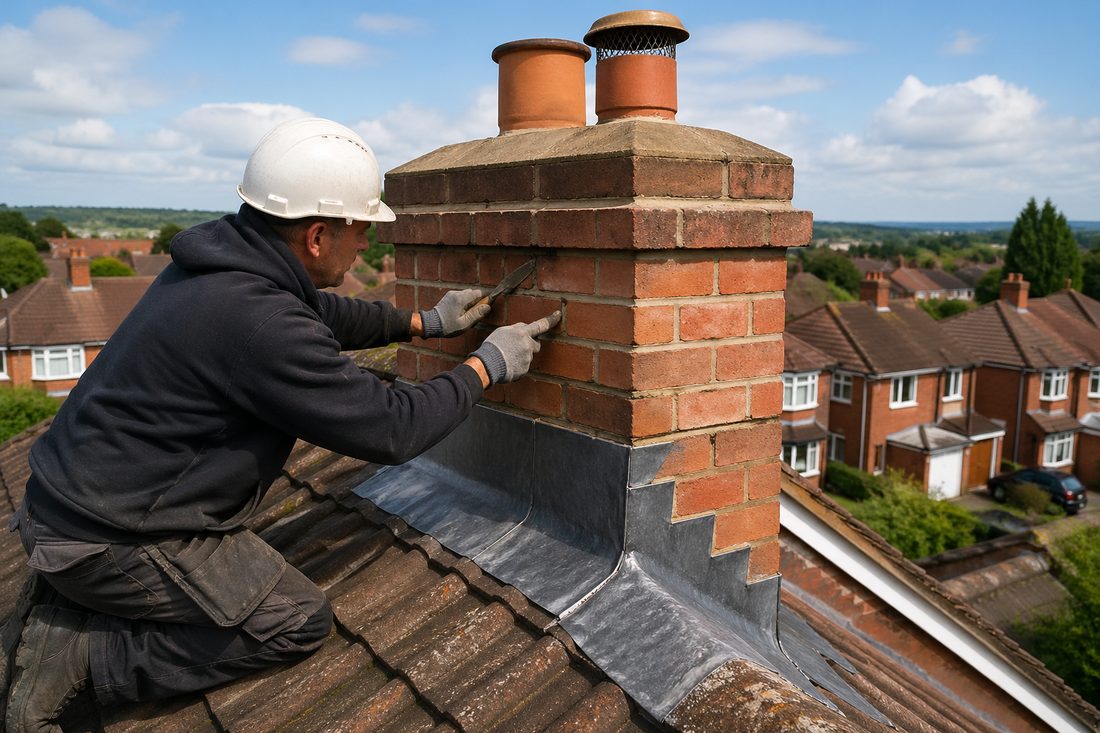
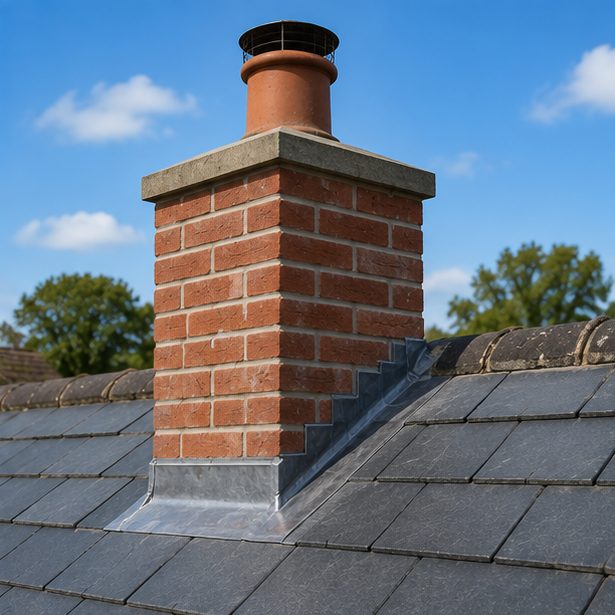
A pair of roofers at work on the head of a tall brick stack carrying four clay pots, standing on scaffold boards raised to head height above the roof slope A roofer pressing fresh mortar into the bed joints on the corner of a stack that already has a new lead apron and stepped flashing below it A slim brick stack standing clear against open sky above a slate roof, finished with a coping, a guard over the pot and new lead run down to the apron

Images above are for illustration purposes only.

Height, Wind and How a Tall Stack Is Held Up

Above the roof line a masonry chimney is a cantilever with nothing bracing it. It is held upright by its own weight and by the strength of the bed joints, and that is the whole of it. Wind pushes on the broad face, the stack tries to pivot about the point where it leaves the roof, and every joint near that level is put alternately into compression and into tension. Mortar is good at the first and poor at the second, which is why a tall stack is almost always at its weakest within two or three courses of where it comes out of the slope.

That is also why proportion matters more than age. The approved guidance that sits behind the Building Regulations puts a limit on how far an unrestrained masonry chimney may stand above the highest point where it meets the roof — broadly, no more than about four and a half times its own smallest width — and plenty of the tall stacks on this hillside were built to the edge of that, or have been pushed past it by a later course or a taller pot. A slim stack that has been made taller is a slim stack with a longer lever on it.

When a stack is over that proportion, or when the joints near the roof line have gone soft, there are three honest routes and the survey decides which. The first is to reduce it: take off the top courses, re-form the head and fit a shorter pot, which costs the flue a little draught and buys a great deal of stability. The second is to rebuild the upper section properly, off sound brickwork, over a damp-proof tray, in a mortar that suits the brick. The third is restraint — a steel stay or bracket set fixed from the stack back into the roof structure — and that one is not a decision to be taken on the roof, because it puts load into rafters and purlins that were never asked to carry it. Anything of that sort, like anything below roof level, is a matter for Building Control and a structural engineer, and we will tell you when you have reached that point.

What to Look At After a Rough Night

A stack on this ridge tells you about a gale the morning after, if you know where to look. Stand back and check the pots against each other: on a stack with more than one, a pot that has gone out of line with its neighbours has moved in its bed. Then look for a fine dark line following a bed joint near the roof, which is the joint that takes the bending, and for lead that has pulled away from its chase on the windward side while the sheltered side sits tight. Debris is the other tell — lumps of flaunching or mortar in the gutter, on a flat roof over a bay, or on the lawn directly below.

Two Heswall habits are worth checking at the same time. Aerial and satellite poles are very often lashed to the stack because it is the highest fixing available, and a two metre pole in an exposed wind works on the brickwork like a spanner, so the strap points are a good place to find cracked joints. And a tall stack that is no longer serving anything is sometimes quietly carrying a television aerial and nothing else, which is a poor reason to keep two metres of unrestrained masonry standing above a roof on an open slope.

Getting to the Stack in Heswall

Sloping ground changes the scaffold before it changes anything else. Standards on a hillside plot have to be levelled and stepped with base plates and sole boards rather than simply stood on the grass, and on a steep garden the lift heights on one side of the house will not match the other. Add mature gardens — the beech, holly and rhododendron that come with this part of the Wirral — and the route from the gate to the gable is often the thing that takes the longest to work out.

Getting the materials there matters too. The lanes running off Telegraph Road and down towards Thurstaston are narrow, some drives are long and steep, and a scaffold wagon cannot always reach the house, so tube and boards get carried the last part by hand. Exposure then feeds back into the design: a tall scaffold on an open slope needs more ties and less sheeting than the same scaffold in a sheltered street in Bebington, and it is built for the wind it will actually stand in.

Leadwork, Pots and Cowls in Heswall

A tall stack usually sits high on a steep roof, and that shape puts a large back gutter behind it. Lead expands and contracts a long way in sunshine, so a gutter or a flashing run in a single unbroken length will buckle and then split along the fixings; the pieces are therefore kept short and lapped, and the lead is chosen heavy enough for its size and its exposure. On a steep pitch the soakers do most of the quiet work under the slates while the stepped cover flashing, chased into the beds and wedged, takes the weather. Where an aerial bracket has been bolted straight through a flashing, that hole gets dealt with properly rather than sealed over.

At the top, the hill itself causes a problem that catches people out. When the ground behind a house rises higher than the chimney does, wind coming over the slope rolls down onto the roof and pushes back down the flue, so a fire that draws perfectly in a still week smokes in a westerly. That is an air-flow problem rather than a blocked flue, and the answer is usually an anti-downdraught pattern cowl rather than anything more drastic. A plain rain cap or a bird guard will not touch it, which is why it is worth knowing which fault you actually have before anything is bought.

Please do not go up to look. A chimney is at the highest point of the roof and the ground below it is usually a path or a drive. Call 07464 259566 and describe what you can see from the garden, or send a photograph on WhatsApp — a phone zoomed in from below shows us more than you would think.

What We Do

Chimney and Roofing Services in Heswall

Repointing, flaunching, stack rebuilds and removals, lead aprons, soakers, stepped flashings and back gutters, pots, cowls and bird guards — and the roof around the stack when it needs attention at the same time.

Customer Reviews

What Our Customers Say

5.0
★★★★★
63 Google reviews
★★★★★

“Excellent workmanship by Buddy Evans. I was impressed and amazed at how quickly the job was done. Obviously due to many years' experience. I've used several mediocre or bad roofers in the past and now I've finally found a good one.”

Czeslaw birukowsk
★★★★★

“Brilliant company. Did a really good job worked hard, looks really good up to my expected standards which are high. Can highly recommend them.”

CHESHIRE PORCELAIN
★★★★★

“Very pleased with Roofline
Efficient, reliable, fast and friendly”

salah zakzouk

Leave Roofline Solutions a Google review →

Advice Centre

Chimney Guides

Written for homeowners working out which part of a chimney has failed, before anyone comes out.

FAQs

Chimney Repairs Heswall — Questions

How tall is too tall for a chimney stack?
It is a proportion rather than a fixed measurement. Guidance behind the Building Regulations limits an unrestrained masonry chimney to roughly four and a half times its smallest width, measured from the highest point where it meets the roof. A wide stack can stand a long way up; a slim one cannot. If yours is past that, the choices are to reduce its height, rebuild it, or restrain it, and restraint brings in Building Control.
Can a tall stack simply be shortened?
Often, yes, and on a redundant flue it is frequently the tidiest answer. The top courses come down, the head is re-formed and a shorter pot or a cap goes back on. If the flue is still serving a fire or a stove, height is what makes it draw, so reducing it is not a free choice and the appliance installer should have a view before anything is taken off.
My chimney rocks slightly in the wind. Is that normal?
No, and it is worth acting on. Visible movement means the joints near the roof line are no longer holding the brickwork together, so the stack is closer to dry-stacked than it looks. In that state it should be treated as unsafe until somebody has been up to it, and the scaffold gets planned to work above the head rather than reaching over it. Do not put a ladder against it in the meantime.
What is a chimney stay, and would I need one?
It is a steel strap or bracket arrangement that ties a tall stack back to the roof structure so it is no longer relying on its own joints alone. It is a real solution, but it transfers wind load into rafters and purlins, so it is designed rather than improvised and it is properly a matter for a structural engineer and Building Control. On most houses reducing or rebuilding the stack turns out to be the simpler route.
The fire smokes when the wind comes off the hill. Is that the stack?
Usually it is the site rather than the stack. Ground rising behind the house sends wind down over the roof and back into the flue, which stops it drawing. An anti-downdraught cowl is designed for exactly that and is normally the fix. If it smokes in still weather too, that points at the flue itself or the appliance, and those belong to a sweep and a registered installer rather than to us.
Where We Work

Chimney Repairs Across Cheshire & the Wirral

Every town below has its own page, written around the stacks that are actually on the roofs there.

Free Quotation

Tell Us About the Chimney

Describe what you can see and roughly where you are, and we will come back to you — usually the same day. If water is coming in now, please call instead.

Prefer to talk? Call 07464 259566 · WhatsApp 0044 7464 259566 · Email Evensbuddy@yahoo.com

Find Us

Roofline Solutions, Elton, Chester

We cover Heswall from our base at Elton, just north of Chester.

Where We Are

2 Manley View
Elton
Chester
CH2 4QF

Almost all of our work happens at your property rather than here, so please call before travelling.

Opening Hours

Monday – Friday — 24hrs — Emergency Call-Outs
Saturday — 8:00 – 19:00
Sunday — 8:00 – 19:00

Weekday emergency call-outs are answered around the clock. Weekend cover is 8:00 to 19:00.